
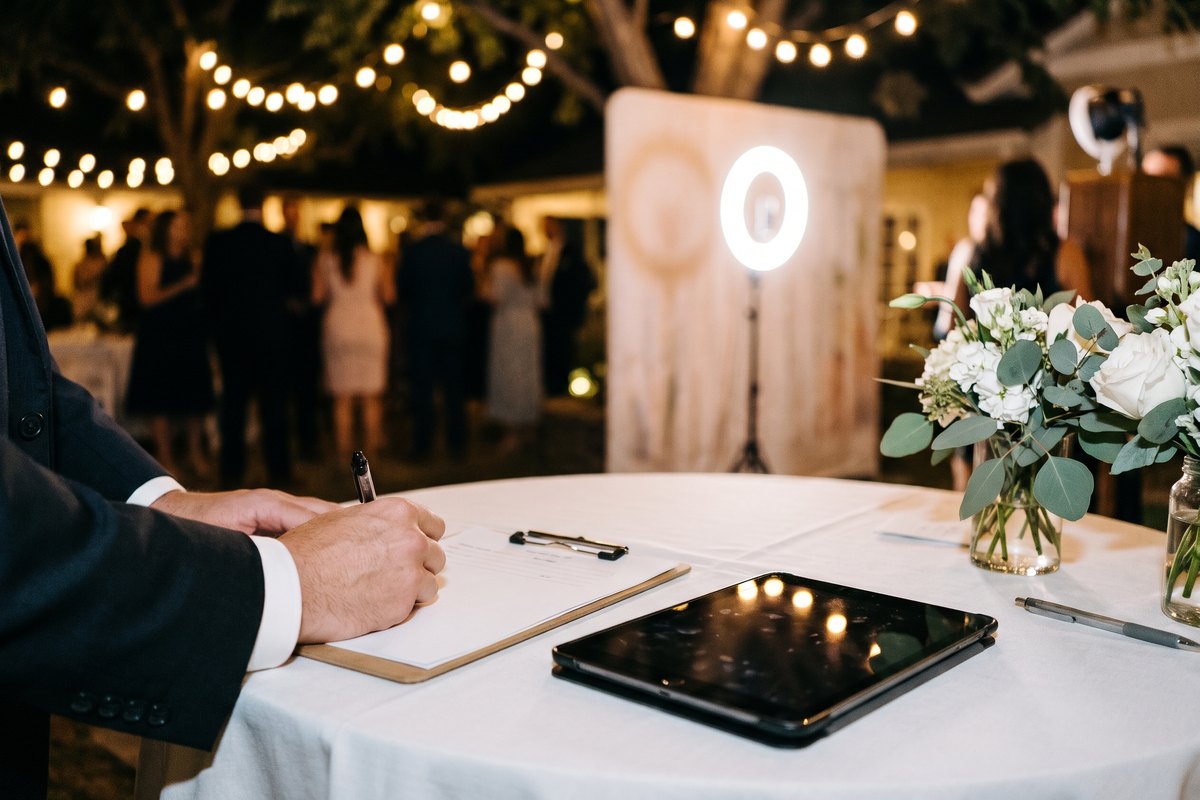
It's 9 p.m., the booth is packed in the van for Saturday's wedding, and a text lands from the planner: is the deposit refundable if the venue moves the date? You scroll back through the thread looking for what you agreed. Somewhere there is a contract, signed on paper weeks ago, and it says nothing about the hour the booth stands idle during speeches, the only outlet being across the room, or who may post the guests' photos. So you answer from memory, again, and hope the couple reads it the same way. A contract that settles those things before the night saves you that text and a lot of awkward ones after it. Here is the checklist we would put in yours, clause by clause, with what nine published contracts actually charge and why each line is there.
Short answer. A photo booth contract fixes the deposit, balance date, idle time, overtime, cancellation, space, power, weather and photo rights. In the operator contracts we read in November 2026, deposits ran $100 to $250 flat or 25% to 50%, balances fell due 10 to 30 days out, idle time cost $40 to $75 an hour and overtime $75 to $200.
Deposit and balance: write the amount, the due date and the refund rule
Start with money, because that is the 9 p.m. text. Across the operator contracts we read, the deposit or retainer was a flat $100 to $250, or 25% to 50% of the price. WeddingPro, The Knot's site for wedding businesses, says some wedding vendors take 50% at signing and others 20% (March 2021). The balance was due 10 to 30 days before the event, which gives you time to collect it before you load the van, not at the door.
Write down whether the deposit is refundable, and when. Ohio's consumer rules (Ohio Administrative Code 109:4-3-07) make it a deceptive practice to take a consumer deposit without a dated written receipt saying whether it is refundable and when. And the label alone may not hold: Aaron Hall, a Minnesota attorney citing a 1959 state Supreme Court case, writes that calling a deposit non-refundable does not decide it; the amount must be a reasonable forecast of a loss that is hard to estimate (August 2026). Tie the amount to what you really lose when a date falls through, like the Saturday you turned away.
Keep the words straight too. The deposit is the upfront payment that holds the date. A security deposit is a different thing: a hold against damage. Don't let your contract use one word for both.
| Clause | What the operator contracts asked |
|---|---|
| Deposit or retainer | $100 to $250 flat, or 25% to 50% of the price |
| Balance due | 10 to 30 days before the event |
| Idle time (booth up, not running) | $40, $50 or $75 an hour |
| Overtime | $75 to $200 an hour |
Idle time and overtime: price the hours nobody planned
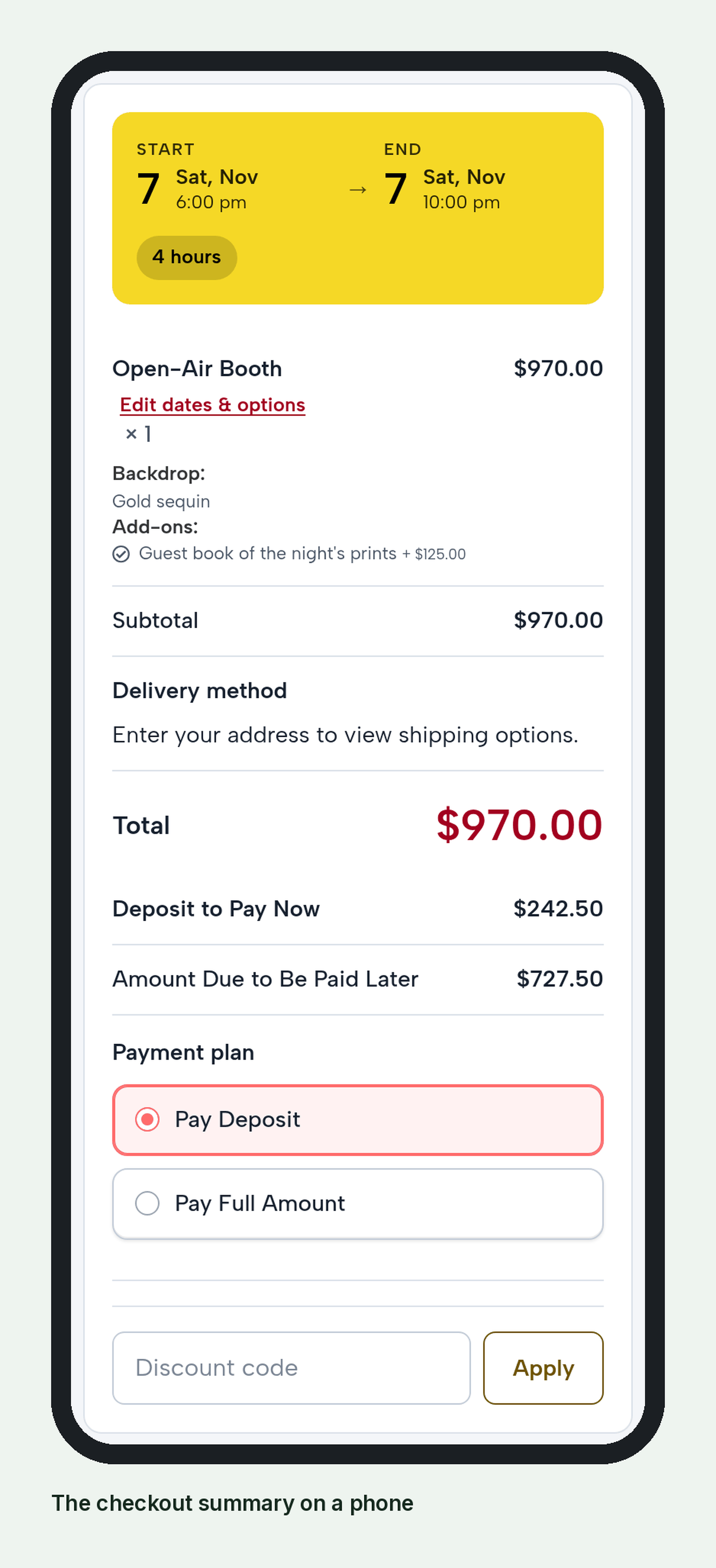
Speeches run long, dinner spills into the booth window, and the booth stands lit with nobody in front of it. Idle time is the clause that pays for that: the booth set up but not running. The operators we read charged $40, $50 or $75 an hour for it, and $75 to $200 an hour for overtime past the booked window.
The free photo booth template we read from Legal Templates (January 2026) had no clause for either. It also had nothing on space, power or image rights. A blank template is a start, not a contract.
Put three things in writing: when the clock starts (setup finished, or first guest), who can approve overtime on the night, and how it is paid. A planner who says "keep it going" at the end of the night should know the hourly rate before saying it.
Cancellation: pick your ladder and print it
Published contracts do not agree on cancellation, so this is a choice you have to make on purpose. Here are three we read, side by side.
Whichever you pick, the test from the deposit section still applies: what you keep should track what you lose, and that loss grows as the date gets closer and the Saturday gets harder to rebook. Also say in plain words what happens when the client moves the date instead of cancelling, so the next 9 p.m. text has an answer already written.
| Contract | Cancellation rule |
|---|---|
| Operator 1 | Keeps all payments inside 60 days of the event |
| Operator 2 | Keeps 50% of the package inside 30 days |
| Operator 3 | Refunds all but fees at 30 or more days; keeps 25% between 14 and 30 days; keeps half under 14 days |
Space and power: the clause that saves the setup
You arrive, the coordinator points to a corner by the DJ, and the nearest outlet is across the dance floor. The contracts we read asked for 7 x 7 feet to 12 x 12 feet for a standard booth and 10 to 13 feet square for a 360 booth, with a 110-volt outlet at 5 or 10 amps within 10 to 50 feet. LA Photo Party, a booth maker, publishes bigger figures once the queue is counted: 10 x 16 feet for a single AI booth and 20 x 20 feet for its 360 booth, each on one dedicated 20-amp, 110-volt circuit (June 2026).
Why a dedicated circuit: under the electrical code, as IAEI Magazine explains, one plug-in device may use no more than 80% of the circuit, which is 12 amps on a 15-amp circuit and 16 amps on a 20-amp one. Share that circuit with the DJ and the margin is gone. Write the space, the amps, the distance and who brings the extension cord into the contract, and say what happens if the venue can't provide them.
| Requirement | What we read |
|---|---|
| Standard booth space | 7 x 7 ft to 12 x 12 ft (operators) |
| 360 booth space | 10 to 13 ft square (operators); 20 x 20 ft (LA Photo Party) |
| AI booth with queue | 10 x 16 ft (LA Photo Party) |
| Power | 110 V outlet, 5 or 10 amps, within 10 to 50 ft (operators); one dedicated 20-amp circuit (LA Photo Party) |
| Code limit per plug-in device | 80% of the circuit: 12 A on 15 A, 16 A on 20 A (IAEI Magazine) |
Outdoor terms: cover, heat, cold and a canopy fee
A garden wedding or a backyard party puts a camera, a printer and a screen under open sky. The contracts we read required a covered area; one form refused setup above 105 degrees Fahrenheit, another below 50 degrees, and one charged a $100 canopy fee per booth. Pick your limits, write them as numbers, and say what the client owes if the day comes in outside them. A number settles the argument before it starts.
Running time: promise a figure you can keep
A printer jams, a connection drops, and a guest posts about the line. Three of the operators we read put a figure on it: 80% running time in one contract and 90% in two, and one of them refunds the rest in proportion when the booth is down. A clause like that reassures a nervous couple and caps what a bad hour can cost you. Skip it, and the client decides what a fair refund looks like, by text, on Sunday morning.
Image rights: get consent in writing, and know your state
The strip of guests in silly hats is your best marketing. Posting it is a legal question, and the free template we read says nothing about it. Three state laws show how far the rules can differ.
Stanford's Copyright and Fair Use Center adds two points: the person signing a release must have the authority to grant it, and a posted photo notice at the booth helps but is weaker than a release. So the couple signing your contract may not be able to consent for every guest. If your booth does more with faces than take the picture, the Troutman law firm notes (July 2022) that consent to collect photos is likely insufficient for face data under Illinois's biometric privacy law. Put a release clause in the contract, decide how guests consent, and have a local attorney check it before you post.
| State | What the law says | Source |
|---|---|---|
| New York | The person's own written consent before a picture is used for advertising or trade; a parent or guardian's for a minor | Civil Rights Law section 50 |
| California | Using a photo for advertising without prior consent costs the greater of $750 or actual damages, plus profits and attorney's fees | Civil Code section 3344 |
| Florida | Written or oral consent accepted; photos of unnamed members of the public exempt | Florida Statutes 540.08 (2025) |
Get it signed at booking, not on the dance floor
A contract only protects the night if it is signed before the night. Paper at the door means chasing signatures and invoices after the event, and a balance that should have landed 10 to 30 days earlier.
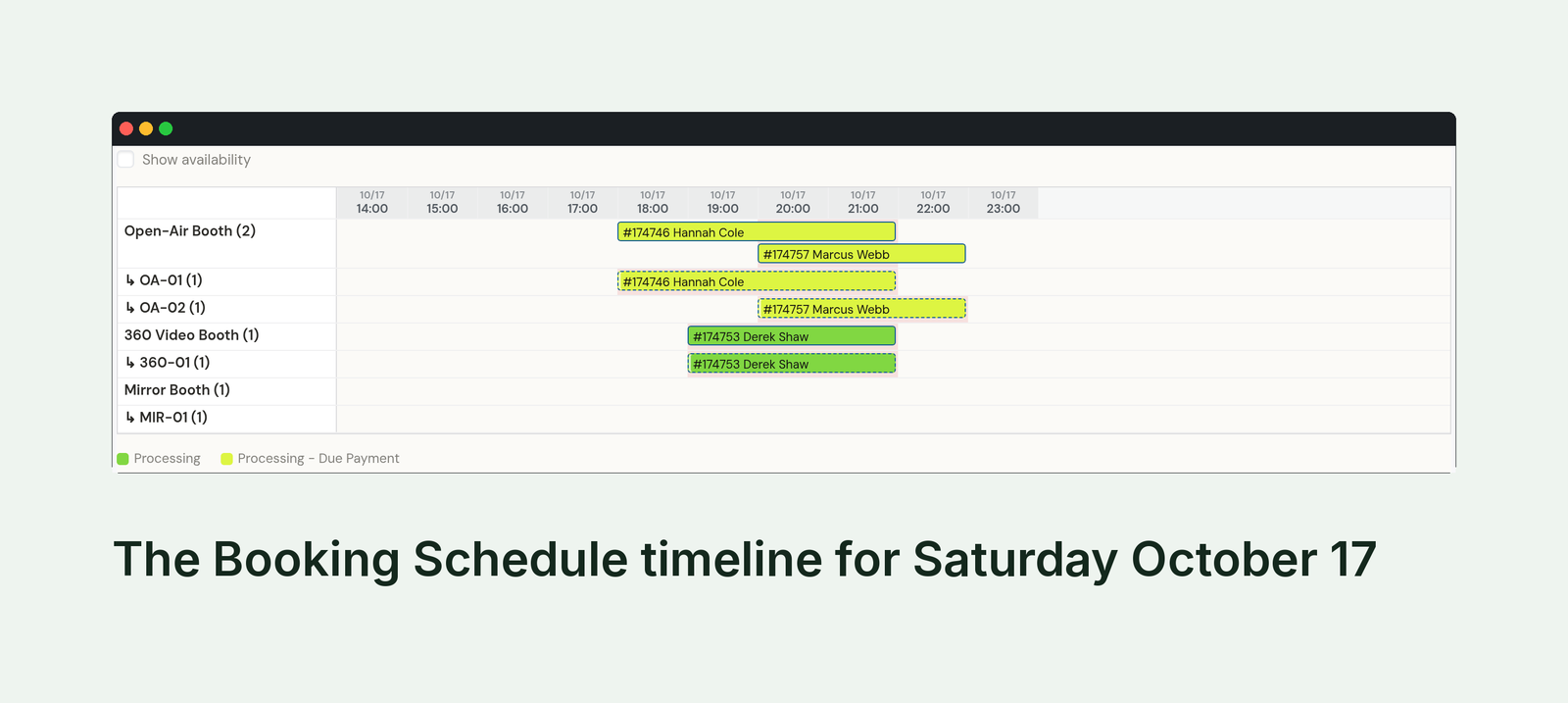
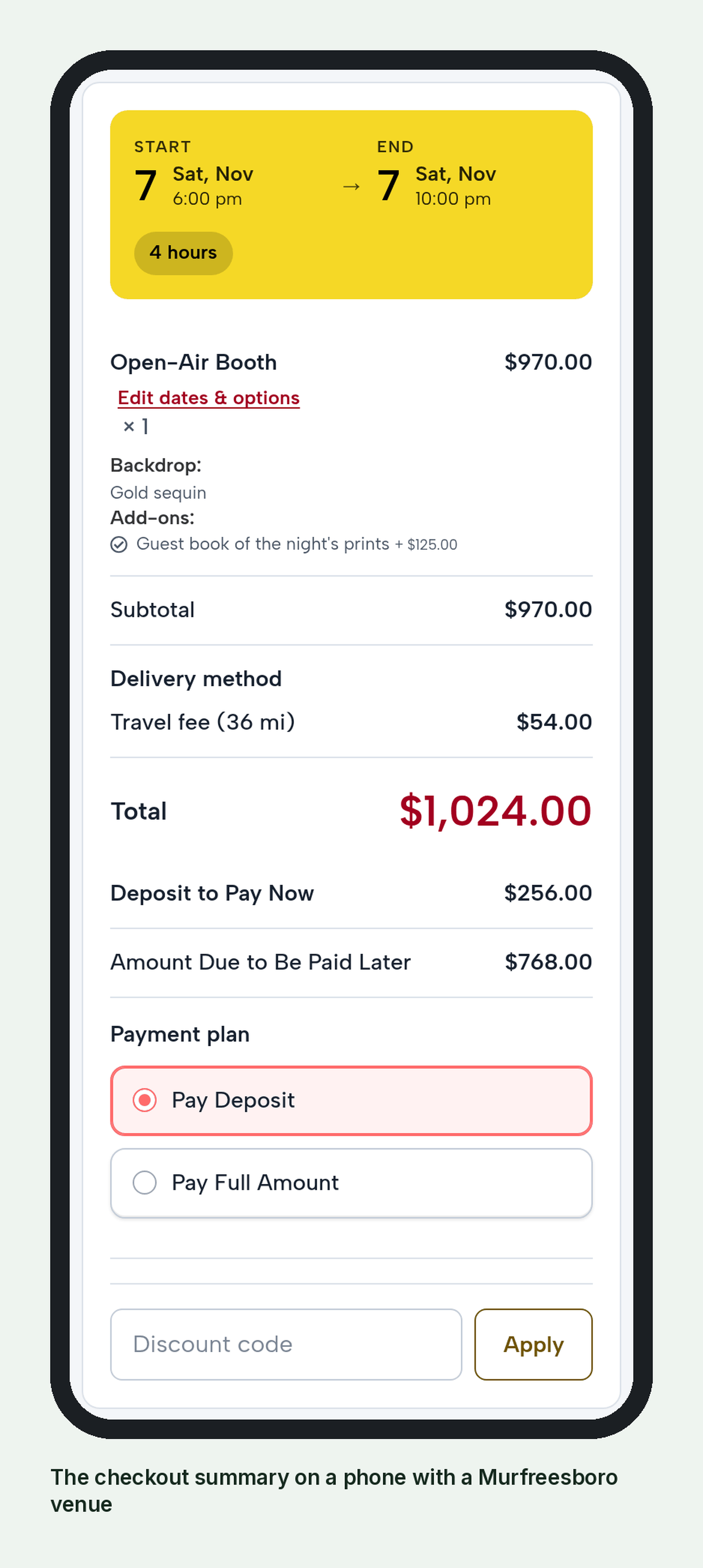
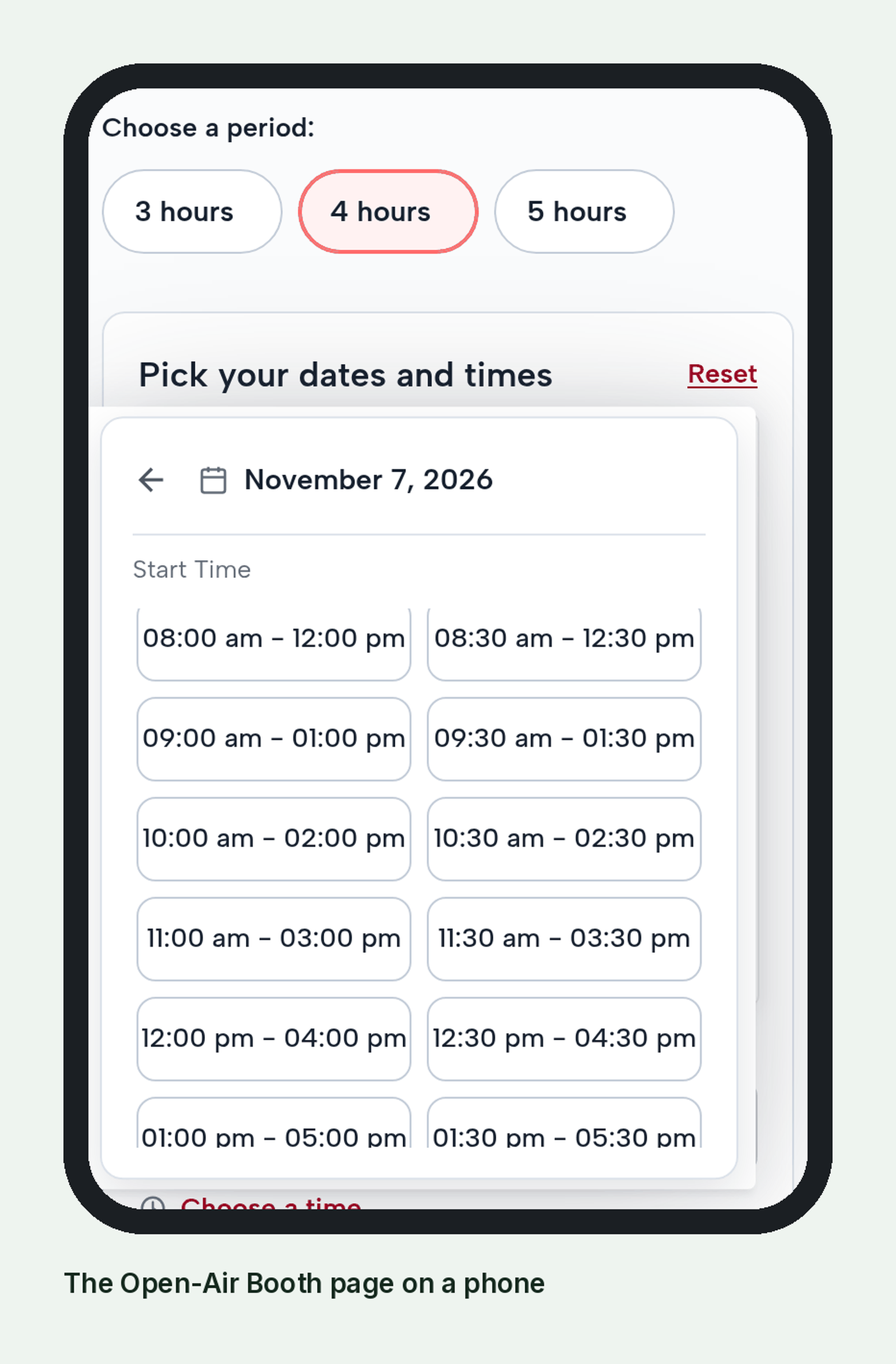
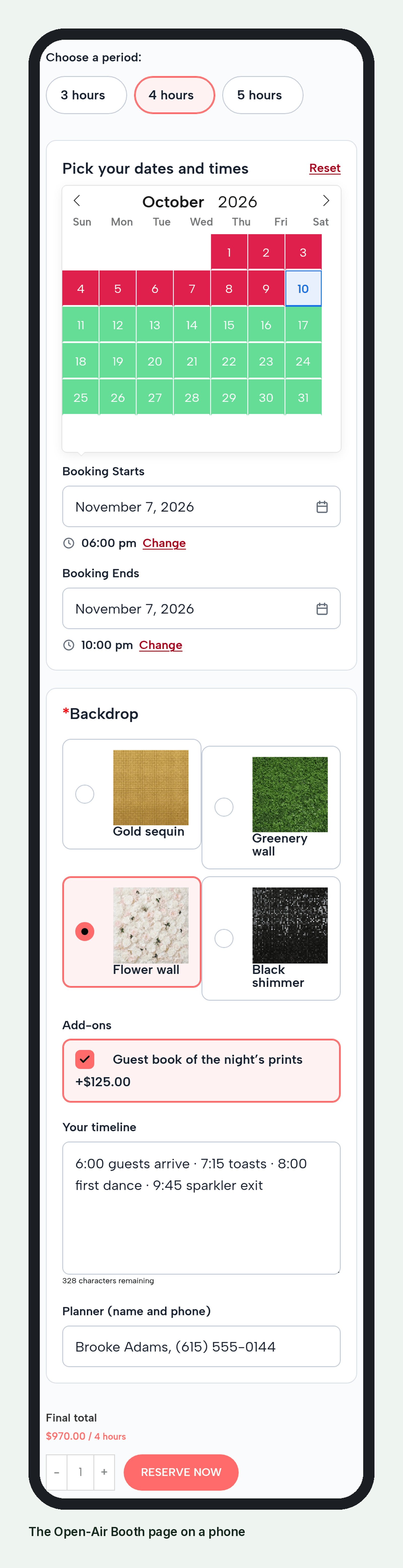
On Reservety, your client books on your own website and signs the agreement as an e-signature during checkout; it is stored with the booking. The deposit, the upfront payment, is taken at checkout too, so the date is held and paid before you hear about it. The booth is blocked on the calendar the moment it is booked, so a second inquiry can't take the same Saturday, and Buffer Time keeps the hours after an event clear for breakdown and the drive back. Delivery fees price themselves from your delivery zones, and client messages land in one inbox tied to the booking instead of a dozen text threads.
You don't set it up alone. You send the Launch Kit (logo, packages, prices, service area; messy notes, PDFs and spreadsheets are fine) and our Concierge Setup adds booking to your website or builds a new one, live in 3–5 business days, or 24–48 hours on Professional. Pricing is flat with zero commission on bookings, and a custom-built website is part of every plan. As of November 2026 we have 103 client websites live, and Reservety is rated 4.9 on Capterra from 36 reviews (checked October 2026). For the wording itself, our free rental agreement template and our guide to rental contracts and waivers are good places to start.
| Plan | Who it is for | Price |
|---|---|---|
| Starter | A booth business that wants online bookings, e-signed agreements and deposits at checkout on its own custom website | $59 a month, flat, zero commission |
| Professional | A booth business that also takes phone orders (POS), wants ID verification at $0.30 per check, QuickBooks sync and crew scheduling, and setup in 24–48 hours | $99 a month, flat, zero commission |
Questions owners ask
Can I use a free photo booth contract template as it is?
Use it as a starting point. The free template we read had no clause on space, power, idle time, overtime or image rights, so add those before you send it to a client.
Will a non-refundable deposit always hold up?
Not on the label alone. A Minnesota attorney, citing a 1959 state Supreme Court case, says the amount kept must be a reasonable forecast of a loss that is hard to estimate. Ohio also requires a dated written receipt saying whether a consumer deposit is refundable and when.
Do guests need to sign a photo release?
It depends on the state and the use. New York requires written consent before a picture is used for advertising or trade; Florida accepts oral consent and exempts unnamed members of the public. Stanford's copyright center notes a posted notice is weaker than a signed release.
How this was made. We read nine published photo booth contracts and templates in November 2026: eight from US operators, three of them order forms, and one free legal template from Legal Templates (January 2026). The deposit, balance, idle time, overtime, cancellation, space, power, running-time and weather figures are theirs; we do not name the operators. Ranges show the lowest and highest figure we found, not an average. Outside figures and legal points come from the sources named in the text, with their dates. This is a checklist, not legal advice: rules differ by state, so have a local attorney read your contract before you use it. Data checked November 25, 2026.
Sources
- Photo booth contracts and terms published by eight US operators and Legal Templates, read November 2026
- Photo booth contracts published by US operators, read November 2026
- Legal Templates photo booth contract, January 2026
- WeddingPro, The Knot Worldwide
- LA Photo Party
- IAEI Magazine
- New York Civil Rights Law section 50
- California Civil Code section 3344
- Florida Statutes 540.08
- Stanford Copyright and Fair Use Center
- Troutman
- Ohio Administrative Code 109:4-3-07
- Aaron Hall, attorney