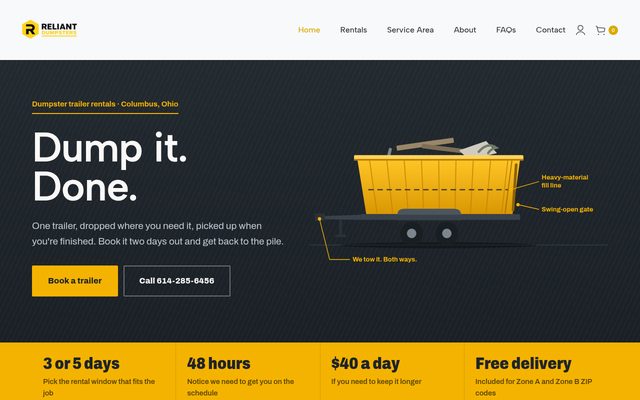
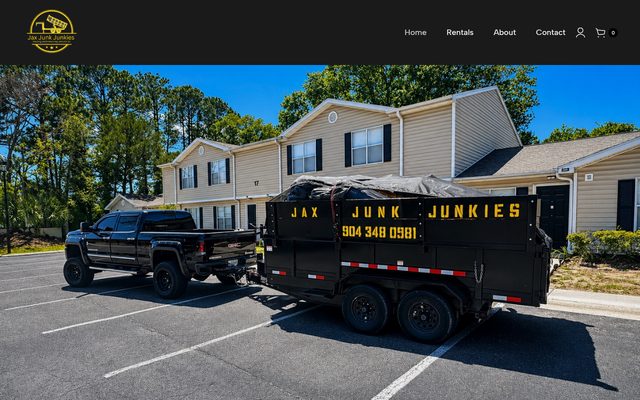
The customer picks the size, sees the price for their address and pays online. A hold goes on the card before the truck rolls. They sign the placement form on their phone. Every can has a number, the driver has the day’s drops and pickups on the phone, and the landfill ticket’s overweight comes off the hold. Your dumpster website is included.
Stripe, Square, PayPal, QuickBooks, Google Analytics, and 100+ more tools for rental management.


Treasure Valley Roll-Off is our test yard in Meridian, Idaho: four 10-yard cans, five 20-yards, three 30-yards and one truck. Every screen below comes from it, during a week of drops, swaps and pickups in October.
01
A homeowner calls to ask if you have a 30-yard for Monday. You check the whiteboard, call back, and they have already booked with the next yard.
Each size has its own page: the photo, what it’s good for, the measurements and a calendar. The days a can of that size is free are green. On the 12th to the 14th all three 30-yard cans are out, so those days are red and can’t be picked. Nobody has to call to ask.
The 30-yard’s October: three cans, all out from the 12th to the 14th. Click the image to enlarge.
02
Every caller asks “how much to Kuna?”, and the answer depends on who picks up the phone.
Before the dates, the customer types their ZIP code. Meridian, Eagle and west Boise get the base price; Kuna, Nampa and Star cost $50 more, and the page shows that price. A 20-yard to Kuna for seven days is $495. A ZIP code you don’t serve gets a plain answer before anyone fills in a form.
Kuna is zone 2: $495 for the 20-yard. Twin Falls is not served. Click the image to enlarge.
03
Customers keep the can three extra days and nobody bills them, or they argue about what “a week” meant.
Each size has one flat price for up to seven days, and the tons it includes are written on the page. Pick nine days and the price is $475, not $445: two extra days at $15. The calendar stops at 14 days; anything longer is a phone call.
Nine days of the 20-yard. Click the image to enlarge.
04
The mattress shows up in the can, and the fee turns into an argument after the pickup.
The customer ticks what they’re throwing out that costs extra: a mattress is $25, a tire $15, an appliance $35. The total includes it, so Amanda’s 10-yard with one mattress is $400. Amanda’s note for the driver, “left side by the garage, gate code 4417”, goes on the order and onto the driver’s phone.
What costs extra, priced before payment. Click the image to enlarge.
05
A can booked with a stolen card gets delivered, the charge is reversed a week later, and the can is gone for a week.
Every booking is paid online. When the order comes in, the deposit for that size ($150 for a 10-yard, $250 for a 30-yard) is held on the same card. It is a hold, not a charge. The order shows the hold and which card it’s on. If a card can’t take the hold, the order shows that in red before you load the truck.
The deposit at checkout; the hold on the order (Stripe test mode); the texts (drawn). Click the image to enlarge.
06
The driver calls from the curb to ask “driveway or street?”, and when the concrete cracks, nobody signed anything.
With the payment comes a link to the placement form: driveway, street (with the city permit) or jobsite, the notes for the driver, and the driveway release. The customer signs it on their phone and it stays on the order. Before the can goes out, the order says “Documents complete”.
The placement form, filled in and signed on the phone.
07
Twelve cans and a whiteboard, and every Monday someone drives around looking for the 20-yard that was due back Friday.
Every can has its own number: 10Y-01, 20Y-04, 30Y-02. The list of what’s out shows each can with the customer, the address, the day it’s due back and how many days it’s overdue.
Five cans out, each with its number and address. Click the image to enlarge.
08
One truck, a dozen stops, and the driver’s route lives in a group text.
The day’s list puts the drops and the pickups together, with their addresses. A swap is a pickup and a new drop at the same address: Nate Fischer’s full 10-yard comes back and an empty one goes down in the same spot. Ray sees the day’s stops in the driver app with the route, the can and the gate code, and takes a photo of each can on its boards when it goes down.
The day’s list; the driver app: the route, the stop, the photo at the drop (a generated photo, chosen in the app, not sent). The driver app comes with the Driver app & dispatch plan. Click the image to enlarge.
09
“Can you drop a 30-yard Tuesday?” The answer is a walk to the whiteboard, a look at the truck’s day and a guess at which cans will be back.
Ray’s truck from Monday the 12th to Saturday, every drop, swap and pickup, the stops used of six a day, and the cans of each size free that day. Tuesday has room for two more stops, but all three 30-yards are out until Thursday. The platform has the day’s list and the driver app (row 08) and each size’s calendar.
The week of October 12. Click the image to enlarge.
10
The ticket says 5.4 tons, the customer paid for 4, and the $91 gets chased by phone for a month.
When the can comes back, the weight from the landfill ticket is typed on the return screen, next to the can’s number. Brooks Roofing’s 30-yard came back at 5.4 tons, 1.4 over the 4 included. At $65 a ton that’s $91, captured from the $250 hold on their card on the same screen. The rest of the hold is released.
The weight and the capture, on the return screen (Stripe test mode); the texts (drawn). Click the image to enlarge.
11
The yard has a brochure site with a phone number, and the brokers rank above it.
We build it in your name: the sizes with their prices and what’s included, the areas you serve, how booking works, what costs extra, and contractors. Hosting is included.
Treasure Valley Roll-Off, the test yard. Yours looks like yours.
Treasure Valley Roll-Off is a test yard we built for this page; the customers’ names are made up, the phone numbers don’t exist and the photos are generated (the website’s photos and the driver’s photo of the drop). The text messages are drawn. The card holds and the $91 capture were made in Stripe’s test mode with Stripe’s test card. Every screen not marked * is the system, with the test yard’s week run through it.
* In beta testing.
Skip the setup headaches. Unlike other software where you start with a blank screen, Reservety includes Concierge Setup (we build your entire system for you) to get you live in 3-5 business days.
Fill out the simple Launch Kit form. Attach your price list (Excel/PDF) and logo.
Our team uploads your inventory, configures your tax zones, and designs a professional website that matches your brand — typically ready in 3-5 business days.
We invite you to a "Go Live" meeting to review your new store. Once you approve, you turn it on and start making money.
Stop wrestling with spreadsheets and disconnected tools. One system for your entire operation — bookings, inventory, payments, deliveries, and customers.
Whether you're a solo operator with a handful of roll-offs or a growing fleet covering multiple counties, pick the plan that matches where you are today.
Everything you need to launch and grow your rental business. Professional tools without the complexity.
From 36 reviews by rental businesses that run on Reservety, as published on Capterra (September 2026).
Real businesses running on Reservety right now.
If yours isn’t here, ask us. A person answers.
Your containers should be out earning, not sitting in the yard. Join 500+ rental businesses already using Reservety — submit your Launch Kit and we'll have you live in 3-5 business days.