
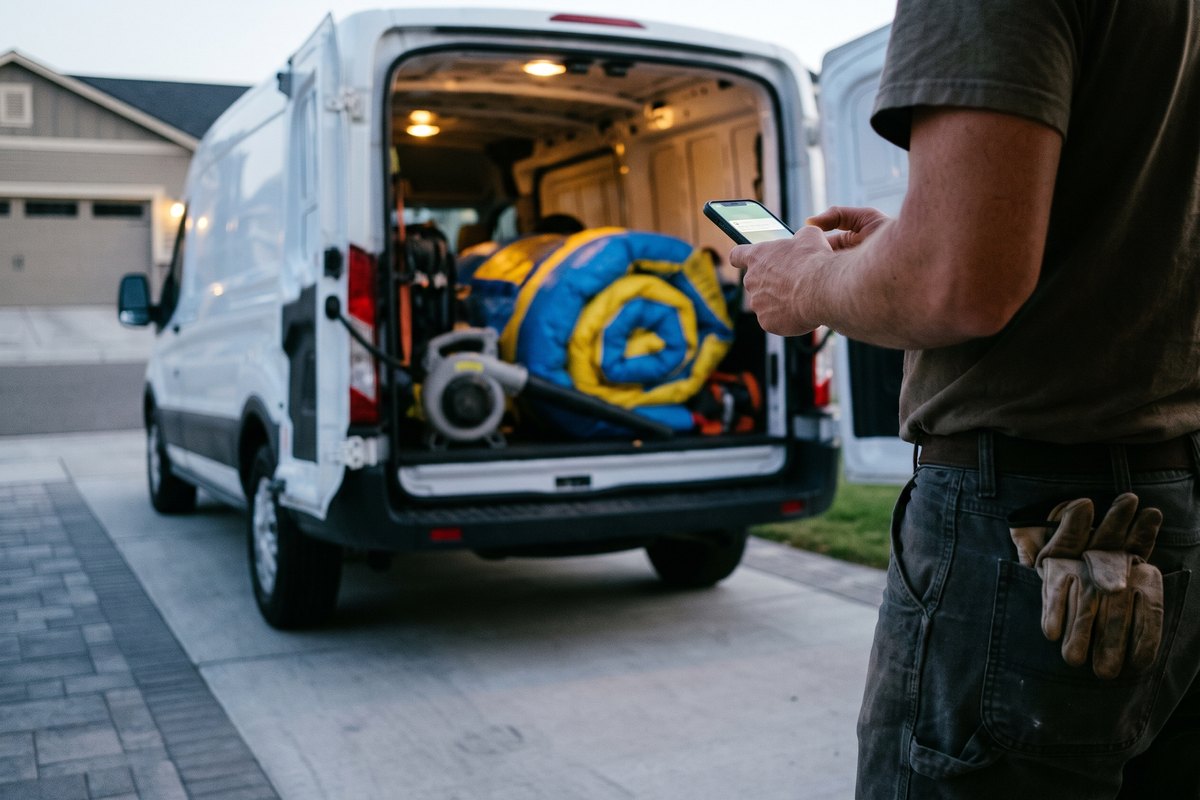
It's 9 p.m., the blower is back in your van, and a permit form from the city park sits in your inbox. It wants a certificate of insurance, the city named as additional insured and the endorsement attached, all before Saturday. You have a policy. You're just not sure it says what this form wants, or that it covers the inflatable you dropped off this morning. Bounce house insurance is less about owning a policy and more about having the right limits and the right paperwork ready when a park, a school or a parish asks. Let's walk through one working day: the form, the cost, the state rules and the wind check, with every figure sourced.
Short answer. Plan on general liability that names inflatables, often $1,000,000 per occurrence and $2,000,000 aggregate, plus the venue as additional insured. MoneyGeek puts general liability at $904 a year on average; inflatable brokers quote $2,500 to $9,500 a year. Texas, New Jersey, Ohio, Pennsylvania and Maryland set legal minimums; Florida's ride law exempts inflatables.
The form in your inbox wants an endorsement, not just a certificate
Two documents get mixed up here. A certificate of insurance is proof that you have coverage and how much. Under Minnesota Statutes 60A.39, it gives the holder no contractual rights. Being an additional insured is different. Providence's city insurance guidelines put it simply: an additional insured enjoys the benefits of someone else's policy. That's why the venue wants its own name on your policy, not just a page showing your policy exists.
The stricter venues go a step further and ask for the endorsement itself. Seattle's 2024 park rules want a copy of the endorsement for inflatables. Long Beach asks for a separate additional insured endorsement. SISC, a California school risk pool, recommends in a 2019 memo that districts ask for the endorsement attached.
So before you answer the form, call your agent with one question: can you issue an additional insured endorsement for this venue, and how fast? Tampa allows 30 days for insurance approval. A request that reaches you the week of the party is already late there.
Parks, schools and parishes ask for $1 million to $2 million per occurrence
Here's what each document asks for, in the year of the document. Line your policy up against the row that matches your next booking.
Look at the DC Public Schools row in the table below. A bounce house is a climb-on inflatable, so there the answer is no at any limit. A $1,000,000 policy clears Tampa and Long Beach, but not Seattle or the parish form. If parks and churches fill your spring calendar, ask your agent what $2,000,000 per occurrence, or an umbrella, adds to your premium.
| Who asks | Limit | Also asks for |
|---|---|---|
| Tampa parks (City of Tampa, June 2026) | $1,000,000 per occurrence | City as additional insured, 30 days for approval, no staking, weights of at least 500 pounds |
| Long Beach parks (City of Long Beach) | $1,000,000 per occurrence, $2,000,000 aggregate | Separate additional insured endorsement, $350 a year vendor fee |
| Seattle parks (2024) | $2,000,000 per occurrence for inflatables | A copy of the endorsement itself |
| California school districts (SISC memo, 2019) | $1,000,000 per occurrence, $2,000,000 aggregate | Endorsement attached |
| DC Public Schools (July 2025) | $1,000,000 and $2,000,000 general liability plus $5,000,000 umbrella | Climb-on inflatables banned outright; the limits apply to other higher-risk attractions |
| Parish form (Catholic Mutual, Diocese of San Diego) | $2,000,000 per occurrence | Parish as additional insured |
What it costs: $904 a year on average, $2,500 to $9,500 from inflatable brokers
The published numbers sit far apart, so it helps to see them side by side.
Three lines in the fine print matter as much as the premium. First, Kelly Insurance Group notes that a policy usually carries a smaller limit for injuries to a participant, typically $100,000 a claimant. Your $1,000,000 headline limit may not be the number that applies when a child is hurt on the inflatable. Ask your agent what yours is.
Second, how you run the event changes the price. ProIns Group says events with staff on site price 15 to 25% better than drop-and-leave rentals.
Third, check that the policy covers inflatables at all. MoneyGeek reports that one online insurer's standard general liability application asks the owner to attest that they do not operate amusement devices, inflatables or bounce houses. A cheap generic quote that excludes your whole fleet isn't a bargain.
| Source | What it covers | Price |
|---|---|---|
| MoneyGeek (October 2026) | General liability, 1 to 4 employees, $1 million and $2 million limits | $75 a month, $904 a year on average |
| MoneyGeek (October 2026) | Five coverages, same business size and limits | $138 a month, $1,662 a year on average |
| Kelly Insurance Group (2026) | New operator under $50,000 of yearly revenue | About $3,500 to $4,000 a year |
| Kelly Insurance Group (2026) | Established operator | About $2,500 a year and up; equipment cover from about $1,100 more |
| ProIns Group (June 2026) | Established inflatable operator, package that may include auto, equipment and umbrella | $3,500 to $9,500 a year |
Five states set a legal minimum; Florida and North Carolina step back
Some states write bounce house insurance into law, with an inspection on top. Here are the seven covered by our sources.
These are floors, not targets. Pennsylvania's $100,000 minimum won't get you into a Tampa park. And an exemption doesn't stop a venue from asking: Tampa's park rules sit on top of a Florida ride law that exempts inflatables. If your state isn't in the table, check your state's current rule and ask your agent before the spring rush.
| State | Minimum coverage | Also required | Source |
|---|---|---|---|
| Texas | $1,000,000 per occurrence for continuous air flow inflatables | Annual inspection arranged through the insurer, $40 per ride filing fee, one-year compliance sticker | Texas Department of Insurance |
| New Jersey | $1,000,000 general liability | Annual ride permit and annual inspection, for public and private events | New Jersey's DCA |
| Ohio | $500,000 for one person, $1,000,000 for two or more in an occurrence | Annual permit and inspection | Ohio Department of Agriculture |
| Pennsylvania | $100,000 per occurrence, $300,000 aggregate (Class I, which names inflatable bounce rides) | Inspection affidavit before operation and at every new location | Pennsylvania Code, Title 7, chapter 139 |
| Maryland | $200,000 | Yearly registration and inspection; no operation at a sustained 15 mph or gusts of 25 mph | COMAR 09.12.66 |
| Florida | None under the ride law | Inflatable rides are exempt | Florida ride law, section 616.242 (2026) |
| North Carolina | None from the state | State stopped inspecting inflatables in October 2023 | North Carolina Department of Labor |
Afternoon at the park: follow the maker's wind limit, not the 25 mph line
It's 2 p.m., the party is in full swing, and the flags at the park are standing straight out. This is the moment your policy exists for, and the one you want to avoid.
The Consumer Product Safety Commission's bulletin says to unload and deflate at gusts above 25 miles an hour, notes that makers' own limits run from 15 to 25, and says a bounce or slide under 15 feet needs at least one operator. Maryland writes a wind limit into law: no operation at a sustained 15 miles an hour or gusts of 25.
Why the maker's number and not 25? A University of Georgia study (2022) counted 132 wind incidents with inflatables worldwide since 2000, with at least 479 injuries and 28 deaths, and more than half happened at or below 25 miles an hour. Across all causes, the CPSC estimated 113,272 emergency room visits and 12 reported deaths from inflatable amusements in 2003 to 2013.
We'd put the maker's wind limit on every delivery sheet, send our safety checklist out with the crew, and keep someone on site when you can. Staffed events also price better, per ProIns Group.
Evening: the waiver and the deposit are already in the booking
Back home, the evening used to go to chasing paper waivers and scrolling through texts to work out which party had paid. You'd lie awake wondering whether that family ever signed anything.
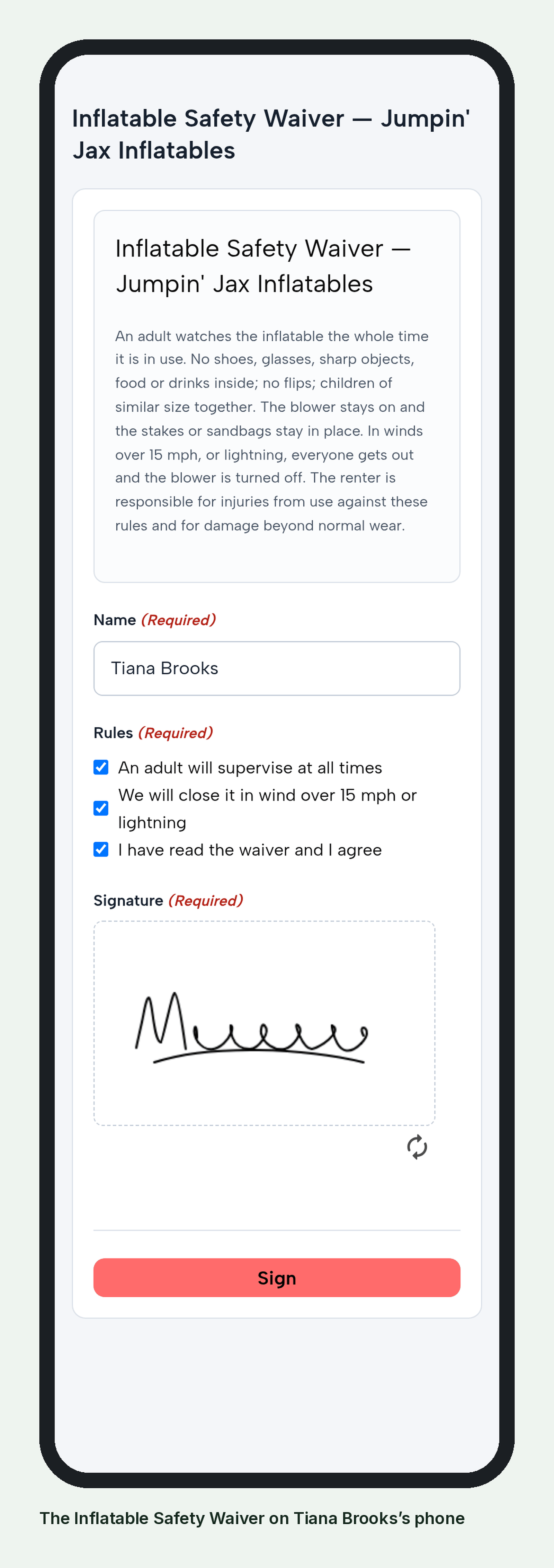
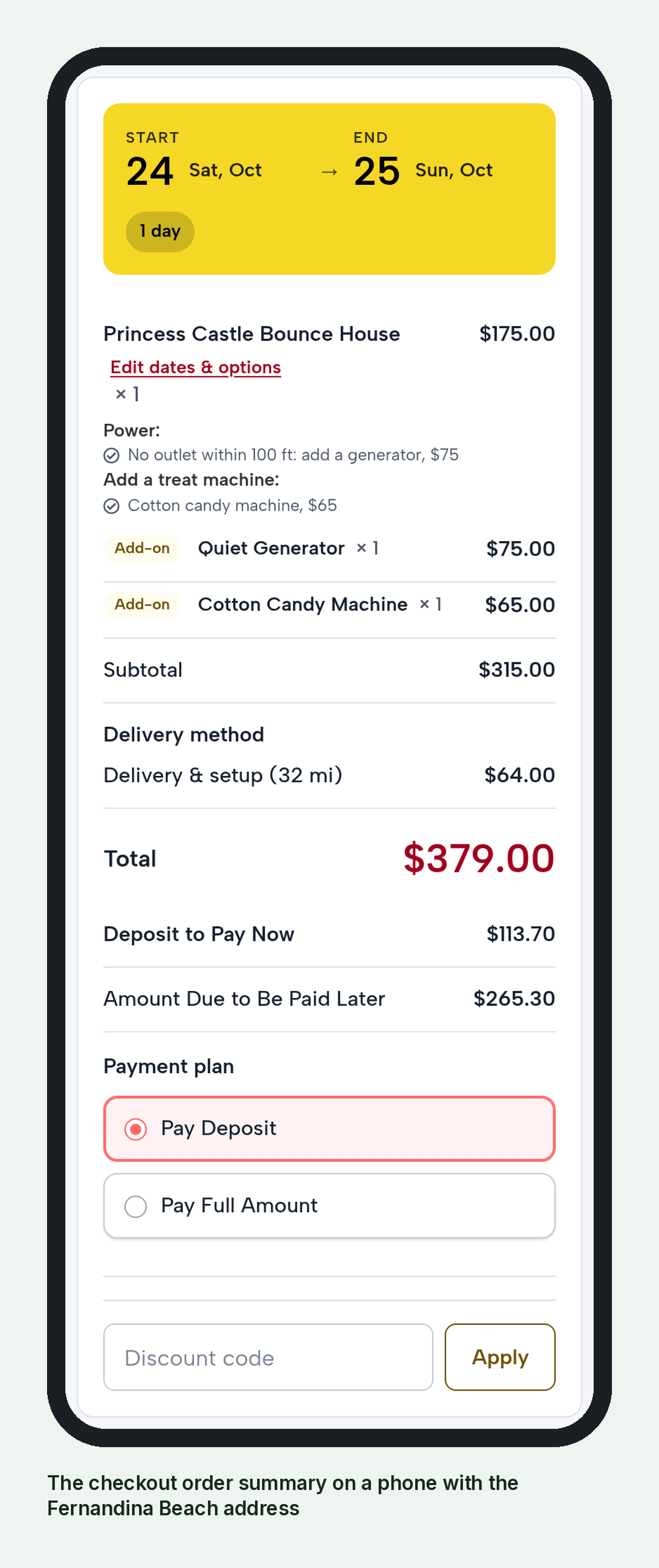
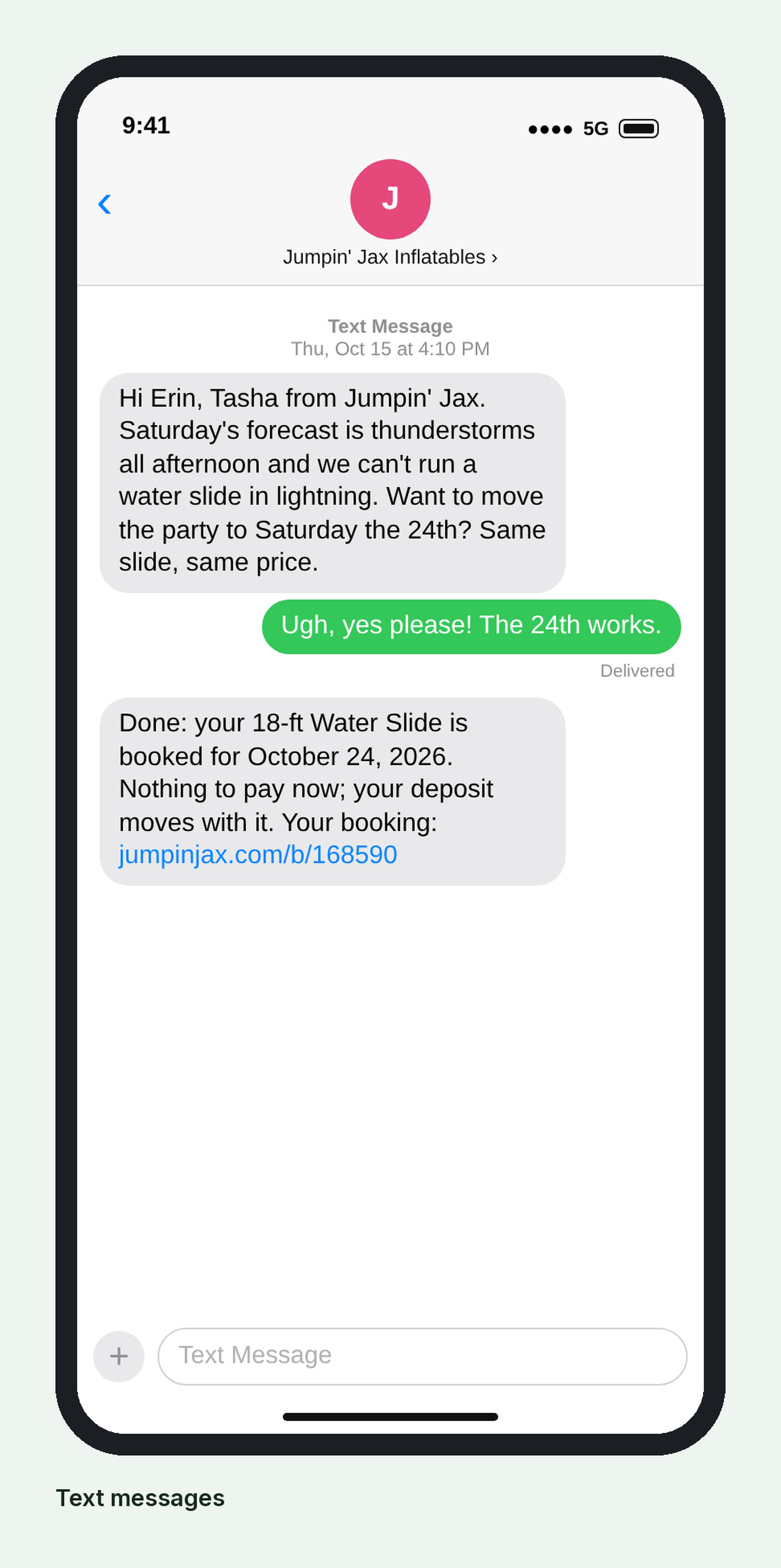
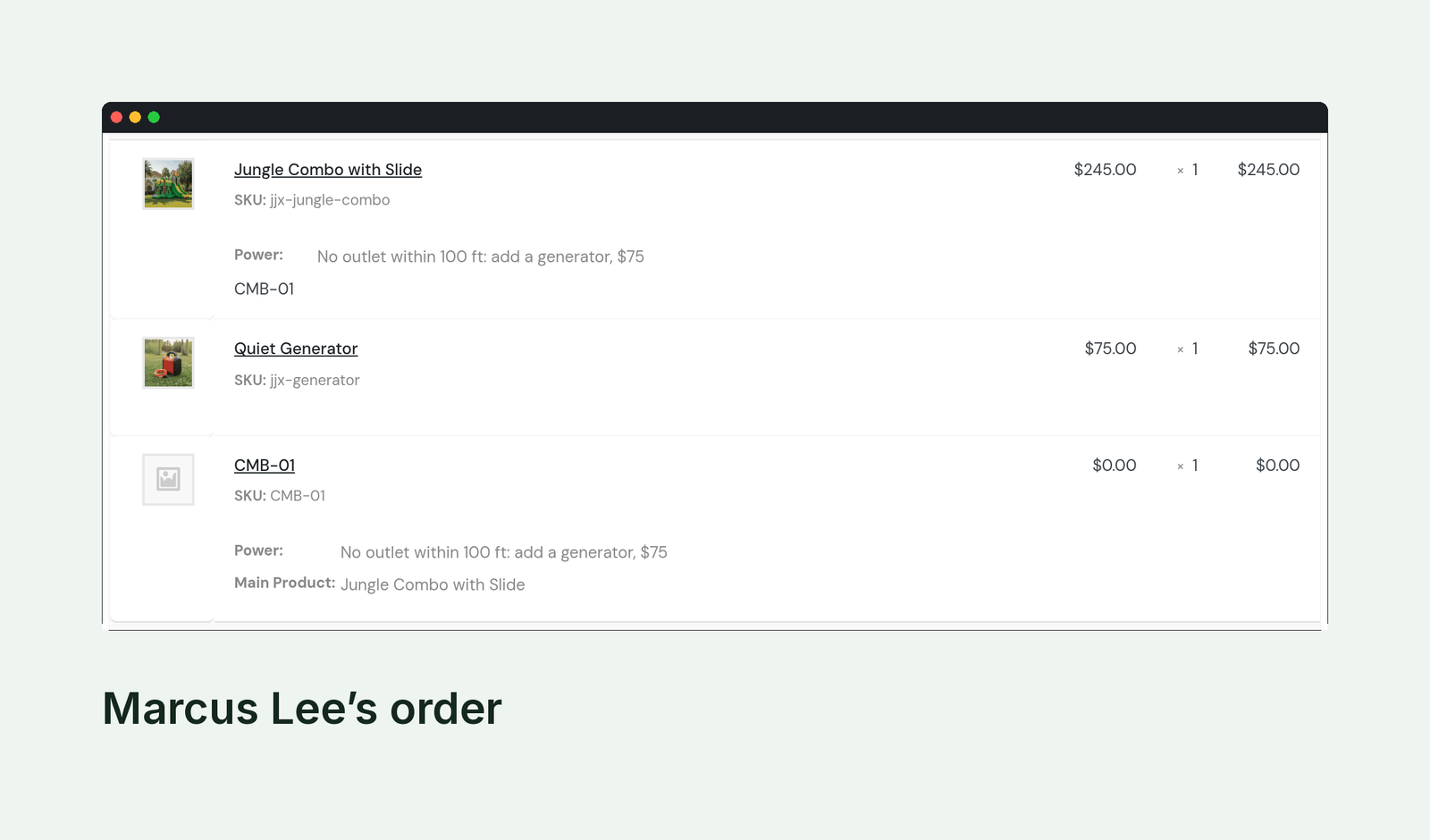
On Reservety, the customer signs a digital waiver during booking, and it's stored with that booking. The deposit, the upfront payment, is taken at checkout, not at the door. Delivery fees come from your delivery zones, so the quote prices itself. Each unit is blocked on one calendar the moment it's booked, and buffer time per item keeps cleaning and drying out of the bookable slots. Customer messages land in one inbox tied to the bookings. A signed waiver doesn't replace your policy; it sits next to it, in the same place as the booking it belongs to.
Setup is done for you. You fill in the Launch Kit with your logo, inventory, prices and service area; messy notes, PDFs and spreadsheets are fine. Our Concierge Setup gets you live in 3 to 5 business days, or 24 to 48 hours on Professional.
Two flat plans, zero commission, a custom website in both
Every plan is a flat monthly price with zero commission on bookings, and a custom-designed booking website with hosting is part of every plan. As of November 2026, we have 103 client websites live, and Reservety is rated 4.9 on Capterra from 36 reviews (checked October 2026).
| Plan | Who it is for | Price |
|---|---|---|
| Starter | Owners who want online booking, digital waivers and deposits at checkout on their own custom website | $59 a month, flat, no commission |
| Professional | Owners running crews who also want ID verification at $0.30 a check, point of sale, QuickBooks sync, crew scheduling and smart locks, live in 24 to 48 hours | $99 a month, flat, no commission |
Questions owners ask
Do I need insurance to rent out bounce houses?
In Texas, New Jersey, Ohio, Pennsylvania and Maryland, yes: each sets a minimum by rule. Florida's ride law exempts inflatables, yet Tampa parks still ask for $1,000,000 per occurrence with the city as additional insured, so you need it to book venues there too.
How much does a $1,000,000 liability policy cost for a bounce house business?
MoneyGeek puts general liability at $904 a year on average for 1 to 4 employees at $1 million and $2 million limits (October 2026). Kelly Insurance Group quotes about $3,500 to $4,000 a year for a new operator under $50,000 of revenue and about $2,500 and up for an established one.
What's the difference between a certificate of insurance and additional insured?
A certificate shows you have coverage and how much, and gives the holder no contractual rights (Minnesota Statutes 60A.39). An additional insured enjoys the benefits of your policy (Providence city guidelines), which is why parks like Seattle and Long Beach ask for the endorsement itself.
Does liability insurance cover a child hurt in the bounce house?
Usually, but often at a smaller limit. Kelly Insurance Group notes that a policy usually carries a lower limit for injuries to a participant, typically $100,000 a claimant. Ask your agent what yours is before you rely on the headline limit.
How this was made. We read every source by hand on November 25, 2026. Venue and state limits are given as published by the city, school body, parish form or state named, with the year of the document where it carries one. Costs are MoneyGeek's published averages and the ranges two inflatable brokers publish, not quotes: your price depends on your state, your fleet, your claims and whether you stay on site. Rules and forms change, so confirm the current form with the venue and the current rule with your state before you sign. Data checked November 25, 2026.
Sources
- City of Tampa Parks & Recreation, June 2026
- City of Long Beach Parks
- City of Seattle Parks and Recreation, 2024
- SISC, California school risk pool memo, 2019
- DC Public Schools policy, July 2025
- Catholic Mutual form, Diocese of San Diego
- Minnesota Statutes 60A.39; City of Providence insurance guidelines, 2024
- MoneyGeek, October 2026
- Kelly Insurance Group, 2026
- ProIns Group, June 2026
- MoneyGeek, October 2026
- Texas Department of Insurance
- New Jersey Department of Community Affairs
- Ohio Department of Agriculture
- Pennsylvania Code, Title 7, chapter 139
- Maryland COMAR 09.12.66
- Florida Statutes 616.242 (2026); North Carolina Department of Labor
- Consumer Product Safety Commission bulletin
- Consumer Product Safety Commission, 2015
- University of Georgia, 2022