
The party rental industry pulled in $12.38 billion back in 2022, and, if the projections are anywhere close, it could hit $37.54 billion by 2030. That's a lot of balloons and tents—and it means there's plenty of room for newcomers. You'll need anywhere from $30,000 up to $100,000 to get started, and you can't skip out on licensing, insurance, and choosing your inventory and pricing wisely. From weddings and company events to killer backyard bashes, this business gives you flexibility and, honestly, some solid profit potential.

Getting into this market isn't as tough as launching, say, a restaurant or a tech startup. People seem to be spending more on experiences, and the demand for party rentals keeps climbing. The business model's pretty straightforward: buy up things like tables, chairs, tents, and maybe a few quirky items, then rent them out for events at rates that cover your costs (and hopefully a good chunk of profit). Most of your gear should last three to five years if you take care of it, so you can keep making money off the same stuff.
This guide covers everything you need to know to actually get your party rental business off the ground. You'll figure out how to estimate your startup costs, pick inventory that actually makes money, set your prices using a rental pricing calculator, and get systems in place with party rental software like Reservety to keep bookings from turning into a nightmare.
Is A Party Rental Business Profitable?
If you run things well, party rental businesses can be surprisingly lucrative. Margins usually land somewhere between 20% and 40%, depending on your market and how tightly you run your ship. The industry's still growing, especially as people get back to throwing events and seem more interested in renting than buying.
Industry Size
This market isn't small potatoes—North America alone sees billions in revenue from party and event rentals. According to the American Rental Association, party rental companies see steady demand from weddings, corporate gigs, birthdays, and all sorts of seasonal get-togethers.
Even when the economy tanks, people still find reasons to celebrate (or at least gather), and they often switch from buying to renting gear. Weddings in particular are huge, with the average one needing $800 to $2,500 in rentals. Corporate events and repeat customers keep things humming all year.
But honestly, what matters most is your local market. You'll want to dig into your area's population, income levels, and how many venues or event spaces there are. If you're in a spot with lots of parties but not much competition, you're in a good place to profit.
Margins
On individual rentals, you're usually looking at gross profit margins between 30% and 50%. The real number depends on how much you spend on equipment, how often it gets rented, what it costs to keep it in shape, and how you set your prices.
The basics—tents, tables, and chairs—are your bread and butter. They rent out often and don't require much upkeep. Specialty items can bring in more per rental, but they might just take up space between bookings. It's worth running the math with a rental pricing calculator so you don't end up losing money on fancy stuff.
Plan for 15% to 25% of your revenue to go toward operating expenses—think storage, transport, insurance, and paying helpers. Delivery fees help cover your vehicle costs (and add a little extra to your bottom line). Most folks charge $50 to $150 per delivery, depending on distance and how much stuff's going out.
Real Numbers
To get started, most people spend somewhere between $15,000 and $60,000, based on startup cost research. You can do it for less if you stick to the basics and build up slowly.
A small operation renting out basic supplies might make $3,000 to $8,000 a month in the first year. As your inventory grows and you connect with event planners, that can climb to $15,000–$40,000 (or more, if you're really hustling). There's even a story about someone who started with just $500 and ended up turning a solid profit by adding inventory at the right pace.
Your take-home pay? It's all over the map—anywhere from $500 to $15,000 a month, depending on your scale and how smart you run things. If you want a clearer picture, use a startup cost calculator to see how your numbers shake out. And honestly, using party rental software like Reservety can save you a ton of headaches and help you avoid double bookings, which is a real killer for margins.
Choose Your Niche
There are a bunch of ways to carve out your spot in this industry, and each niche has its own startup costs and types of customers. Tent rentals can run you $2,000–$10,000 to get started, while inflatables are usually a bit cheaper, around $1,500–$5,000 per unit.
Tents
If you go the tent route, you'll be serving weddings, corporate events, and outdoor parties—basically any event where people don't want to get rained on. A 20x20 tent can handle around 40 guests and rents for about $550 an event. Go bigger—a 40x60 tent for 240 people—and you're talking $2,400.
You'll need to buy the tent, stakes, sidewalls, and gear to move it all. Storage isn't free—figure about $180 a month for a climate-controlled unit. Here's a solid guide to starting a tent rental business if you want to dig deeper.
After paying for labor and delivery, you might clear $650 per rental for a 100-person event. You'll need a truck or trailer, and it takes two people a couple of hours to set up.
Inflatables
Bounce houses and slides are crowd-pleasers for kids' parties, school events, and community festivals. Entry costs are $1,500–$5,000 per inflatable, depending on how fancy you want to get.
Rental rates depend on the unit—basic bounce houses go for $150–$300 a day, while bigger obstacle courses can fetch $400–$800. Want to get specific? Run your numbers with a rental pricing calculator.
Storage isn't a huge deal since they pack down small, but you'll need a van for deliveries and a blower for each unit. Insurance is a must here—no way around it. Cleaning takes about half an hour per item between rentals.
Linens
If you're not into heavy lifting, linens might be your thing. Tablecloths, chair covers, and napkins are needed for weddings, galas, and high-end events. There's less physical work, but inventory management and cleaning are critical.
Standard tablecloths rent for $8–$15, specialty linens for $25–$50. Chair covers are $2–$5 each. A starter batch of 50 tablecloths and 100 chair covers will run you about $2,000–$3,000.
You'll need access to commercial laundry or a good relationship with a cleaning service. Knowing how to get stains out is non-negotiable, since damage fees can eat into your profits. Use party rental software to keep track of inventory—especially during wedding season when everything's in demand.
Full-Service
If you want to go all-in, a full-service operation covers tents, tables, chairs, linens, lighting, and décor. It's more work, more money, and a bigger payoff per client.
You'll probably need $50,000+ to get started if you want to cover all the bases. Use a startup cost calculator to get a real sense of what you'll need based on your market.
All-in-one packages make it easier for clients to book. A typical 100-person wedding package (tent, tables, chairs, basic linens) rents for $2,500–$4,000. You'll need warehouse space, a couple of vehicles, and a crew of at least three to five people. Reservety or similar software helps you juggle all the moving parts and avoid overbooking.
Write A Business Plan
A good business plan isn't just for investors or banks—it's your playbook for the next few years.
Start with an executive summary. What kind of party rental business are you building? Are you focused on weddings, corporate events, backyard parties? Nail down your niche.
Here's what you'll want to include:
- Market Analysis – Check out your local competition and see where you can stand out
- Customer Segments – Who are your main clients? Individuals, companies, event planners?
- Financial Projections – Lay out your startup costs, pricing, and what you expect to bring in
- Operations Plan – Spell out how you'll handle bookings, deliveries, and pickups
When you get to the financials, be specific. Maybe you're starting with 20 tables, 200 chairs, and some linens—that's $8,000 to $15,000 in inventory. Use a startup cost calculator to add up your total costs, including vehicles, storage, and insurance.
Don't wing your pricing. A rental pricing calculator helps you set rates that actually make sense after you factor in cleaning, depreciation, transportation, and storage.
Banks (and honestly, you) want to see realistic projections based on actual research. Make sure to include a marketing plan—how will people find you? Social media, partnerships with venues, event planners?
Think through how you'll run things from day one. Party rental software like Reservety can make your life easier with inventory tracking, online bookings, and customer management. That's the kind of detail that makes your plan (and your business) stronger.
Calculate Startup Costs
How much you'll spend up front depends on what you want to offer, how much you need to store, and how you'll get everything to your clients. Most people need between $5,000 and $50,000 to get started the right way.
Realistic Budget Breakdown $5K-$50K
Starting a party rental business usually takes $13,000 to $50,000 in capital. Your biggest spend will be inventory—expect $5,000 to $30,000, depending on what you stock.
A basic starter kit with six tables and forty folding chairs is about $3,000. Toss in a bounce house, and that's another $1,500 to $2,500.
Transportation is the next big ticket. Set aside $5,000–$10,000 for a down payment on a box truck or cargo van that can haul tents and inflatables.
Storage deposits can run $2,000–$5,000, depending on where you are. Building a decent website with booking features will cost $1,000–$3,000. And seriously, consider party rental software from day one—it's worth it for keeping reservations organized.
Setting up your business legally is about $150–$200, with insurance adding another $100–$300 to start. Don't forget business cards and brochures—budget $200–$300 for those.
Use a startup cost calculator to get a handle on your actual costs, tailored to your niche and local market.
Register Your Business And Get Licenses

Before you can get any licenses, you'll need to register your business structure. Most folks in the party rental world go with an LLC for the liability protection—it's just safer, honestly. But if you're on a tight budget, a sole proprietorship is cheaper to set up (usually $50 to $150 to file).
Your startup costs will include a handful of licenses and permits you can't skip. First up: apply for a Federal Employer Identification Number (EIN) on the IRS website. It's free, and honestly, it takes less than 20 minutes.
Here's what you'll need to cover:
- General business license from your city or county ($50–$500 each year)
- Sales tax permit (needed in most states to collect tax on rentals)
- DBA registration if your business name is different from your own ($10–$100)
- Zoning permit to make sure your storage spot is allowed for business use
If you're in New York, you'll need to register for a Certificate of Authority with the Department of Taxation and Finance. In California, you're looking at both a seller's permit and city business licenses for every area you serve.
Renting out tents larger than 400 square feet or inflatables? Fire safety inspections are pretty much a given. Florida is strict—permits for inflatable rides are required and they'll check your equipment regularly.
Set aside $300 to $1,000 for all the initial paperwork and licensing. And don't forget general liability insurance—it starts around $500 per year, and most venues won't let you bring in your stuff without it.
Once you've got your licenses, set up your rental management system (Reservety's a popular one). That way, you can track sales tax right from the start and keep all your compliance docs in one place.
Keep digital copies of everything handy for clients or inspectors. Most licenses renew annually, so put those dates on your calendar. Forgetting can lead to fines or worse, a sudden halt in business.
Get Insurance

General liability insurance isn't just a box to tick—it's the thing that protects your party rental business from lawsuits and big financial headaches. Most party rental owners spend somewhere between $500 and $1,100 a year for $1 million in coverage.
You really do need general liability insurance. It covers you if someone gets hurt, property gets damaged, or you need to pay legal fees. Say a customer trips over a cord in your warehouse and gets a concussion—your policy covers their medical bills. Or, if someone ignores the weight limit on a bounce house and gets injured, you're covered for legal costs even if the case gets tossed.
Venues will almost always ask for proof of insurance before you can set up your gear. No insurance? You'll lose out on jobs and risk huge bills if something goes wrong.
Other insurance types to think about:
- Commercial property insurance for your warehouse, office, and inventory
- Commercial auto insurance for vehicles hauling equipment
- Workers' comp insurance (required in most states if you have employees)
- Commercial umbrella insurance for extra protection in worst-case scenarios
Equipment rental insurance is worth a look once you build up your collection—tables, tents, inflatables, all that. It covers loss or damage during rentals, which isn't rare.
Reach out to providers like The Hartford, ERGO NEXT, or biBerk to get some quotes. And honestly, buy your policy before your first gig. Don't risk it.
Buy Your First Inventory

Getting the right inventory upfront is key if you want to make your money back quickly and keep customers happy. Stick to versatile, high-demand items and work with suppliers who actually get the party rental business.
What To Buy First
Start with the essentials: commercial-grade inflatables, tents, tables, and chairs. Folding chairs are a must—they're needed at almost every event you'll ever book.
Plastic folding chairs run $8–$15 each and are basically your bread and butter. Lightweight, easy to stack, and tough enough to survive a lot of rentals. Buy 100–200 to handle small and mid-size events.
Resin folding chairs cost more ($20–$35 each), but they're a favorite for weddings. You can charge more to rent them out ($2–$4 per chair), and they keep looking good longer. Once you've got steady bookings, consider adding 50–100 of these.
Plastic folding tables are $50–$80 for 6-footers and $60–$100 for 8-foot. Honestly, skip wood tables at first—plastic is lighter, easier to clean, and stacks better. Start with 20–30 tables.
Don't forget folding chair dollies ($150–$300) and table carts ($200–$400). They'll save your back and your gear. Figure out your total spend with a startup cost calculator before you go on a buying spree.
Where To Source
Restaurant supply warehouses usually have good deals on commercial tables and chairs. Check out WebstaurantStore, Globalindustrial, and similar sites if you're buying in bulk (50+ units).
Local wholesalers are great if you want to see items in person and skip shipping fees. If you're near a big city, explore warehouse districts for party supply distributors. Many will deliver within 50 miles for free.
Used inventory can save you a ton—sometimes 40–60% off retail. Look for items that are only two or three years old so they've still got plenty of life left. Check for solid frames, clean surfaces, and minimal repairs.
Direct from the manufacturer is the cheapest route if you're buying $5,000+ at once. Companies like Lifetime Products, McCourt Manufacturing, or Flash Furniture will give you dealer pricing if you ask for quotes on 100+ units.
Once you know your costs, set your rental rates with a rental pricing calculator. And from day one, track everything—bookings, availability, damages—using party rental software like Reservety.
Set Up Your Rental Software And Website
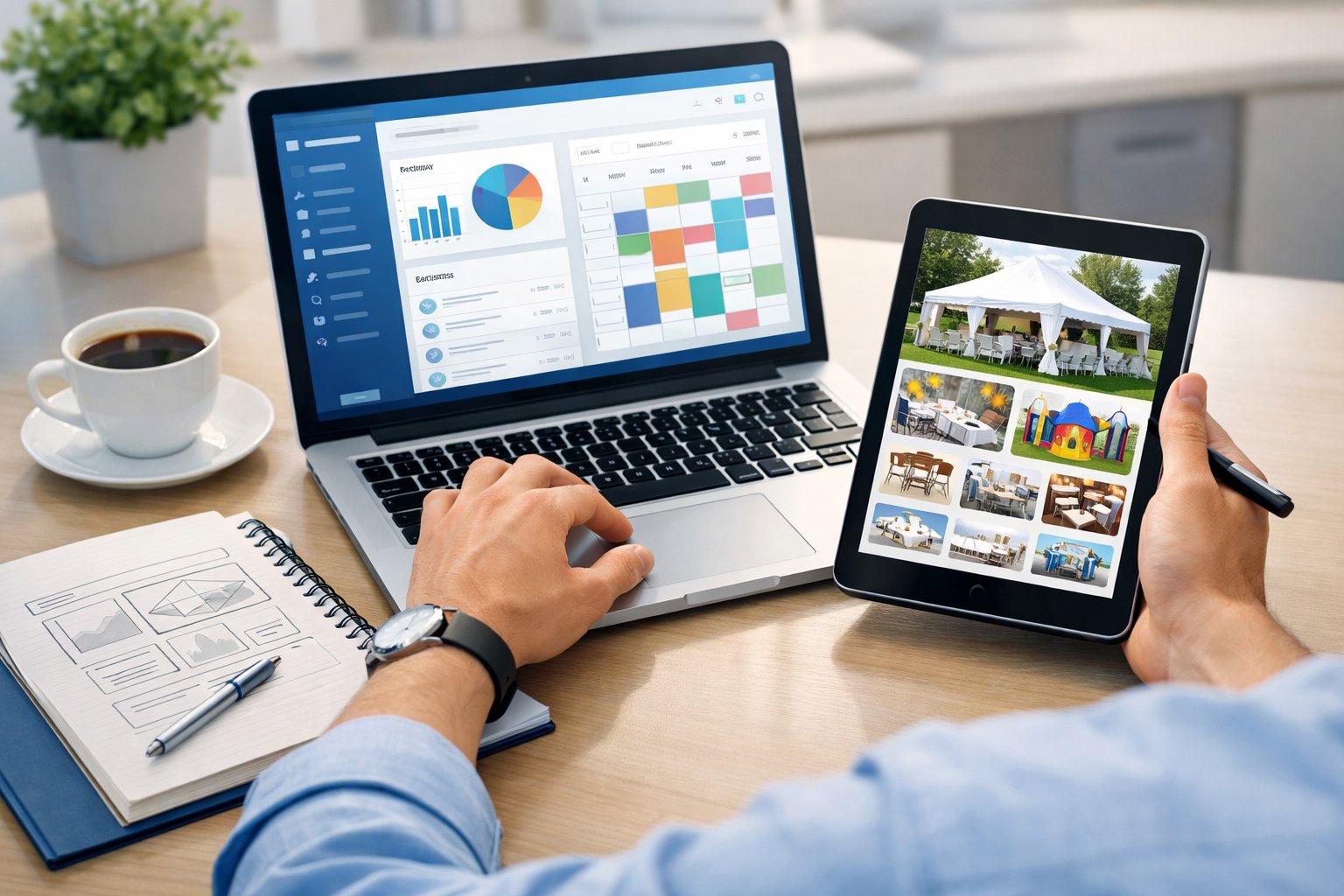
Rental software is the backbone of your business. It handles everything—inventory, bookings, payments, customer emails. Reservety's a solid choice, honestly, because it's built for party rentals and has real-time tracking and automated bookings.
Look for these features:
- Real-time inventory calendar (no double-bookings, please)
- Automated payments and invoices
- Customer database and messaging tools
- Damage waiver and contract management
- Reporting and analytics (so you actually know what's working)
Most rental software runs $25–$200 per month, depending on how much you use it and what you need. Use a startup cost calculator to figure out what fits your budget.
Your website should show off your inventory with great photos and clear pricing. The event rental industry is projected to hit $6.3 billion by 2026, so having a strong online presence isn't optional anymore.
Pick party rental software that either builds your website or plays nicely with whatever site you already have. That way, you're not juggling two separate systems.
Set up online booking so people can reserve gear 24/7—no more waiting on emails or calls. Add a rental pricing calculator so customers can get instant quotes. Let them check availability, pick delivery, and pay on your website. Makes life easier for everyone.
Set Your Pricing Strategy
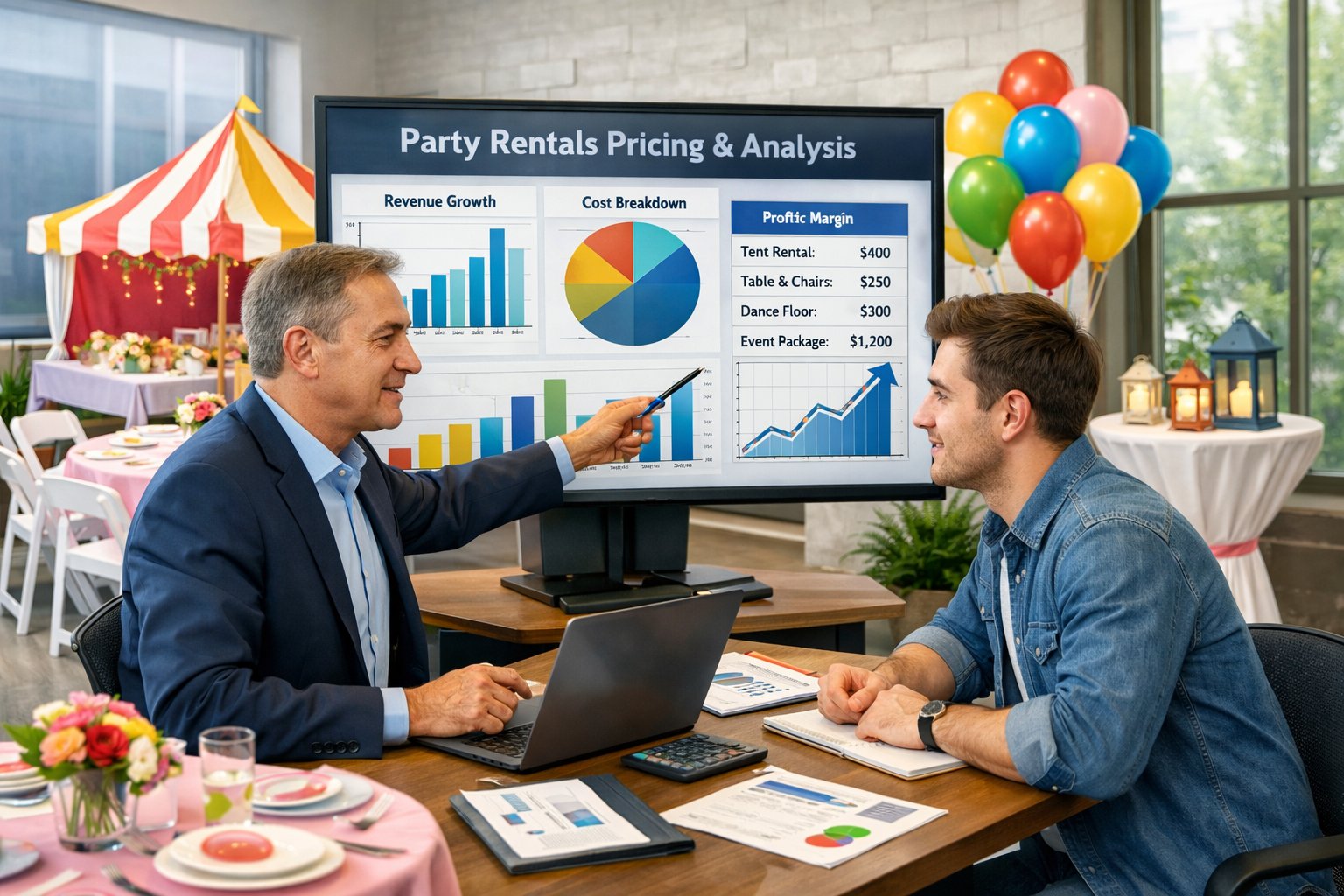
Get your pricing wrong and you'll struggle to turn a profit—set it right, and you're off to a great start. You need a plan that covers your costs, fits your market, and leaves room for real profit.
The 10x Rule is a good place to start: buy a folding chair for $30, rent it out 10 times at $3 each, and you've covered your cost and made something extra. Use a rental pricing calculator to speed up the math.
Figure out the real cost per item:
- Purchase price and shipping
- Delivery and pickup labor
- Cleaning and supplies
- Storage space
- Insurance and replacement savings
The 10x rule works well for basics like chairs and tables. Higher-maintenance items, like linens, need more—maybe 15–20% of the purchase price per rental, since you'll be washing and pressing them every time.
Definitely check out what your competitors are charging, but don't just copy them. Your service, delivery, and condition might justify charging a little more.
Aim for a 20–40% profit margin above your base costs. Remember to factor in admin time, slow seasons, and how often each item will actually go out. A bounce house that rents 30 times a year lets you charge less per rental than a rare specialty piece.
Rental management software like Reservety can track what's making you money and help you tweak your prices based on real numbers. And if you want to see how much cash you'll need upfront, try out a startup cost calculator before you lock in your rates.
Market Your Business
Getting steady bookings means putting yourself in front of customers wherever they're already looking. Focus on Google, social media, and local partnerships to keep your calendar full.
You want your business to pop up when someone types "party rentals near me" or "bounce house rental [your city]." Start by claiming your Google Business Profile and filling out every bit of info you can. Add crisp photos, reply to reviews (even the tough ones) within a day, and post weekly updates about what's available or any deals.
Google Ads can get you bookings fast if you target the right keywords. Plan for $500–$1,000 a month for local ads—think "table rental," "tent rental," or "inflatable rental" plus your city. Expect to pay $2–$8 per click depending on how crowded your local market is.
Your website should load fast and let people browse and book without hassle. Make sure every page lists product details, prices, and delivery areas. Use party rental software like Reservety to handle online bookings, payments, and confirmations. And before you spend big on ads, check your actual startup costs with a startup cost calculator so you don't overspend.
Social
Facebook and Instagram are pretty much a no-brainer for party rentals—they're made for visual stuff. Try to post real event photos and videos at least 3 or 4 times a week. Show your gear in action, not just lined up in your storage space. Nobody wants to see a lonely bounce house waiting in a warehouse, right?
If you're running Facebook ads, target parents ages 25-45 within about 15 miles of your delivery zone. A $300 monthly budget split between carousel ads (showing off your different rentals) and short video ads (think bounce houses, full setups) is a solid starting point. Use event targeting to zero in on people interested in birthdays or weddings.
Ask your customers to tag you in their event pics. With their permission, repost those—it's the best kind of social proof. Toss up some simple reels: maybe a timelapse of a setup, a peek at equipment features, or some behind-the-scenes chaos. Local hashtags like #[YourCity]Events or #[YourCity]Parties help more people stumble onto your stuff.
Jump into local Facebook groups for parents, party planners, or community happenings. But don't just drop promos—actually participate, answer questions, and only mention your services when it makes sense. Nobody likes a spammer.
Partnerships
Building good relationships with venues, planners, photographers, caterers, and DJs can really move the needle. Offer a 10-15% referral commission for every booking they send your way. Print up some nice referral cards for them to hand out.
Reach out to schools, churches, and corporate event folks directly to pitch becoming their go-to rental company. Offer special rates for recurring or bulk bookings. A lot of these groups will book 5-20 events a year and honestly, they'd rather just call one reliable vendor.
Stop by local businesses—party supply shops, bakeries, entertainment venues. Drop off some brochures and business cards. If you can, sponsor community events like school fundraisers or charity festivals by donating some gear. It's great goodwill, and your name gets in front of a ton of new people.
Set up your rental pricing calculator so you can whip up custom package quotes for partners who send you multiple clients. Keep an eye on which partnerships actually bring in money, and double down on those.
Manage Deliveries And Operations
Getting deliveries and operations dialed in is huge for both profits and happy customers. You'll need a system to track when stuff leaves your warehouse, arrives at the venue, and comes back for cleaning and repairs.
Essential Delivery Planning Steps:
- Schedule deliveries in 30-60 minute windows to allow for traffic and setup hiccups
- Plan your routes every day to save on gas (which can easily hit $150-300/month for local gigs)
- Use two-person crews for bigger stuff—tents, staging, anything heavy or awkward
- Snap photos of gear before and after each rental to document condition
Choosing your delivery vehicle is a big deal. A new cargo van runs $25k-$40k, box trucks even more ($35k-$60k). Most folks start with a used cargo van around $15k to keep startup costs from getting out of hand.
Calculate your startup costs so you don't blow your budget on vehicles and gear. Seriously consider party rental software like Reservety to handle scheduling, track inventory, and spit out delivery lists.
Critical operational tasks include:
- Inspecting returns within 24 hours so you spot damage right away
- Keeping strict cleaning routines between rentals to keep gear looking sharp
- Having backup plans for vehicle breakdowns or bad weather
- Training staff on loading so you don't end up with $500-$2,000 in broken gear each time someone rushes
Keep tabs on your delivery costs per order—ideally, you want them at 10-15% of the rental's value. If you're spending $100 to deliver and pick up a $500 rental, that's 20%—time to tweak your pricing or plan better routes.
Scale And Grow
Growth really comes when you reinvest profits into the stuff people rent the most. Track what's constantly booked and buy more of those first. If your 10 round tables are out every weekend, grab 10 more before you even think about adding new categories.
Strategic expansion usually looks something like:
- Months 1-6: Use starter inventory, iron out your process, get your name out locally
- Months 7-12: Add things customers keep asking for (linens for tables, tent lighting, etc.)
- Year 2: Branch into related niches or get another delivery vehicle
- Year 3+: Maybe expand your service area or start offering specialty gear
Most successful party rental businesses see 20-30% annual growth by following actual customer demand—not just guessing.
Once you get past about 50 rentals a month, you'll need software. Spreadsheets will start causing double-bookings and inventory headaches. Reservety and similar tools handle reservations, inventory, and customer messages all in one dashboard.
You'll probably hire your first helper when delivery/setup eats up more than 20 hours a week. Start with part-time weekend help. Pay rates vary, but $15-20/hour is typical.
Marketing gets more serious as you grow—word-of-mouth only goes so far. Plan to spend 5-10% of monthly revenue on Google Ads and Facebook, targeting local event planners. A $300-500 monthly ad budget should get you in front of plenty of new clients.
Use the startup cost calculator before buying more gear. As your inventory grows, test your pricing with a rental pricing calculator so you're not accidentally shrinking your margins.
Honestly, it's worth investing in party rental software that can grow with you. Rebuilding your system later is a pain.