
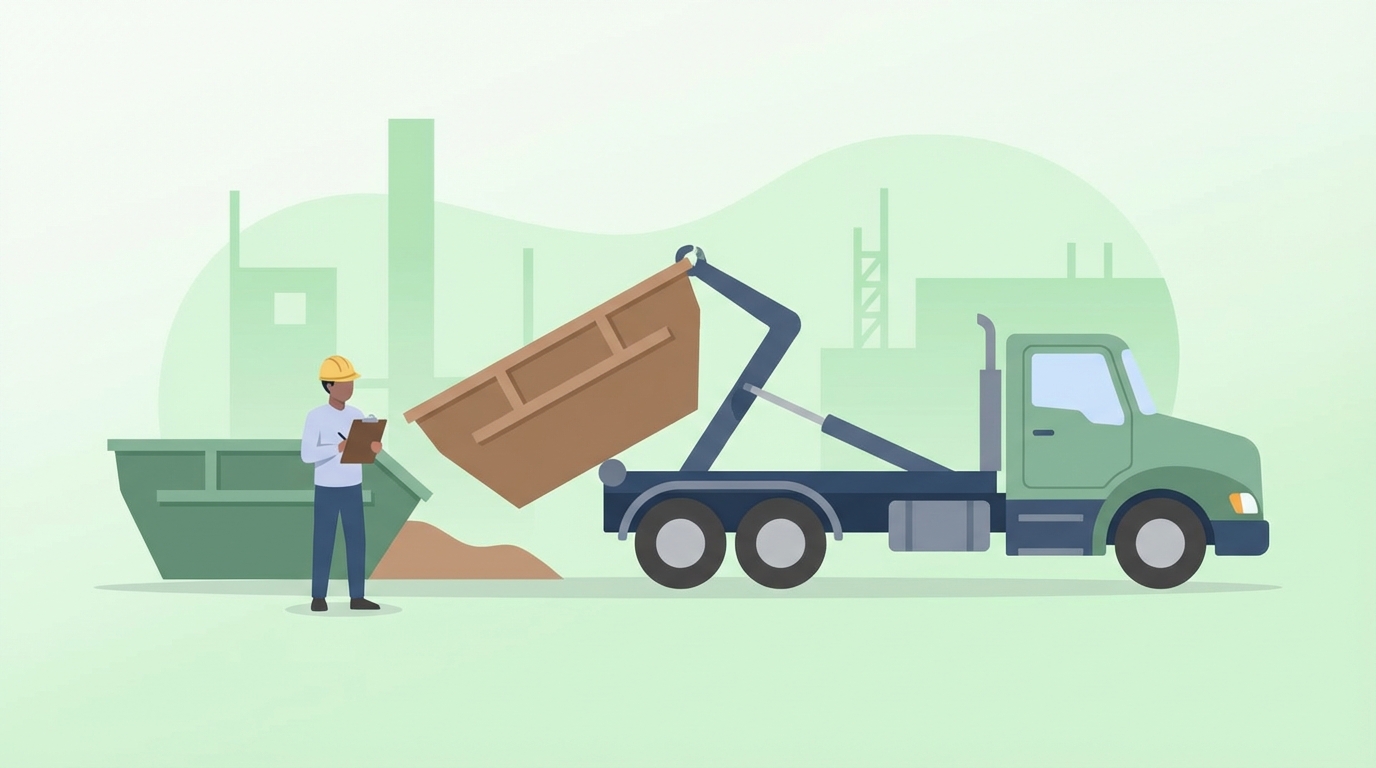
A dumpster rental business provides roll-off containers to construction sites, renovation projects, and cleanup jobs. Customers rent dumpsters for 3-14 days, you deliver and pick up with a hook-lift or roll-off truck. It is a capital-intensive but highly profitable business - operators typically earn $300-$600 net profit per dumpster per haul with utilization rates of 60-80%.
Starting a dumpster rental business is one of the more straightforward paths into the waste and construction services industry. The business model is simple: buy containers, buy a truck to move them, charge customers a flat rate that covers your disposal costs and leaves a healthy margin. There are no storefronts to lease, no employees required on day one, and demand is steady year-round.
This guide walks through the seven steps to get your first dumpster on a job site - from choosing the right truck to setting prices that actually make money. We will cover real costs at every stage so you know exactly what you are getting into before you write a check.
Is a Dumpster Rental Business Profitable?
Yes, and the margins are better than most service businesses. A single dumpster haul - deliver, let the customer fill it for a week, pick it up, dump the load - generates $300-$600 in net profit after disposal fees, fuel, and wear-and-tear costs. That is per haul, not per month.
Run the math on a small operation. With 10 dumpsters averaging 3 hauls per month each at $400 net profit per haul, you are looking at $12,000/month in profit. With 20 dumpsters at the same utilization rate, that doubles to $24,000/month. These numbers assume 60-70% utilization, which is conservative for an established operator in a decent market.
Demand is recession-resistant because the work that generates dumpster rentals does not stop. New construction slows during downturns, but renovation projects, estate cleanouts, storm cleanup, roofing jobs, and commercial tenant improvements continue regardless of economic conditions. Homeowners still remodel kitchens. Roofs still need replacing. Trees still fall down in storms.
The businesses that struggle are the ones that overspend on equipment before they have customers, or underprice because they did not calculate their true disposal costs. Both mistakes are avoidable with the right planning.
What You Need to Get Started
Every dumpster rental business needs three things before it can take its first order:
- A truck capable of loading, hauling, and unloading roll-off containers. This is your single largest expense.
- Dumpsters - the actual containers you rent out. You need at least 3-5 to start.
- Disposal access - an account at a landfill or transfer station where you can dump loads at a negotiated per-ton rate.
Everything else - insurance, licensing, a website, marketing - layers on top of those three essentials. Get the truck, the dumpsters, and the disposal account sorted first, and the rest falls into place.
Step 1: Choose Your Truck
Your truck is the engine of the business. Without it, your dumpsters are expensive metal boxes sitting in a yard. There are two main options: hook-lift trucks and roll-off trucks.
Hook-lift trucks
A hook-lift truck uses a hydraulic arm to load and unload containers. The arm hooks onto a bar at the front of the dumpster and slides it onto the truck bed. Hook-lifts cost $80,000-$150,000 new or $30,000-$60,000 used.
Hook-lifts are the better choice for startups for several reasons. Many models fall under 26,001 lbs GVWR, which means you do not need a CDL to operate them in most states. The truck can haul flatbeds, storage containers, and other equipment beyond just dumpsters, which gives you revenue flexibility. They are also easier to maneuver in tight residential driveways and narrow job sites.
Roll-off trucks
A roll-off truck uses a cable winch or hook system on a tilting bed to slide containers on and off. These are the large trucks you see at construction sites. Roll-off trucks cost $100,000-$200,000 new or $40,000-$80,000 used.
Roll-off trucks are the industry standard for larger operations. They handle 30-yard and 40-yard containers better than hook-lifts, and loading/unloading is faster with experienced operators. The trade-off is that most roll-off trucks require a CDL, the purchase price is higher, and the truck is purpose-built for hauling containers only.
CDL requirements vary by state. The federal threshold is 26,001 lbs GVWR, but some states have additional requirements. Check your state's DMV or DOT website before purchasing. Many hook-lift operators specifically choose trucks that stay under the CDL threshold to avoid the licensing requirement, medical card renewals, and DOT inspections that come with a commercial license.
For most startups, a used hook-lift truck in the $35,000-$50,000 range is the practical choice. It gets you on the road without six figures of debt, and you can upgrade to a roll-off when volume justifies it.
Step 2: Buy Your First Dumpsters
Dumpsters come in standard sizes measured in cubic yards. Each size serves different project types and customer needs. Here is what each size costs and where it fits:
| Size | Cost (New) | Best For |
|---|---|---|
| 10-yard | $3,500-$5,000 | Residential cleanouts, small renovations, garage cleanups |
| 15-yard | $4,000-$5,500 | Mid-size projects, single-room remodels, roofing (small home) |
| 20-yard | $4,500-$6,000 | Most popular - construction, renovation, large cleanouts |
| 30-yard | $5,500-$7,500 | Large construction, commercial projects, whole-house renovations |
| 40-yard | $6,500-$9,000 | Commercial demolition, large construction, industrial |
The recommended starter inventory is 3-5 dumpsters with a mix of sizes. A practical first order might be two 10-yard, one 15-yard, and two 20-yard containers. This covers the most common residential and light commercial jobs without requiring the larger truck capacity that 30-yard and 40-yard containers demand.
The 20-yard dumpster is the workhorse of the industry. It is large enough for most construction and renovation projects but small enough for residential driveways. If you could only buy one size, buy 20-yard containers.
Buy from a manufacturer, not a reseller. Companies like Wastequip, Galbreath, and Iron Container sell direct. Used dumpsters are available but inspect them carefully - rust, bent rails, and damaged hook points create safety issues and shorten the container's useful life.
Step 3: Secure Disposal Access
Every load you pick up needs somewhere to go. You need accounts at one or more landfills or transfer stations in your service area. This is not optional, and the terms you negotiate directly affect your profit margin on every haul.
Disposal fees typically run $40-$80 per ton depending on your region, the type of waste, and whether you are using a landfill or transfer station. Some markets are higher - parts of the Northeast and West Coast can exceed $100/ton. Rural areas with less competition among disposal sites may have limited options but often lower rates.
There are several ways to reduce your disposal costs:
- Negotiate volume discounts. Landfills want consistent business. Committing to a minimum number of loads per month often gets you a better per-ton rate.
- Separate recyclable materials. Clean concrete, metal, and wood often have lower disposal rates at recycling facilities than mixed waste at landfills. Some recyclables even generate revenue.
- Establish accounts at multiple facilities. Having options means you can route loads to the cheapest disposal point based on the waste type and location of the pickup.
- Weigh loads before disposal. Knowing your actual tonnage prevents overpaying on flat-rate disposal and helps you set accurate overage fees for customers.
Call every landfill and transfer station within a reasonable driving radius of your service area. Get their rate sheets, ask about volume pricing, and understand their accepted materials. Some facilities refuse certain waste types (tires, mattresses, hazardous materials), and you need to know this before you quote a customer.
Step 4: Get Licensed and Insured
The licensing and insurance requirements for a dumpster rental business are straightforward, but skipping any of them creates serious liability exposure.
Business registration
Form an LLC. It separates your personal assets from business liability, which matters in an industry where a dumpster could damage a driveway, a truck could be involved in an accident, or a customer could claim injury at a job site. LLCs are inexpensive to set up ($50-$500 depending on your state) and protect you from personal liability.
Insurance requirements
- Commercial auto insurance - required for the truck. Costs vary based on vehicle value, driver history, and coverage limits, but expect $3,000-$8,000/year.
- General liability insurance - covers property damage and injury claims. Carry at least $1,000,000 per occurrence. Many commercial customers and municipalities require proof of general liability before they will hire you. Expect $1,500-$4,000/year.
- Inland marine insurance - covers your dumpsters while they are on customer sites. Optional but smart, since containers sitting on job sites for days are exposed to theft, vandalism, and damage from third parties.
Permits and regulatory requirements
- Business license - required in most cities and counties. Apply through your local government.
- DOT number - required if your truck crosses state lines for commercial purposes. Register through the FMCSA.
- Environmental permits - some jurisdictions require waste hauler permits. Check with your state environmental agency.
- CDL - required if your truck exceeds 26,001 lbs GVWR. Factor in the time and cost of obtaining one if your chosen truck requires it.
Step 5: Set Your Pricing
Dumpster rental pricing has three components: the base rental rate, an included tonnage allowance, and a rental period. Customers pay the base rate upfront. If their load exceeds the included tonnage, they pay an overage fee per ton. If they keep the dumpster past the included rental period, they pay a daily extension fee.
Here are typical price ranges by dumpster size:
| Size | Base Rate | Included Weight | Rental Period |
|---|---|---|---|
| 10-yard | $300-$400 | 1-2 tons | 7 days |
| 15-yard | $350-$475 | 2-3 tons | 7 days |
| 20-yard | $400-$550 | 2-3 tons | 7 days |
| 30-yard | $500-$700 | 3-4 tons | 7-10 days |
| 40-yard | $600-$850 | 4-5 tons | 7-10 days |
- Overage fee: $50-$80 per ton over the included weight allowance
- Extended rental: $10-$20 per day after the included rental period
To set your actual prices, start with your costs and work backward. Calculate your disposal cost per ton, fuel cost per delivery and pickup, truck payment per haul, and insurance cost per haul. Add those up, add your target profit margin, and you have your base rate. Then check competitor pricing in your market to make sure you are in a reasonable range.
Do not compete on price alone. Reliability, responsiveness, and same-day or next-day delivery win more business than being $25 cheaper. Contractors call the company that answers the phone and delivers on time, not the one with the lowest rate on a website.
Step 6: Build Your Online Presence
Most dumpster rental customers start with a Google search. "Dumpster rental near me" and "dumpster rental [city name]" are the two highest-volume search queries in this industry. If you do not have a website, you do not exist to these customers.
Your website needs three things to convert searchers into paying customers:
- Online ordering - let customers select a dumpster size, choose delivery and pickup dates, and pay online. Phone calls work, but online ordering captures customers at 10 PM when they are planning tomorrow's project. The businesses that take orders 24/7 get more bookings than those limited to phone hours.
- A dumpster size guide - most customers do not know whether they need a 10-yard or 20-yard container. A visual size guide with photos and project examples reduces phone calls asking "which size do I need?" and helps customers order confidently without calling you.
- Google Business Profile - claim and optimize your Google Business Profile with your service area, hours, photos of your trucks and dumpsters, and customer reviews. This is free and drives more local leads than any other single marketing channel.
You do not need to spend weeks building a website from scratch. The right dumpster rental software gives you an online booking system, inventory management, and a professional storefront without hiring a developer. Use our startup cost calculator to estimate your full launch budget including website and marketing costs.
Let Reservety build your dumpster rental website
Our concierge team builds your complete booking site during the free trial - dumpster catalog, availability calendar, online payments, and delivery scheduling included.
Start Free TrialStep 7: Get Your First Customers
You have the truck, the dumpsters, the permits, the insurance, the pricing, and the website. Now you need to fill those containers. Here are the channels that work for new dumpster rental businesses:
Contractor relationships
General contractors, roofing companies, remodeling firms, and demolition crews use dumpsters on nearly every job. Visit construction sites in your area, introduce yourself, and leave a card. Offer reliable next-day delivery, competitive rates, and easy reordering. One busy contractor can fill your schedule alone. A dozen contractor relationships and you will have more work than you can handle.
Google Ads
Pay-per-click advertising on "dumpster rental [your city]" puts you at the top of search results immediately. You do not need to wait for SEO to kick in. Start with a small daily budget ($20-$50/day), target your service area only, and track which keywords convert to actual bookings. The cost per lead in dumpster rental typically runs $15-$40 depending on your market's competitiveness.
Yard signs on placed dumpsters
Every dumpster sitting on a job site is a billboard. Put your company name, phone number, and website URL on every container in large, readable text. Neighbors see the dumpster, realize they need one for their own project, and call you. This is free advertising that scales with your business.
Community channels
Post your services on Nextdoor, local Facebook groups, and neighborhood community boards. Homeowners planning cleanouts, renovations, and landscaping projects are active in these channels. A simple post explaining your services and pricing generates leads at zero cost.
Property manager and realtor partnerships
Property managers need dumpsters for tenant turnover cleanouts. Realtors need them for estate cleanups before listings go live. Both are repeat customers who can send you steady, predictable work. Reach out to property management companies and real estate offices in your area.
Startup Cost Summary
Here is what it actually costs to start a dumpster rental business, from bare minimum to a more comfortable launch:
| Item | Low End | High End |
|---|---|---|
| Truck (used) | $30,000 | $80,000 |
| Dumpsters (5 units, mixed sizes) | $17,500 | $30,000 |
| Insurance (first year) | $4,500 | $12,000 |
| LLC + licenses + permits | $500 | $2,000 |
| Website + software | $700 | $2,000 |
| Initial marketing (signs, cards, ads) | $1,000 | $4,000 |
| Working capital (fuel, disposal, repairs) | $5,000 | $15,000 |
| Total | $59,200 | $145,000 |
The wide range reflects the difference between buying a $30K used hook-lift with 5 basic containers versus a $80K used roll-off truck with larger, higher-quality dumpsters and a bigger marketing budget. Most operators land somewhere in the $50,000-$100,000 range for a functional startup.
Financing is available for both trucks and dumpsters. Commercial equipment loans typically require 10-20% down with 3-7 year terms. Some manufacturers offer in-house financing on container purchases. The monthly payments on financed equipment should be covered by 2-3 hauls per month, leaving the remaining revenue as profit.
Common Mistakes to Avoid
- Buying too many dumpsters before proving demand. Start with 3-5 containers. If they are all rented consistently, buy more. Sitting on 15 dumpsters with no customers means $75,000+ in idle inventory depreciating in your yard.
- Underestimating disposal fees. Disposal is your largest variable cost. If you price a 20-yard rental at $400 and the customer fills it with 4 tons of debris at $70/ton, you just spent $280 on disposal alone before fuel and truck costs. Know your disposal rates cold before setting prices.
- Not weighing loads before disposal. Landfills charge by the ton. If you do not weigh your loads, you are guessing at your costs and cannot accurately bill overage fees. Many landfills have scales on-site, but you should know your load weight before you get there.
- Pricing without knowing competitor rates. Call every dumpster rental company in your service area and get quotes for 10-yard and 20-yard rentals. This takes an afternoon and gives you the pricing floor and ceiling for your market. Pricing blind is pricing wrong.
- Skipping the online presence. A dumpster rental business without a website is invisible to the majority of potential customers. At minimum, you need a Google Business Profile and a basic website with your services, sizes, prices, and a phone number or online ordering.
- Buying a truck that is too big or too expensive for startup volume. A brand-new $180K roll-off truck does not generate more revenue than a $40K used hook-lift when you have 5 dumpsters and 10 customers. Match your equipment investment to your current volume, not your five-year goal.