
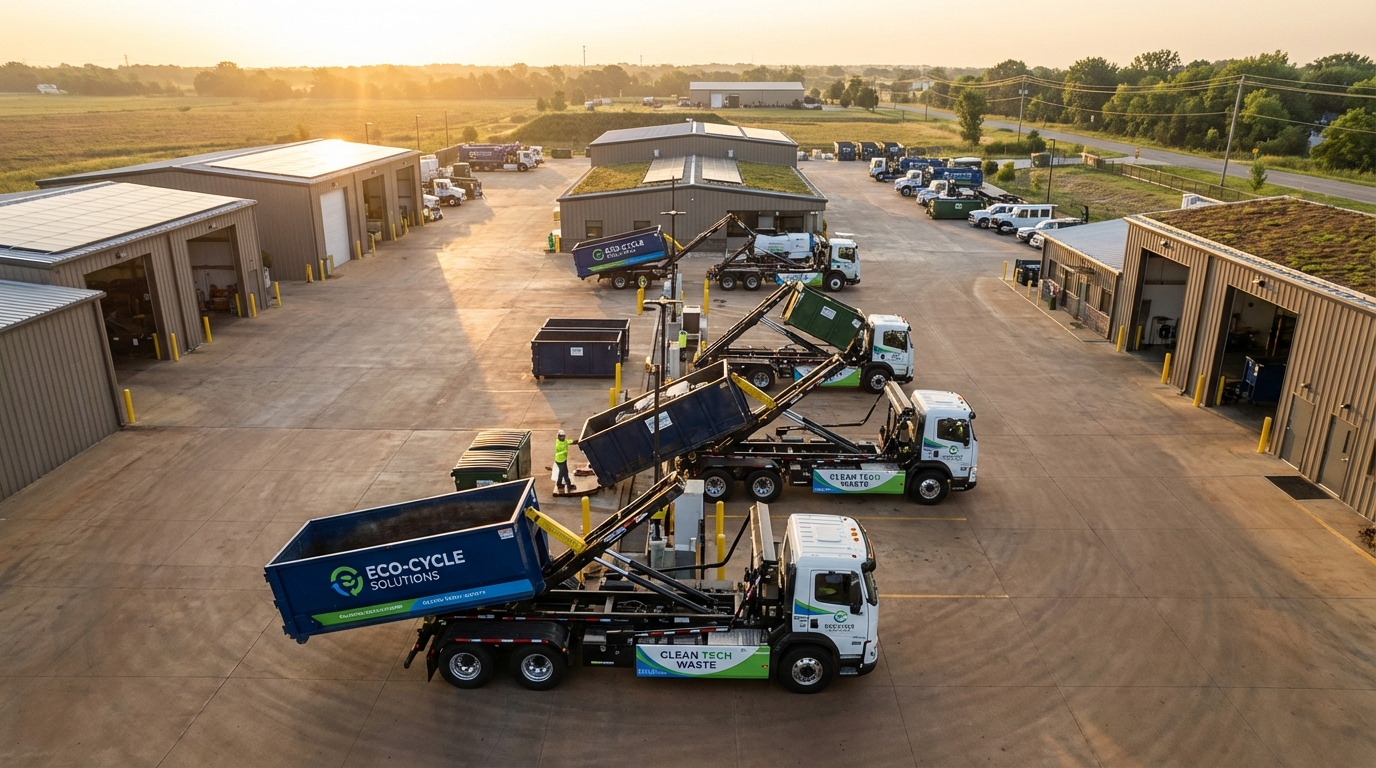
Running a roll-off dumpster rental business means juggling driver schedules, container inventory, delivery windows, pickups, swaps, and billing - often from a truck cab or a cramped office. Spreadsheets and whiteboards work until they don't, and most operators hit that wall somewhere between 3 and 10 trucks.
Dumpster rental software replaces that patchwork with a single system: orders come in online, dispatch happens on a map, drivers get routes on their phones, and invoices go out automatically. The right platform saves hours every day. The wrong one costs you months of migration headaches and a contract you can't escape.
This guide covers 9 platforms worth evaluating in 2026. Each entry includes what the software actually does, who it's built for, and what it costs (when the vendor discloses pricing). Reservety leads the list for independent operators, but every option here solves a different problem - so read the full breakdown before making a decision.
1. Reservety

Reservety is a rental management platform that handles dumpster operations alongside trailers, equipment, and other rental verticals. It runs on flat monthly pricing - $59 or $99 per month - with zero commission on bookings. That pricing stays the same whether you process 10 orders a month or 200.
The standout feature for dumpster operators is the concierge onboarding: Reservety's team builds your entire booking website as part of setup. You get a professional, SEO-optimized storefront where customers can see container sizes, check availability by date, and book online without calling. For a one-truck operator who's been running on phone calls and a clipboard, this eliminates the biggest barrier to taking online orders.
The platform includes real-time inventory tracking (know which dumpsters are on-site, in transit, or available), automated booking confirmations via email and SMS, payment processing through Stripe and Square, delivery zone pricing, and add-on charges for overweight or extended rental periods. Reporting dashboards show revenue by container size, utilization rates, and customer history.
Best for: Independent operators with 1-15 trucks who want predictable costs and a done-for-you website. Particularly strong for businesses transitioning from phone-only booking to online ordering.
Pricing: $59/mo (Standard) or $99/mo (Pro). No per-transaction fees. Free 14-day trial.
2. Docket (by ServiceCore)
Docket ranks #1 on Google for "dumpster rental software" and positions itself as the market leader for roll-off operations. It was founded in 2019 in Dayton, Ohio by Brian Ingle and Dan Klimkowski, then acquired by ServiceCore in May 2023. The two brands now share infrastructure, with Docket focused on roll-off and dumpster rental while ServiceCore covers portable sanitation.
The platform operates as a full ERP: order entry, scheduling, dispatching with real-time routing, billing, payments, driver mobile app, asset tracking, and QuickBooks integration. Docket claims to have processed over $400 million in customer revenue and publishes annual benchmark reports with industry data.
Pricing follows a per-truck model. You pay based on the number of trucks actively on the road - office staff don't count. Exact rates aren't published; you'll need a sales demo to get a quote. Based on industry comparisons, expect costs in the $150-250+ per truck per month range, which adds up quickly for larger fleets.
Best for: Mid-size to large roll-off operations (10+ trucks) that want enterprise-grade features and can justify the higher per-truck pricing. The ServiceCore backing means long-term stability and continued development.
Pricing: Per-truck pricing (Grow and Pro tiers). Contact sales for a quote.
3. DSQ Hauler
DSQ Technology was founded in Pittsburgh by brothers Charlie and Brian Dolan, who previously built and sold Sequoia Waste Solutions (a waste brokerage they ran from 2011 to 2022). They developed internal dispatch and management tools for their own hauling operation, then productized them as DSQ Hauler in 2020.
That operator background shows in the feature set. Hauler covers order entry, driver dispatching, real-time routing, dumpster inventory management, recurring schedules, invoicing, payments, and reporting. It includes two-way SMS and email messaging with customers, iOS and Android driver apps, and QuickBooks Online integration.
The pricing model is the simplest in the market: $99/month flat, unlimited drivers. No per-truck charges, no per-user seats, no transaction fees. There's a free 14-day trial with no credit card required. Every account gets a dedicated Client Success team member, which is unusual at this price point.
DSQ also builds adjacent products: DSQ Discovery (invoice automation for waste brokerages), DSQ Pioneer (compactor monitoring sensors), and DSQ Tilt (container sensors). These suggest the company is investing in the waste/hauling vertical long-term, not just selling software.
Best for: Small to mid-size dumpster rental operators who want full-featured software without per-truck pricing. The flat rate makes costs predictable regardless of fleet growth.
Pricing: $99/month flat, unlimited drivers. Free 14-day trial.
4. Dumpster Rental Systems (DRS)
DRS is an all-in-one dumpster rental and hauling platform based in Cedar Park, Texas. It's been around longer than most competitors on this list and has built a loyal following among established haulers.
The feature list covers the essentials: online booking with automatic job creation (including overnight orders), dispatch and routing with real-time updates, inventory management organized by container size and category, billing with cards on file, and a driver app for iOS and Android. DRS also offers its own payment processing service called DRSPay.
Where DRS stands apart is customizable per-client pricing. If your business runs on negotiated rates and Master Service Agreements (MSAs) with contractors, property managers, or commercial clients, DRS handles that pricing complexity natively. You can set different rates for different customers without workarounds or manual overrides.
Pricing isn't published. You'll need to contact their sales team for a personalized quote. Based on market positioning, expect mid-range pricing - likely $200-400/month depending on features and fleet size.
Best for: Established haulers doing significant B2B or commercial work with negotiated rates per client. The MSA pricing support is a genuine differentiator for businesses with complex billing needs.
Pricing: Contact sales for a personalized quote.
Need a simpler setup?
Reservety builds your dumpster rental website and booking system for you. $59/mo, zero commission, and your customers can book online in minutes.
Start Free Trial5. TrashLab
TrashLab calls itself "the operating system for waste haulers" and backs that up with the most technically ambitious feature set on this list. Built by a Silicon Valley team in collaboration with 100+ haulers, the platform covers commercial, residential, roll-off, portable toilet, storage containers, and junk removal operations.
The headline feature is an AI Order Taker that handles inbound phone orders automatically. A customer calls, the AI captures the order details, and the job lands in the dispatch queue without a human answering the phone. For operators who lose revenue to missed calls (especially after hours), this is a meaningful capability - assuming the AI handles the nuances of dumpster sizing, placement requirements, and pricing accurately.
Beyond the AI, TrashLab includes dispatch management, billing, route optimization, a driver app, customer portal, inventory tracking, and integrations with QuickBooks, Xero, and NetSuite. The company claims 15% revenue increases from online/digital sales, 20 hours saved per rep per week, and 5 gallons of fuel saved per truck per day.
Pricing isn't public. Given the enterprise-grade feature set and AI capabilities, expect premium pricing - likely $500-1,500/month or more depending on fleet size. This isn't budget software.
Best for: Mid-size to large waste haulers (multiple lines of business) who want cutting-edge technology and can invest in a premium platform. The AI Order Taker is genuinely novel in this space.
Pricing: Contact sales. Premium tier expected.
6. CurbWaste
CurbWaste was founded by Mike, who previously ran his own hauling business called Curbside. That firsthand experience shapes the product: it's built for the operational realities of running roll-off trucks rather than the theoretical workflows imagined by developers who've never dispatched a driver.
The platform covers order management, embedded online ordering (eCommerce widgets for your own website), inventory with live ETA tracking, a driver app (iOS and Android), automated invoicing with QuickBooks integration, and real-time dispatch with both map view and drag-and-drop scheduling boards. The Pro tier adds automated sales tax, dynamic pricing, and dumpsite reconciliation. Enterprise includes advanced reporting and admin controls.
CurbWaste has been selected as the exclusive operational management platform for the Recycling Certification Institute (RCI), which adds credibility in the compliance-focused segment of the industry. The company claims 15% more revenue from same-day orders, 5 hours saved weekly with real-time dispatching, and 20% cash flow improvement through automated payments.
Pricing runs across three tiers (Core, Pro, Enterprise) but exact costs aren't published. Payment processing fees are transparent: approximately 3.1% for credit cards and 1% or $15 for ACH, with volume discounts above $99K/month in processing.
Best for: Roll-off haulers who want software built by someone who actually ran a hauling business. The embedded eCommerce and RCI partnership add value for operators focused on online ordering and compliance.
Pricing: Three tiers (Core, Pro, Enterprise). Contact for pricing. Transparent payment processing fees.
7. ServiceCore
ServiceCore is the parent company behind Docket (listed separately above). While Docket focuses on roll-off dumpster rental, ServiceCore's core product serves portable toilet, septic, and temporary fencing businesses. After acquiring Docket in May 2023, the combined platform covers both sanitation and dumpster verticals.
For operators who run both portable toilet services and dumpster rentals (a common combination), ServiceCore offers the advantage of managing everything in one system. The platform includes job management, route optimization, inventory tracking, automated billing, scheduling, dispatch, field service management, and customer account tools.
ServiceCore has processed over 3.5 million jobs and tracks 550,000+ units across its customer base. The company is backed by Mainsail Partners (private equity), which means it has resources for continued development but also faces pressure to grow revenue - something to consider when evaluating long-term pricing stability.
Best for: Operators who run portable sanitation AND dumpster rental from the same business. If you're dumpster-only, Docket (or another option on this list) may be a better fit.
Pricing: Per-truck pricing, same model as Docket. Contact sales for a quote. 4.0/5.0 on Capterra with 51 reviews.
8. Bin Boss
Bin Boss is a newer entrant targeting small and startup dumpster rental operations. The value proposition is straightforward: $99/month flat rate, and they build you a free professional website as part of signup (they value the website at $1,500+).
Features include online booking, dumpster tracking with unique box numbers and real-time status updates (integrates with Samsara and Verizon Connect for GPS), dispatch management with drag-and-drop job assignment, and a driver app for iPhone and Android. One unusual feature is a local market pricing scanner that shows competitor rates by ZIP code - useful for operators trying to price their services competitively in a new market.
The company claims most customers are up and running in under 48 hours, which aligns with the simplicity of the platform. It's clearly optimized for speed-to-value rather than feature depth.
Best for: New or small dumpster rental businesses (1-5 trucks) who want the lowest barrier to entry. The free website and local pricing data are genuinely helpful for operators just getting started.
Pricing: $99/month. No contracts. Currently running a promo: $100 off the first three months.
9. Dispatcher.com
Dispatcher.com is the simplest tool on this list - which is either a strength or a limitation depending on what you need. Originally launched in 2014 as Thumbster Connect, it was acquired and rebranded in June 2021.
The platform has two components: a web app for scheduling, dispatching, GPS tracking, asset management, invoicing, and reporting, plus a mobile app for drivers that handles daily routes, communication, asset management, and work order completions. The map-based drag-and-drop dispatching interface is straightforward, and the real-time GPS tracking syncs through the mobile app without separate hardware.
It's not dumpster-specific. Dispatcher.com works for any asset rental and hauling operation: porta-potties, compactors, construction equipment, and roll-off containers. That versatility means the workflow isn't tailored to dumpster-specific needs (container swaps, weight-based billing, haul-off scheduling), but it covers the dispatch fundamentals well.
Best for: Small hauling businesses that need basic dispatch and scheduling without the complexity (or cost) of a full ERP. Also works if you rent multiple asset types beyond just dumpsters.
Pricing: Not published. Varies by number of users. Contact for a quote.
Dumpster Rental Software Comparison
| Software | Best For | Pricing | Key Differentiator |
|---|---|---|---|
| Reservety | Independent operators, 1-15 trucks | $59-$99/mo flat | Zero commission, concierge website build included |
| Docket | Mid-large roll-off fleets, 10+ trucks | Per-truck (contact sales) | Market leader, ServiceCore-backed, benchmark reports |
| DSQ Hauler | Small-mid operators wanting flat pricing | $99/mo flat, unlimited drivers | Founded by waste industry operators, dedicated CSM |
| DRS | B2B haulers with negotiated rates | Contact sales | Customizable per-client MSA pricing |
| TrashLab | Large multi-service haulers | Contact sales (premium) | AI Order Taker for phone orders |
| CurbWaste | Roll-off operators wanting operator-built software | 3 tiers (contact sales) | Built by a hauler, RCI-certified, embedded eCommerce |
| ServiceCore | Combined porta-potty + dumpster businesses | Per-truck (contact sales) | Covers sanitation + roll-off in one platform |
| Bin Boss | Startups and new operators | $99/mo flat | Free website included, local pricing scanner |
| Dispatcher.com | Basic dispatch needs, multi-asset haulers | Per-user (contact sales) | Simple two-component system, asset-type agnostic |
What to Look for in Dumpster Rental Software
Not every feature matters equally. Here's what actually impacts daily operations for most roll-off businesses:
Dispatch and Routing
This is the core of the software. You need drag-and-drop scheduling, map-based routing, and a driver app that works reliably on both iPhone and Android. Real-time GPS tracking is standard now - if a platform doesn't include it, move on. The difference between good and great dispatch software is how it handles same-day changes: a customer calls to move a pickup from Tuesday to Thursday, and the system should update the driver's route, send the customer a confirmation, and adjust the invoice without you touching three different screens.
Online Ordering
Customers expect to book online. The software should either provide a booking widget you can embed on your existing website, or build you a booking-enabled website from scratch. Look for container size selection, date/location picking, automatic pricing based on delivery zone, and upfront payment collection. Every order that comes in online is one fewer phone call to answer.
Container Tracking
Knowing where every dumpster is - on a job site, on a truck, or in the yard - prevents lost assets and missed pickups. Good platforms assign unique IDs to each container and track their status in real time. Some integrate with GPS hardware (Samsara, Verizon Connect) for physical location tracking; others track status through driver app check-ins.
Billing and Payments
Look for automated invoicing that triggers on pickup/haul-off, support for overweight charges and extended rental fees, cards on file for recurring customers, and QuickBooks integration if that's your accounting system. ACH payment support is increasingly important for commercial clients who pay by bank transfer rather than credit card.
Pricing Model
This is where the market splits sharply. Flat-rate platforms ($59-$99/mo) give you predictable costs as you grow. Per-truck platforms charge $150-300+ per active truck, so a 10-truck operation could pay $1,500-3,000/month or more. Neither model is inherently better, but understand what you'll pay at your target fleet size before committing.
Frequently Asked Questions
How much does dumpster rental software cost?
Prices range from $59/month (Reservety Standard) to $1,500+/month for enterprise per-truck platforms like Docket or ServiceCore. Budget options like DSQ Hauler and Bin Boss charge $99/month flat regardless of fleet size. Most mid-range platforms don't publish pricing and require a sales call. As a rule of thumb: flat-rate platforms favor small operators, while per-truck models work better for larger operations that need deeper feature sets.
Is dumpster rental a profitable business?
Yes, with strong margins once you get past the initial equipment investment. A single 20-yard dumpster can generate $300-500 per rental cycle (typically 7-14 days), and a well-run truck can service 4-8 containers per day. Operators with 3-5 trucks regularly report gross revenue of $30,000-80,000/month. The keys to profitability are route density (minimizing empty miles), utilization rate (keeping containers rented rather than sitting in the yard), and controlling disposal costs at the landfill.
Can I run a dumpster rental business without software?
You can - many operators start with spreadsheets, a phone, and a whiteboard. It works fine with 1-2 trucks and a manageable number of containers. The problems start when you have 50+ active containers, multiple drivers, and enough daily orders that manual tracking leads to missed pickups, double-bookings, or lost invoices. Most operators hit that pain point between 3 and 10 trucks.
What's the difference between per-truck and flat-rate pricing?
Per-truck pricing (used by Docket, ServiceCore) charges based on the number of trucks actively in your fleet. Add a truck, your bill goes up. Flat-rate pricing (Reservety at $59-99/mo, DSQ Hauler and Bin Boss at $99/mo) stays the same regardless of fleet size. For a 5-truck operation, the difference can be $500-1,000/month - which adds up to $6,000-12,000/year.
Do I need a website to use dumpster rental software?
Not necessarily - most platforms work as standalone dispatch and billing tools. But having a website with online booking dramatically reduces phone calls and lets you capture orders 24/7. Reservety and Bin Boss include a professional website as part of their service. Other platforms offer embeddable booking widgets you can add to an existing site. If you don't have a website at all, prioritize a platform that builds one for you.