Use case · Golf cart rental

Keys in the hand

A six‑seat golf cart is booked online with a $25 deposit, and everything else happens at the counter: the renter scans a QR code, pays the balance, signs the rental agreement, and both sides sign the condition sheet before a key changes hands. Every screen below is the live system, in the order the shop actually touched it.

ORDER
#29099
RENTER
Marcus Webb
UNIT
GC6-01
OUT
Tue 22 Sep
BACK
Fri 25 Sep
PICKUP
Dauphin Island, AL

A golf cart shop on a barrier island has a specific problem. The money is easy — people book online weeks ahead. The risk is the ninety seconds at the counter: has this person paid the balance, have they signed the liability release, is anyone recording what the cart looked like before it drove away, and can you prove any of it six weeks later when a bumper turns up scratched.

Reservety puts that whole ninety seconds behind a QR code on the counter. The renter does their half on their own phone; staff do their half on the prepare screen; the condition sheet is signed by both, in that order, and the order will not move to Sent with a gap in it.

This page follows exactly one hire — order #29099 — through all of it. The cart is real inventory in the demo, the order is a real order paid through a real gateway, and every figure is a screenshot taken while the run was happening.

PART 00

How it is wired

Done once, before any renter sees the counter. Three settings carry the whole flow: the check‑in page itself, which documents are staff‑first, and when a physical cart gets attached to the booking.

0.1 The check‑in page, and the code that points at it

Store check‑in is a shortcode on an ordinary page. Point the setting at that page and the system prints the link and a QR code ready to laminate. The window is the part worth thinking about: twenty‑four hours either side of the rental start, so somebody arriving the evening before is recognised, and somebody arriving a week early is told when to come back rather than being told their booking cannot be found.

Store check-in settings showing a 24 hour window either side of the start, contract and balance required, security deposit not required, and a generated QR code beside the check-in link
The whole feature, configured. Contract and balance are required before a renter can announce themselves; the security‑deposit hold is switched off for this shop. The QR is generated from the link, so it can never point at the wrong page.

Worth knowing. Leaving Check‑in Page empty is quietly expensive. The QR panel stays blank, and a renter who pays the balance from the kiosk is returned to the ordinary thank‑you page instead of back to their checklist — so they have to find the counter code and look themselves up a second time. One field.

0.2 Documents that staff fill in first

Three documents are attached to golf cart hires: the rental agreement, a condition checklist at check out, and a condition checklist at return. The agreement is the renter’s alone. The two checklists are marked Staff fills first, then renter signs — an inspection nobody has carried out is not something to ask a customer to sign.
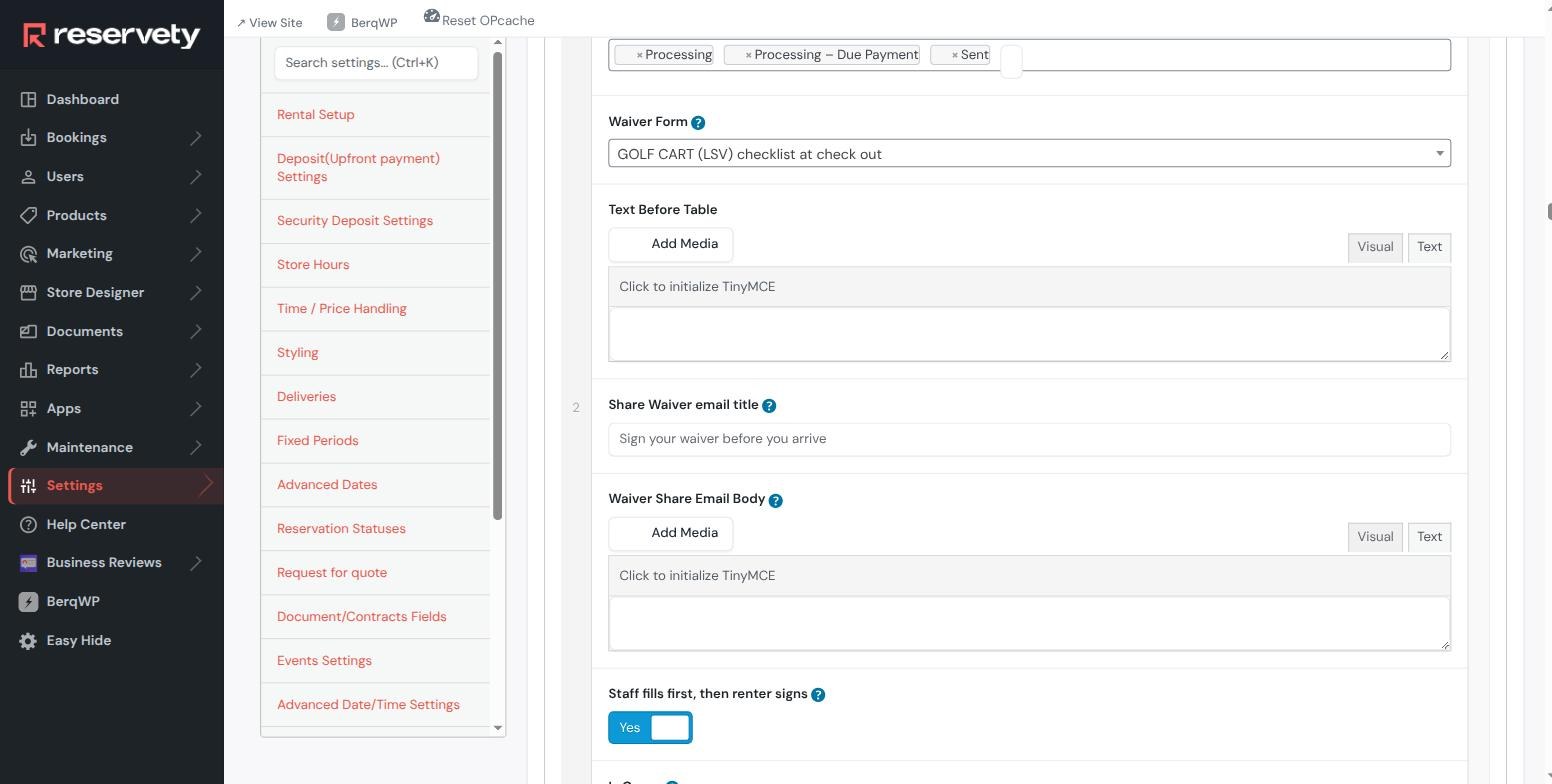
Document rule for the check-out checklist, mapped to the Processing, Processing Due Payment and Sent statuses, with Staff fills first then renter signs switched to Yes
The check‑out checklist rule. Note the statuses along the top: Processing, Processing – Due Payment and Sent. A document has to be mapped to the statuses on both sides of the transition it guards, or it stops applying halfway through the hand‑over and the renter’s signature is lost.

The setup trap. The return checklist is mapped to Sent and Returned for the same reason. Nothing blocks Mark as sent or Mark returned if you get this wrong — the paperwork simply goes quiet, which is worse than an error.

0.3 Which cart, and when it is decided

Twenty carts sit behind one bookable listing. Renters book “a 6‑seater”, never a specific one. The question is when a physical unit gets attached, and for a shop whose contract names the vehicle there is only one right answer: at check‑in, before the agreement is rendered.

Serial Selection dropdown on the golf cart product set to Auto - When the customer checks in at the store
Assigned at the counter. The alternatives are at checkout (weeks early, when you cannot know which cart is serviceable) or manually at hand‑over (too late for the paperwork). This setting picks the first free unit the moment the booking is found.
PART 01

Books online, pays a deposit

Three days over a long weekend, taken on the shop’s own site. The shop asks for a small non‑refundable deposit now and the rest at the counter.

1.1 Pick the days

The calendar is availability, not decoration — green is a day with a free cart on it, red is a day already gone or in the past. Twenty units behind one listing means the shop is only sold out when all twenty are out.
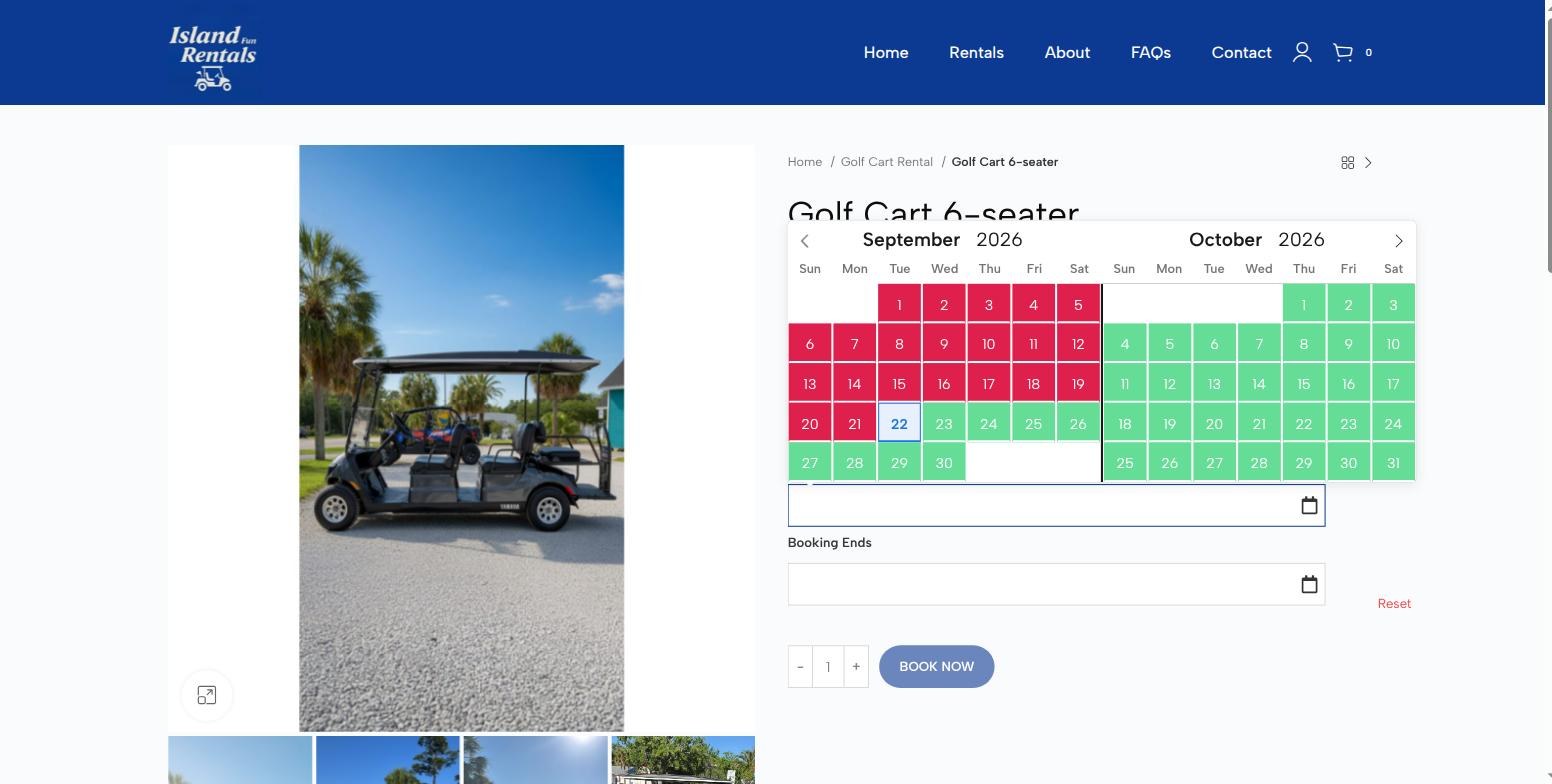
Golf Cart 6-seater product page priced at 150 dollars a day with a two-month availability calendar open
$150 the first day, $120 each day after. The two‑month calendar is drawn from live availability across the whole fleet.

1.2 Pay the deposit, not the lot

Three days comes to $390 plus $39 tax. At checkout the shop offers a choice, and the default is the deposit: $25 now, $404 at the counter. That is the number the kiosk will chase later, and it is why the order does not sit in plain Processing after checkout.
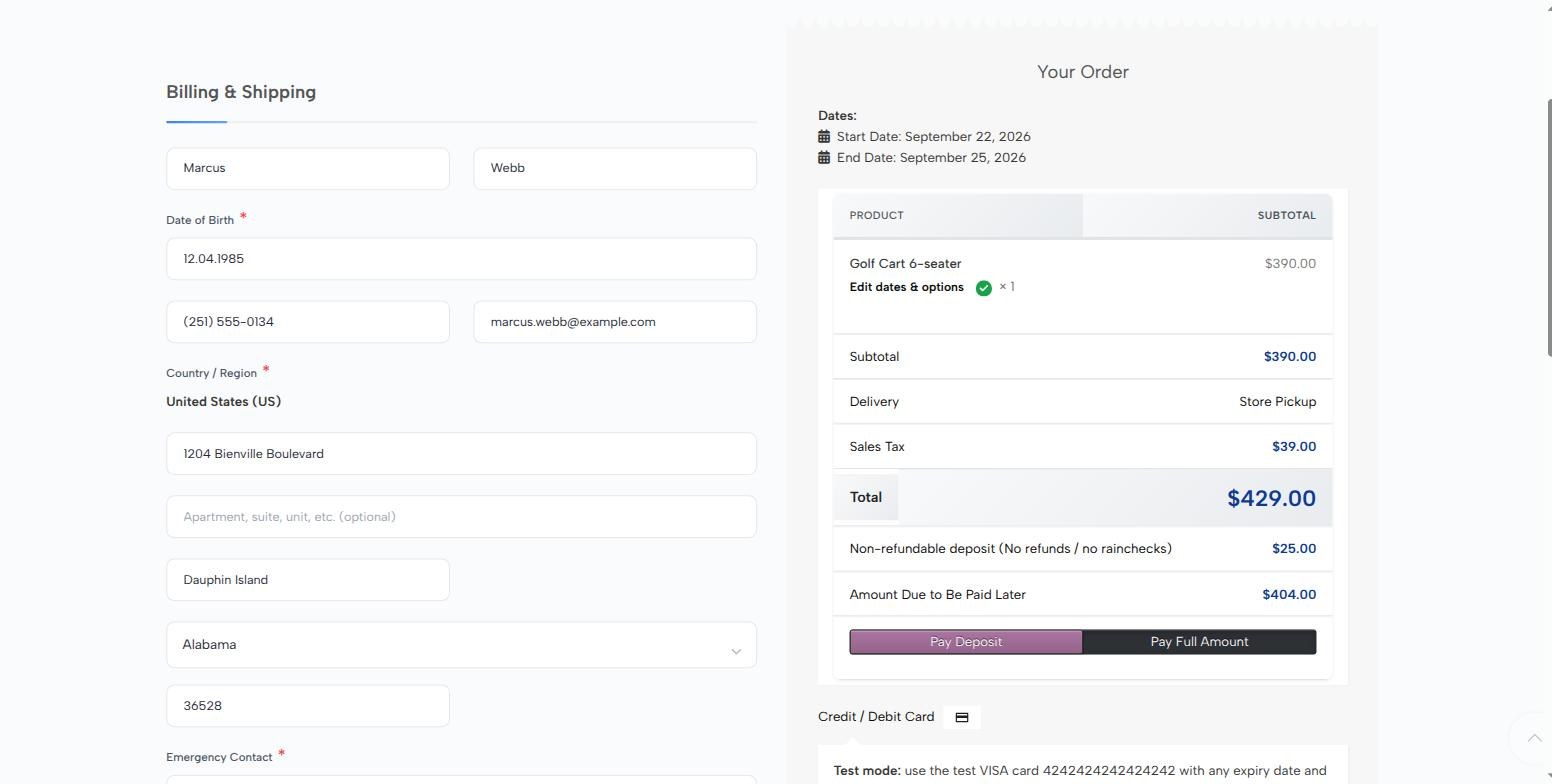
Checkout showing a 429 dollar total split into a 25 dollar non-refundable deposit and 404 dollars due to be paid later, with Pay Deposit selected
Split at checkout. Pay Deposit is the selected option; Pay Full Amount is there for anyone who would rather be done with it.

1.3 The consents a cart shop actually needs

Low‑speed vehicles on public roads carry obligations an ordinary rental does not. Three tick boxes sit above the pay button, and every answer is stored on the order where staff can read it back.
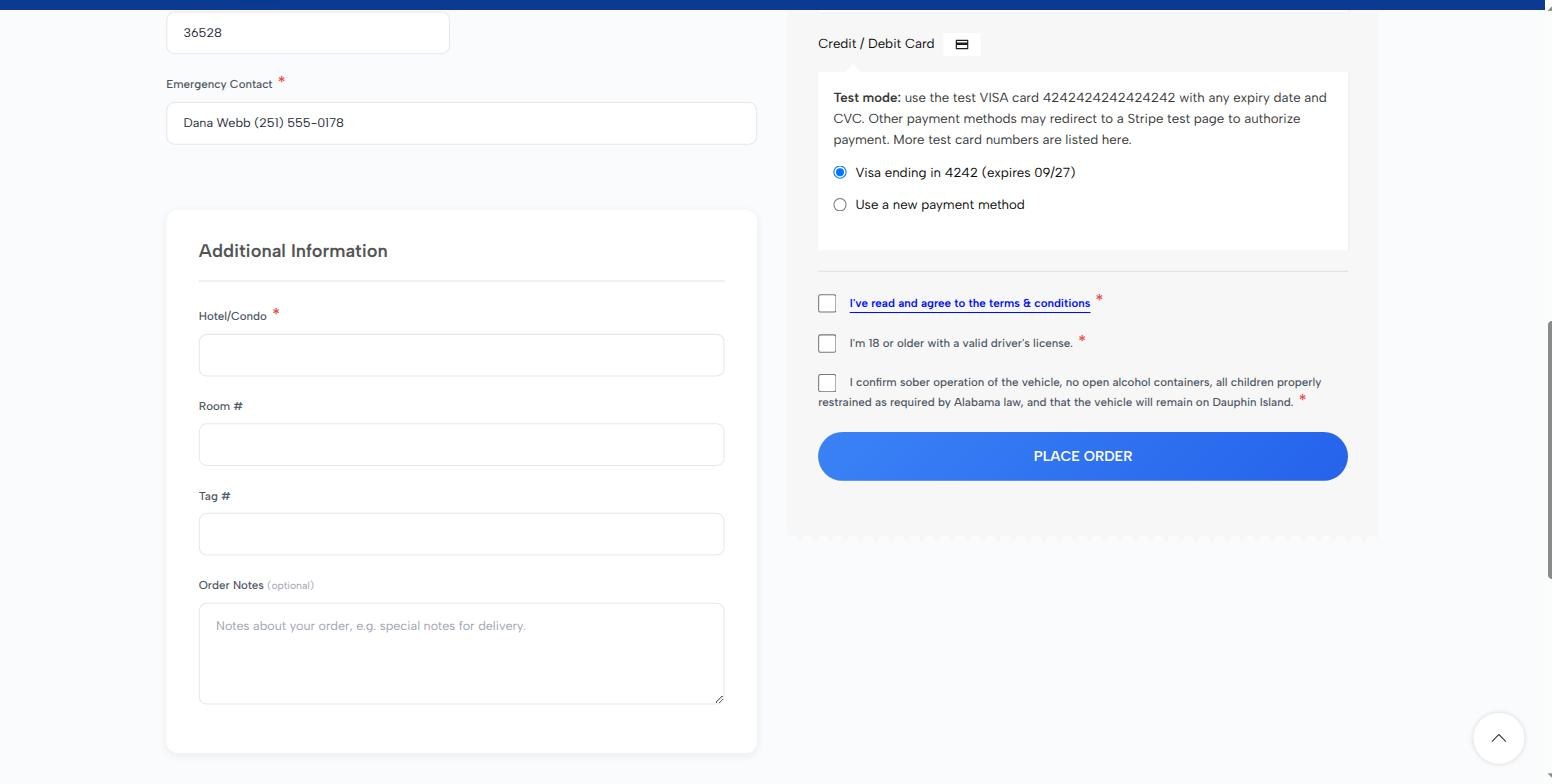
Checkout consent checkboxes covering terms, being 18 or older with a valid licence, and sober operation with the vehicle remaining on Dauphin Island
Age, sobriety, and where the cart may go. The third box is specific to this island. The card is saved at the same time, which is what makes the balance payable in one tap later.

1.4 Booked, and told what is still outstanding

The confirmation does not pretend the job is done. The rental agreement is unsigned, and the page says so with a link to sign it there and then. Marcus does not — which is the interesting case, because it is what most renters do.
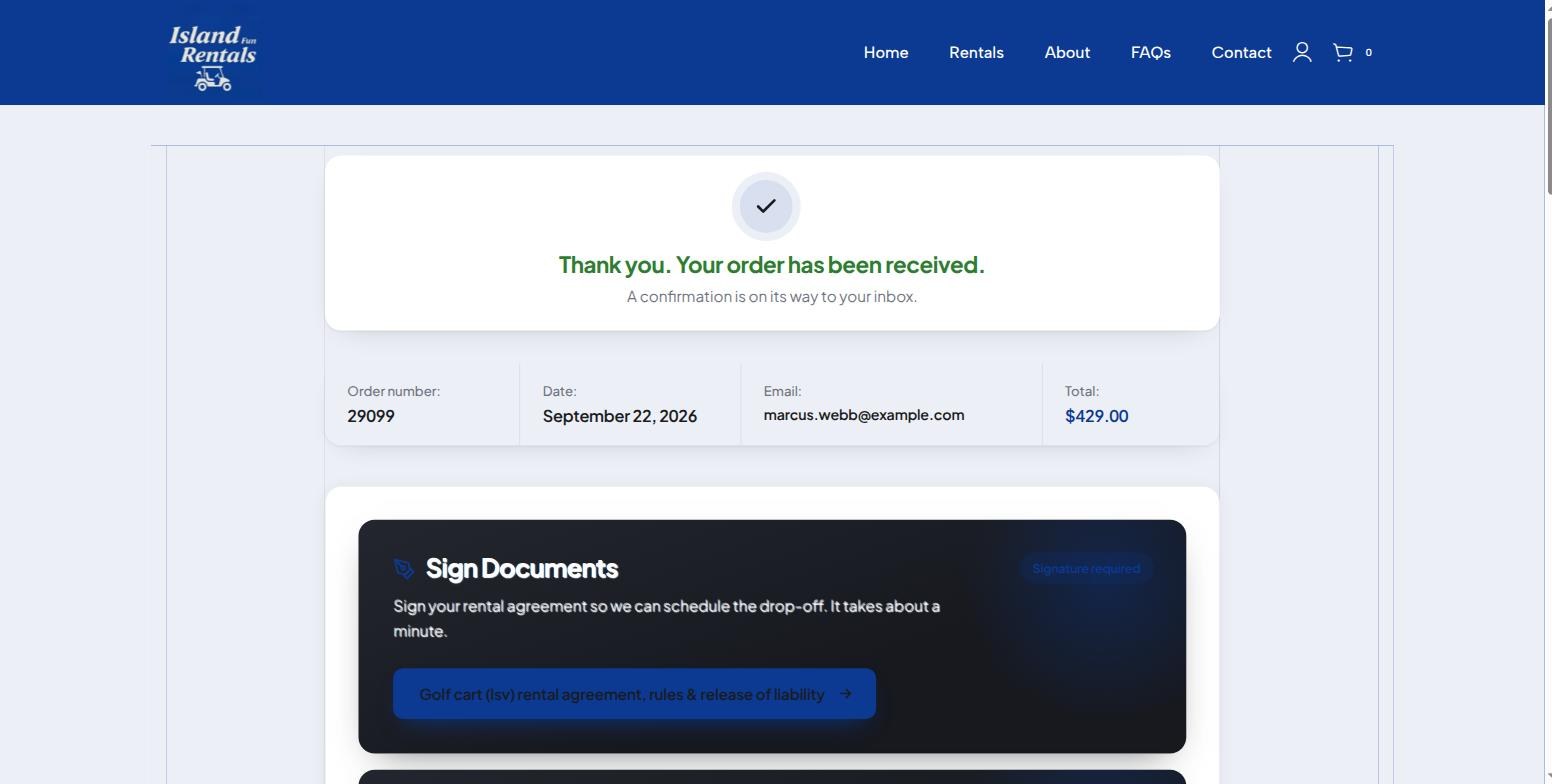
Order received page for order 29099 showing a Sign Documents panel with the rental agreement marked signature required
Order #29099. Signature required, with a one‑tap link. Everything the renter skips here simply reappears at the counter.
PART 02

Scans the code at the counter

Tuesday morning. The cart is due out today, so the check‑in window is open. There is no app to install and nothing to log into.

2.1 One code on the counter

The code below is the live one for this shop. Scanning it opens the check‑in page on the renter’s own phone.


QR code encoding the Island Fun Rentals store check-in page address
Printed once, used by everyone. It encodes nothing but the page address, so it never expires and carries no customer data.
Store check-in landing page offering New reservation and Existing reservation buttons
Two doors. New reservation is the ordinary shop, for walk‑ins with no booking. Marcus has one, so he takes the other.

2.2 Order number and the contact on the booking

Two fields, and deliberately no others. The e‑mail or phone is the part that matters: an order number on its own is guessable, and the system will not confirm that a booking exists until the contact matches too.

Check-in lookup form with reservation number 29099 and the renter e-mail filled in
The lookup. Every failure before the contact matches gives one identical message, so the screen cannot be used to farm order numbers.

2.3 Found — and a cart is now attached

This is the moment the booking stops being generic. Cart 01 — 6‑seater is picked from the free units and added to the order, before anything is shown to the renter, so every document from here on can name the vehicle.

Check-in screen showing order 29099 with Cart 01 6-seater attached, status Processing Due Payment, total 429 dollars, 25 dollars already paid, and steps to sign documents and pay the balance
What the renter sees. The unit, the dates, the total, and the $25 already paid. Note what is not here: no delivery address. An order number plus an e‑mail is weak proof of identity, and an address is exactly where a wrong match becomes a privacy problem.

Why it happens here. Assignment fires on the lookup, not on the final button. It has to: the last button is gated behind a signed contract, so assigning the cart there would attach it after the renter had already signed for it.

PART 03

Clears what is outstanding

Two things stand between Marcus and the counter: $404 and a signature. Both are done from the phone in his hand, without leaving the page.

3.1 The balance, on the card already on file

Pay now opens the real payment page inside the check‑in screen, so the renter never loses their place. The card saved at checkout is offered — and because reusing a stored card on nothing more than an order number would be too easy, the screen offers to send a one‑time code to the address on the booking before it will use it. Typing a fresh card needs no code, because a new card only ever adds money.
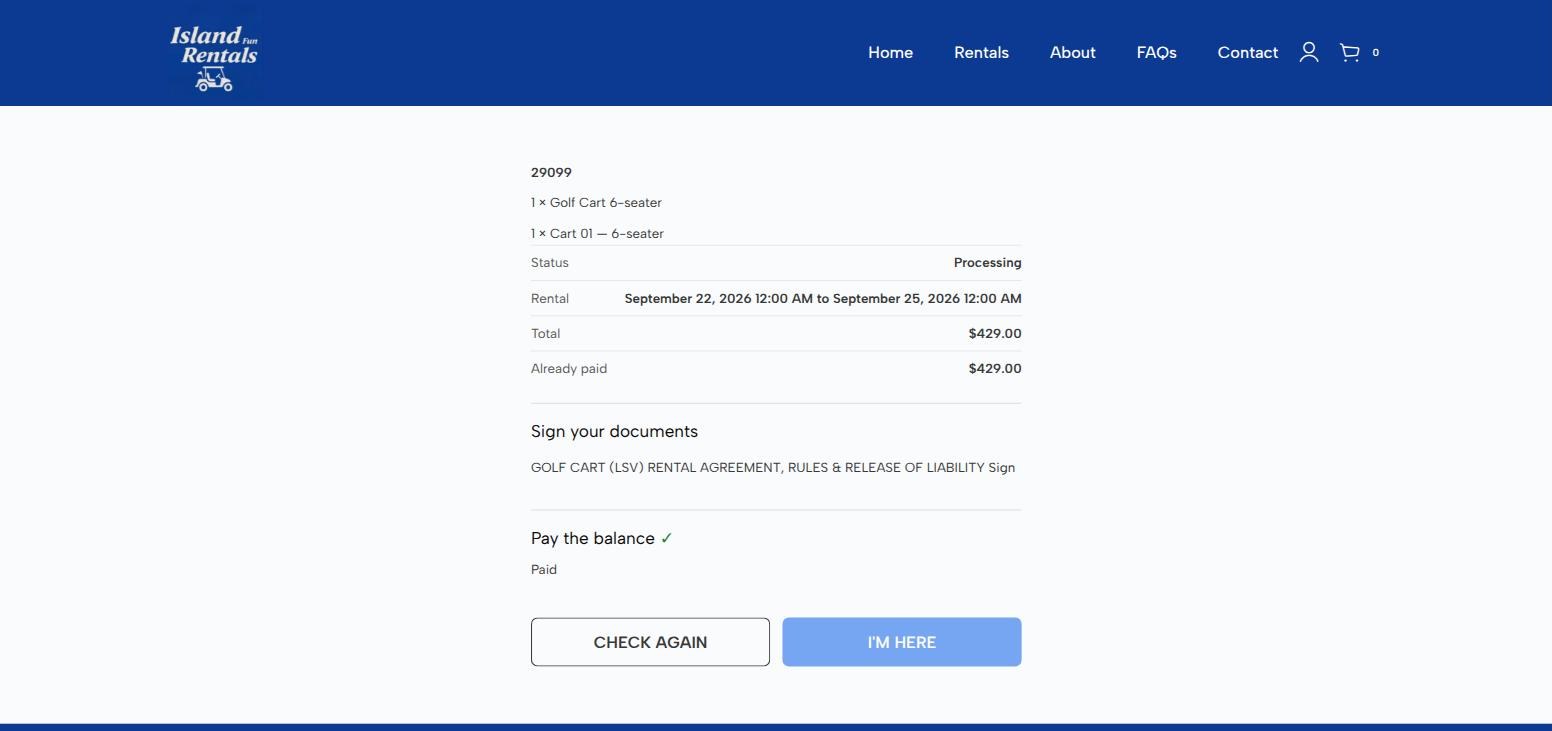
Check-in screen after payment showing status Processing, 429 dollars already paid, Pay the balance ticked as Paid, and the I'm here button still greyed out
Paid, and back where he started. Already paid now reads the full $429 and the status has moved off Processing – Due Payment. The renter was returned to their checklist automatically — that is the Check‑in Page setting from part 00 doing its job.

3.2 The agreement, already filled in

The rental agreement opens in the same frame with everything the shop already knows merged into it — name, address, hotel and room, dates, date of birth, emergency contact, the lot. The renter reads and signs; they do not re‑type their own booking.
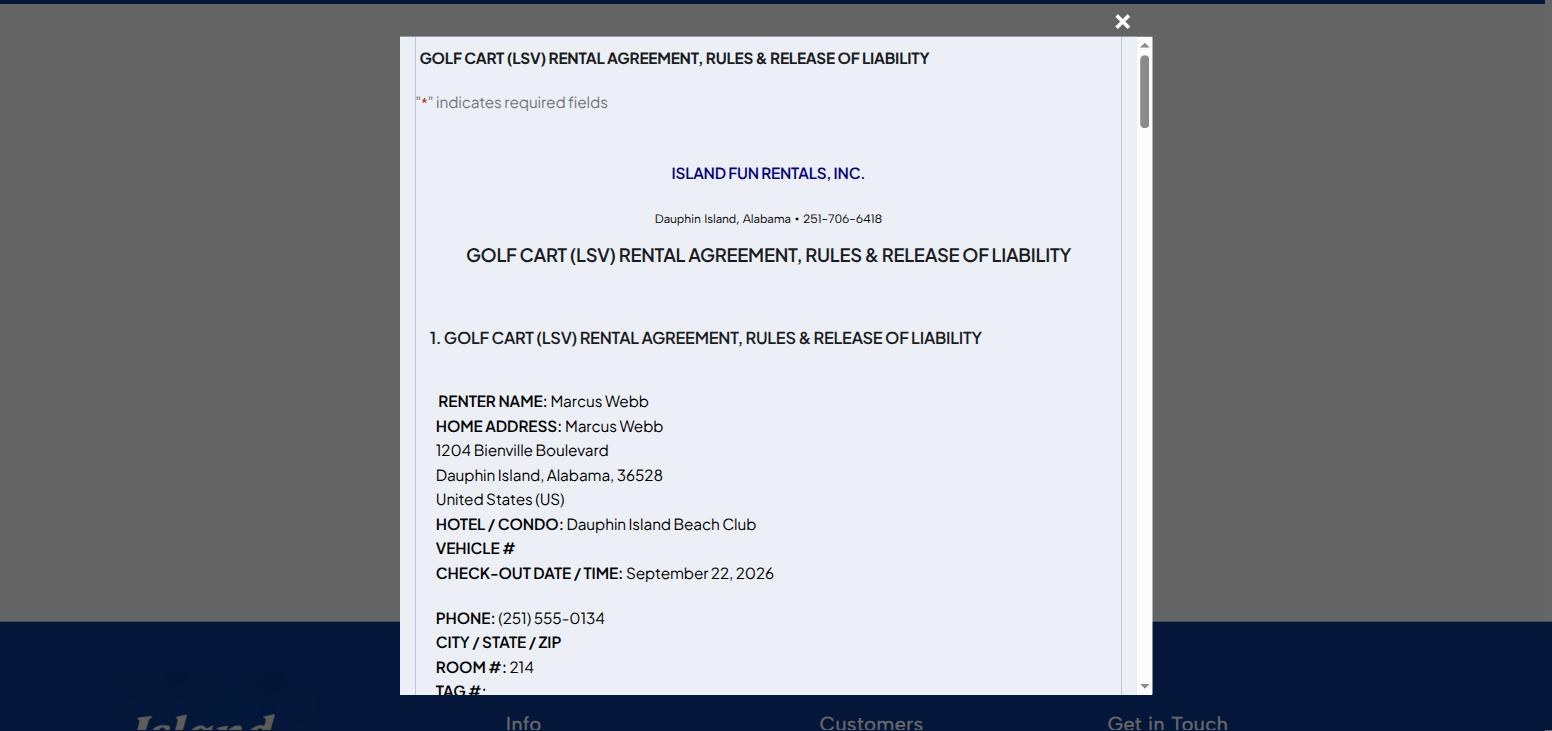
The golf cart rental agreement open inside the check-in screen with renter name, address, hotel, room number and check-out date already merged in
Nine sections, pre‑filled. Driver eligibility, rules of operation, the fee schedule, the release of liability and the jury‑trial waiver — the shop’s own document, not a generic one.
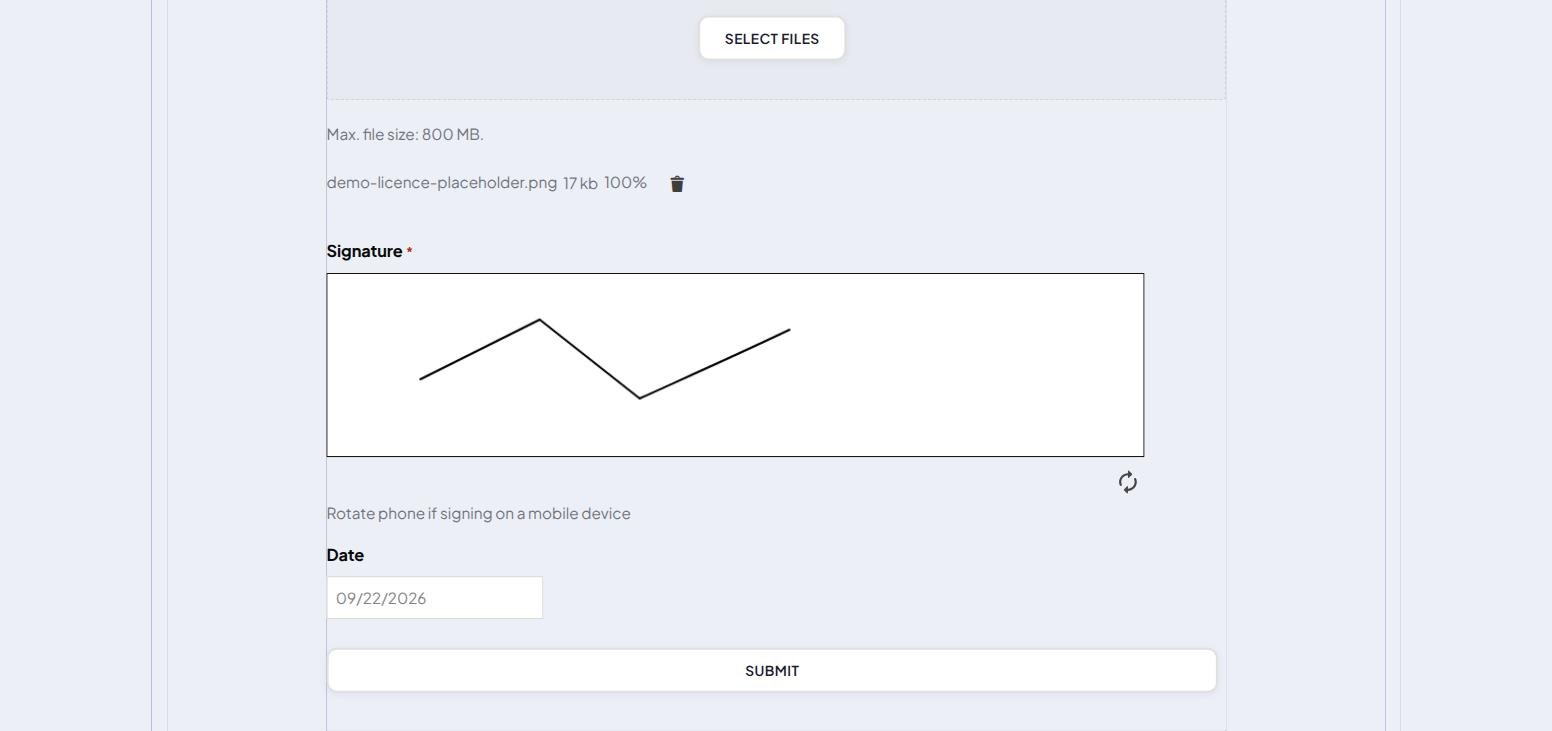
Signature pad on the rental agreement with a drawn signature, an uploaded driving licence photo at 100 percent, and the date filled in
Signed on the glass. A photo of the driving licence is a required upload, and the date fills itself. (The licence image here is a labelled placeholder — this is a demo booking, not a real person.)

3.3 “I’m here”

With both items ticked the button comes alive. It is worth being precise about what it does and does not do: it records an arrival and nothing else. It moves no status, touches no stock, and hands over no keys. A customer cannot promote their own order.
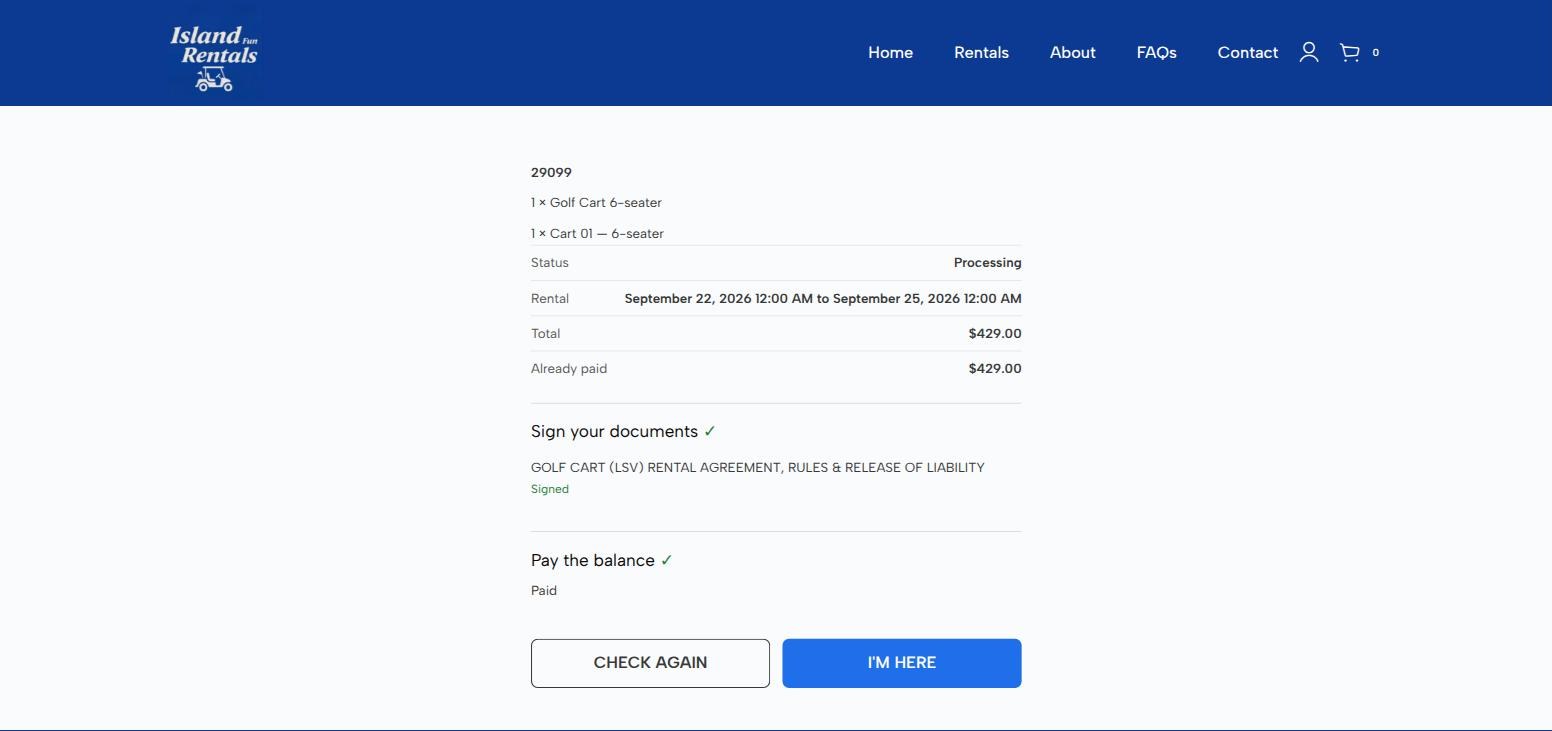
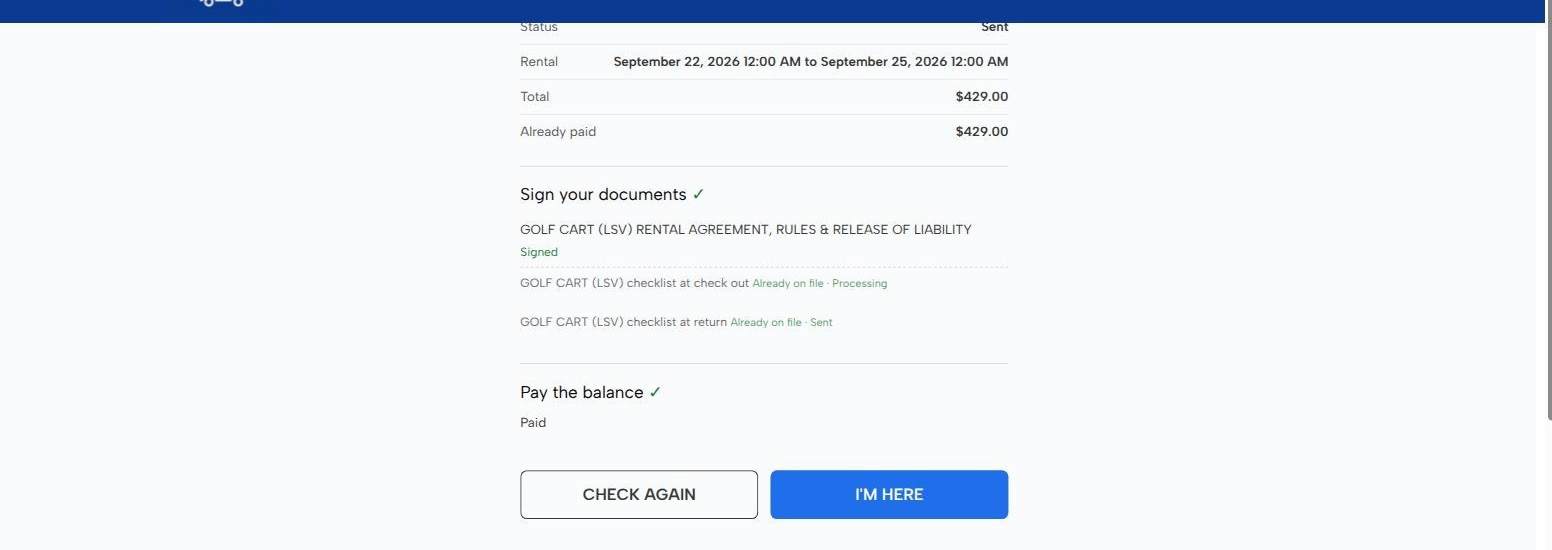
Check-in screen with both Sign your documents and Pay the balance ticked and the I'm here button now enabled
Both green. The condition checklist is deliberately absent from this list — nobody has inspected the cart yet, so there is nothing for the renter to countersign and it would be wrong to make them wait on it.
PART 04

The shop sees them arrive

Nobody has to be watching a screen for this to work, but if somebody is, it lands in front of them within seconds.

4.1 A live queue for the counter

The Logistics dashboard keeps a self‑refreshing panel of local‑pickup orders due out, with an optional chime on anything new. Marcus’s row now carries a green Checked in 10:23 AM badge next to his name, and a Prepare button straight into the picking screen.
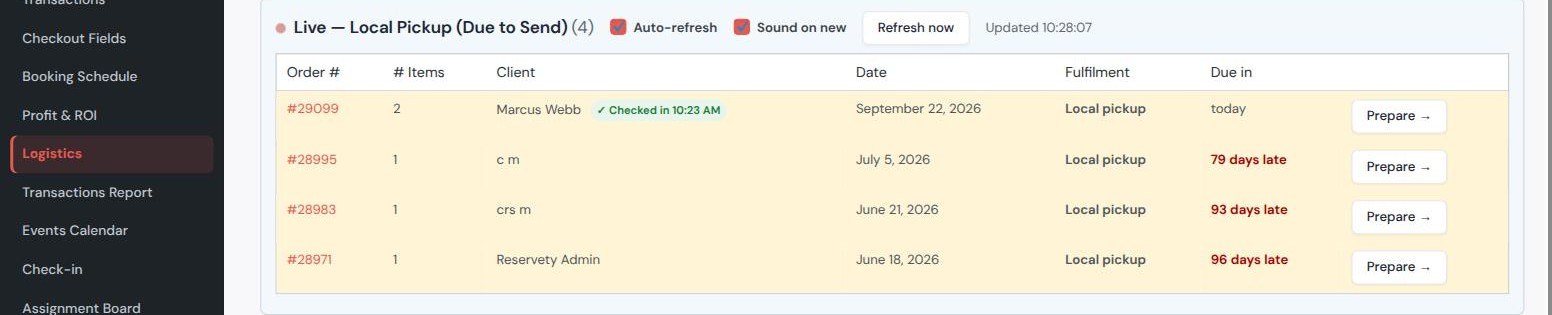
Live local pickup panel in the Logistics dashboard with order 29099 for Marcus Webb carrying a green Checked in 10:23 AM badge and a Prepare button
Top of the queue. The three rows beneath are older demo bookings left unclaimed — the panel scores by how overdue each one is, so a genuine no‑show does not quietly disappear.
PART 05

Prepare order, assigned unit

One screen for the person actually fetching the cart. It answers the two questions that matter at a counter before anything else: are they paid, and which vehicle is theirs.

5.1 The header says it first

Arrival is a pill in the header bar, beside the status — not buried in a sidebar card that staff have to scroll to. Underneath it, two badges: Paid in full, and a warning‑coloured 1 document to sign.
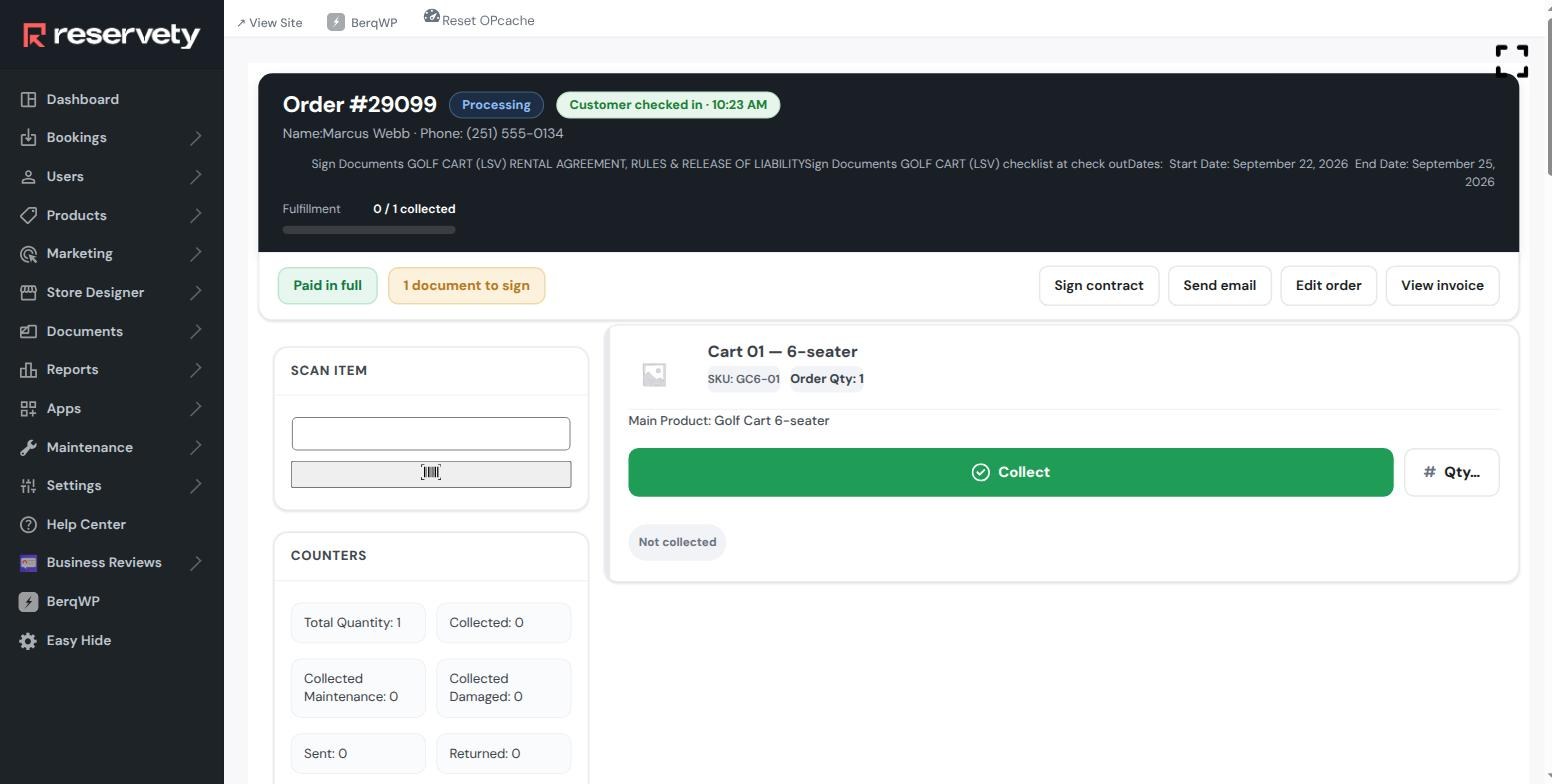
Prepare order screen for order 29099 showing Processing status, a Customer checked in 10:23 AM pill, Paid in full and 1 document to sign badges, and the assigned Cart 01 6-seater with SKU GC6-01
Cart 01 — 6‑seater, SKU GC6‑01. Staff are told which physical cart to walk out to, and the scan box beside it will accept its barcode instead if the shop prefers to scan.

5.2 The document that is waiting on staff

The documents card carries the state of each piece of paperwork separately. The agreement is signed. The check‑out checklist reads awaiting inspection — it is the shop’s turn, not the renter’s.
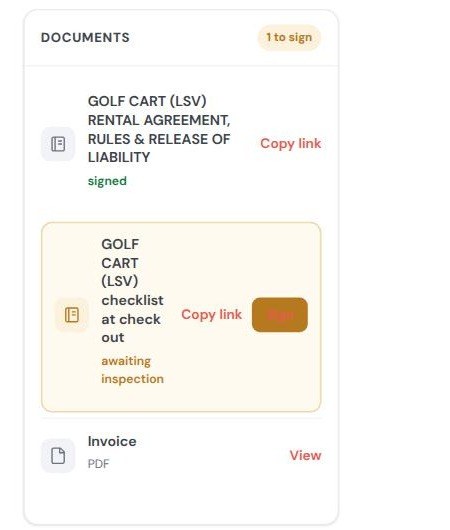
Documents card showing the rental agreement signed and the check-out checklist marked awaiting inspection with a sign button
Per document, not per order. One signature on one form no longer marks an unrelated second form as done — each row is resolved against its own signatures, across every status the order has been through.

5.3 What the order itself has recorded

Nothing above is a special case that only the picking screen knows about. The ordinary order view has the same story in its notes, in order, with the card on file and the checkout consents alongside.
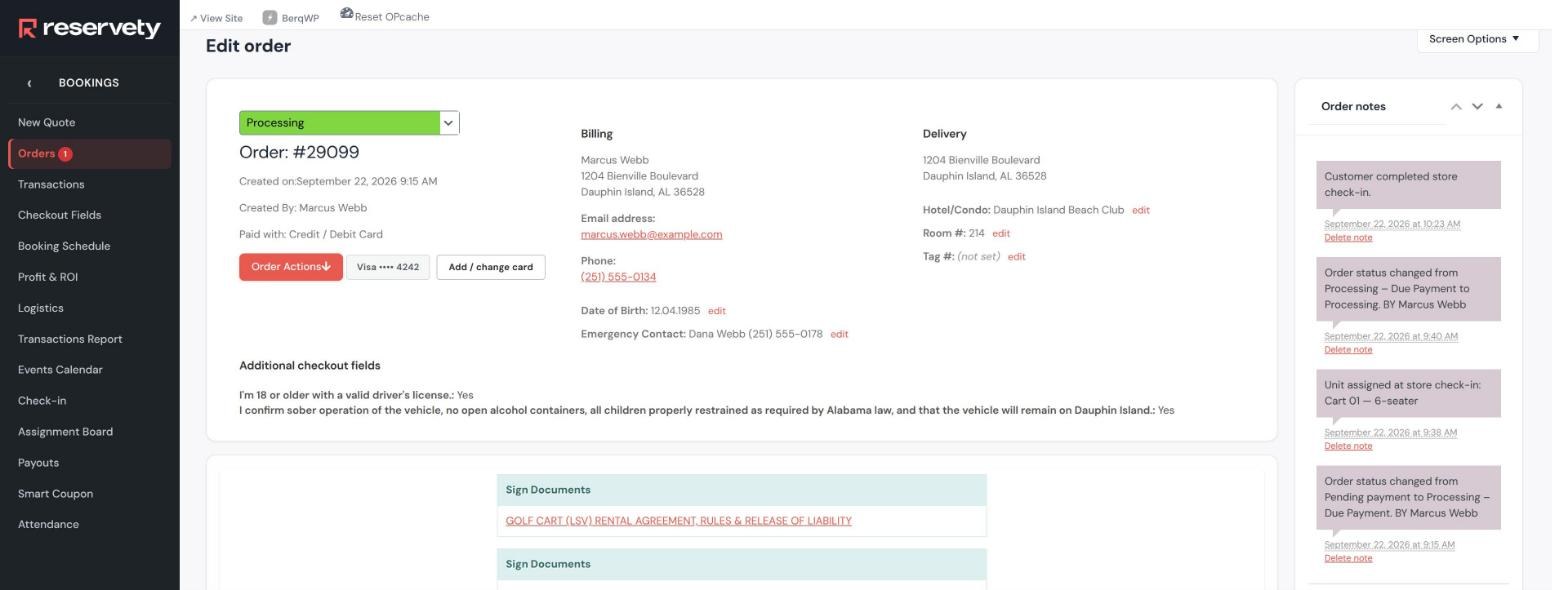
Order edit screen for 29099 showing billing details, checkout consent answers, card on file, and order notes recording the unit assignment, the payment and the completed store check-in
The audit trail so far. Unit assigned at store check‑in: Cart 01 — 6‑seater at 9:38, the balance at 9:40, Customer completed store check‑in at 10:23.
PART 06

Inspected, then co‑signed

The part most rental software leaves to a clipboard. Staff record the cart’s condition, the renter agrees to that record, and the two signatures live on the same document.

6.1 Staff walk the cart

The checklist is the shop’s own: tyre pressure, lights, indicators, plate, brake pads, parking brake, gauges, bodywork, seatbelts. What goes in the notes is the thing worth having — existing damage, recorded before the cart moves.
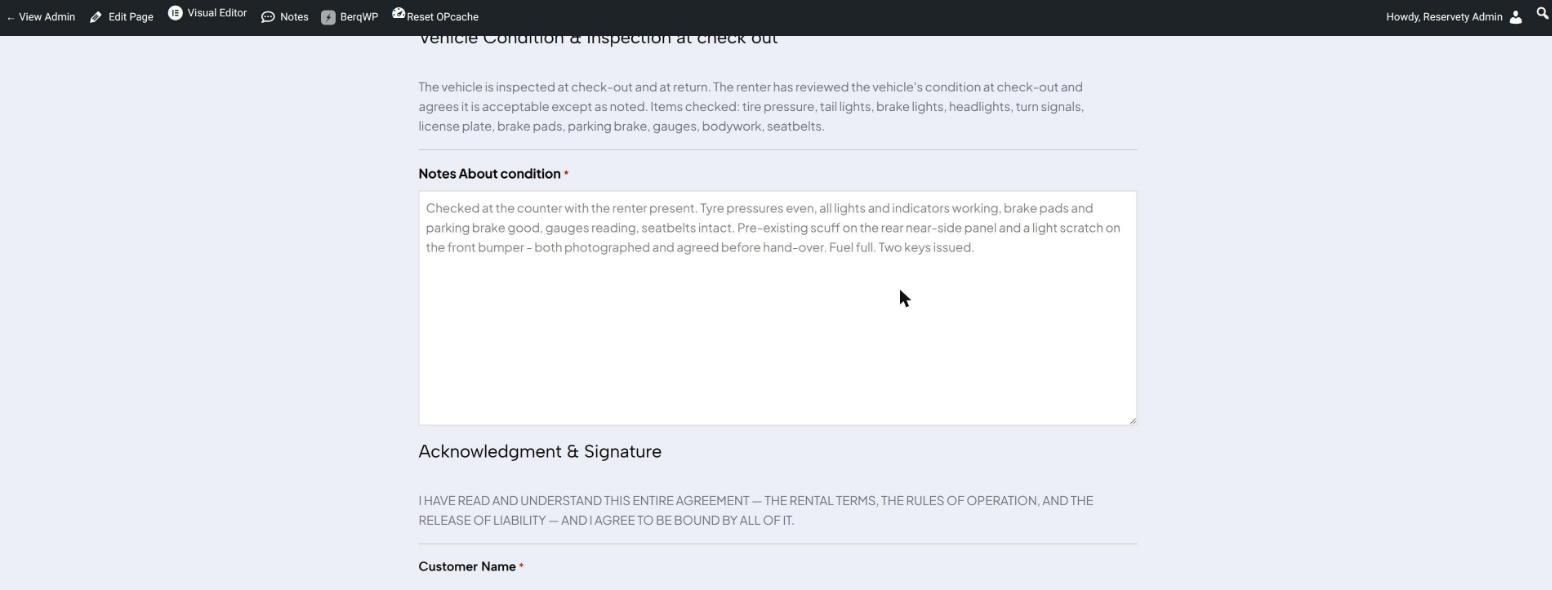
Check-out condition form with staff notes describing tyre pressures, working lights, a pre-existing rear scuff and front bumper scratch, full fuel and two keys issued
The sentence that settles arguments. “Pre‑existing scuff on the rear near‑side panel and a light scratch on the front bumper — both photographed and agreed before hand‑over.”
Signature pad on the check-out condition form signed by the staff member with the date filled in
Signed by the member of staff. The system classifies the signer by their account, so this is recorded as the shop’s signature, not the customer’s.

6.2 The card flips to the renter’s turn

Back on the prepare screen the same row has changed state: inspected — awaiting renter, and the button now reads Renter signs.

Documents card with the check-out checklist now reading inspected awaiting renter and a Renter signs button
Three states, one row. awaiting inspection → inspected — awaiting renter → complete. Staff can tell at a glance whose move it is.

6.3 It appears on the renter’s phone

Nothing is pushed to the renter, so the kiosk has a Check again button for exactly this moment: staff finish the inspection while the customer is standing there with the page open, and one tap pulls it through.
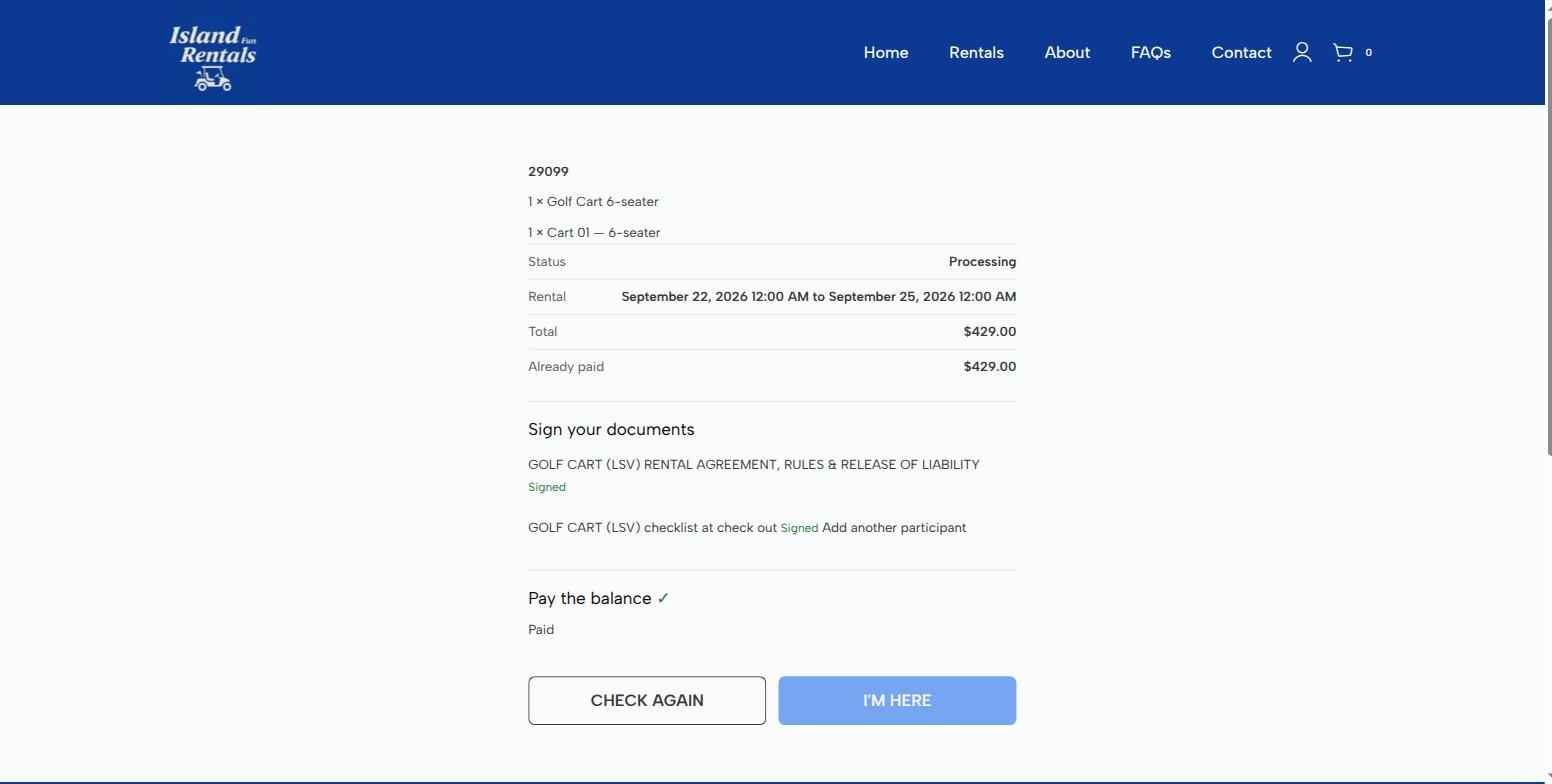
Check-in screen now listing the check-out checklist alongside the rental agreement, with the I'm here button greyed out again
The checklist has arrived. The renter’s own signature is still outstanding, so the row stays listed and the button is greyed out until they sign it.

6.4 They sign what staff actually wrote

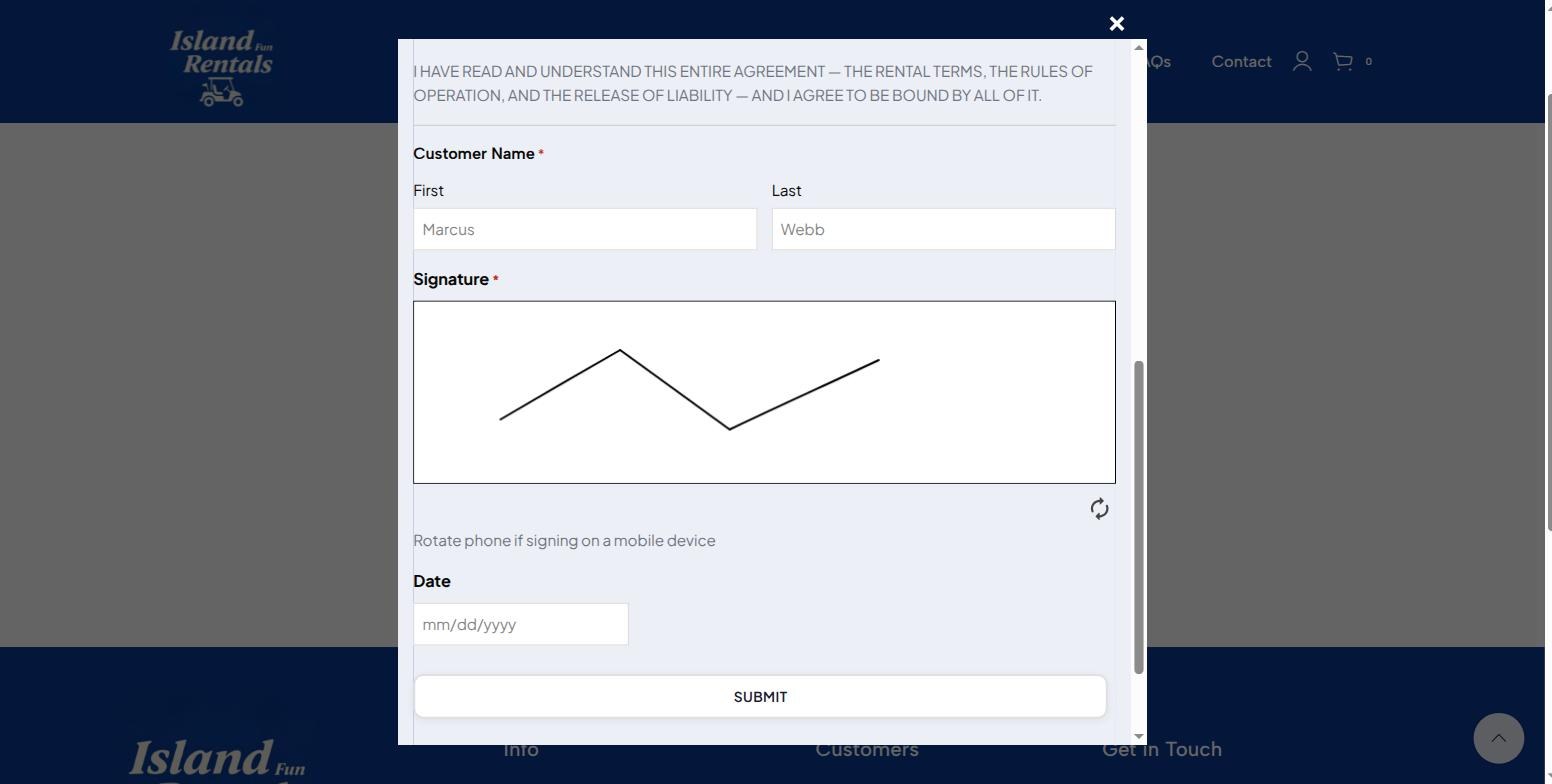
This is the point of the whole mechanism. The renter’s copy opens with the inspection notes already in it — they can read exactly what the shop recorded about the cart’s condition. Only the name, signature and date are blank.
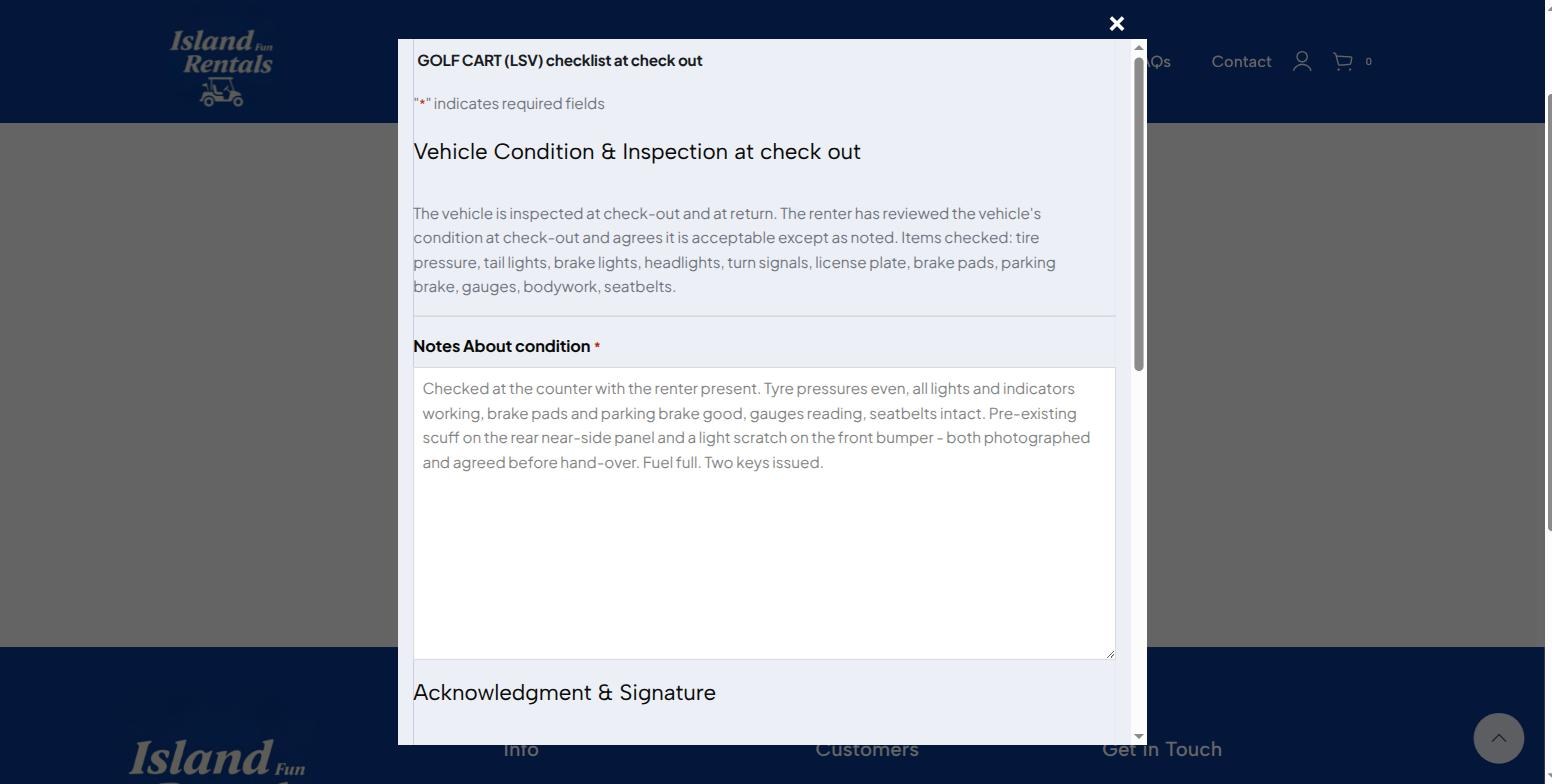
The renter's copy of the check-out condition form opened on their phone with the staff condition notes already filled in
Not a blank form. A renter asked to sign an empty inspection has agreed to nothing; a renter shown “scuff on the rear near‑side panel” and signing under it has agreed to something specific.
The renter signing the condition form on the kiosk with their name filled in
The second signature. Same document, same entry trail — not a separate form that has to be matched up later.

6.5 Everything clear

Check-in screen with documents ticked, the check-out checklist moved to already on file, and the balance paid
Co‑signed, and filed. The checklist drops to the read‑only Already on file list with the status it was signed under. There is nothing left to collect, so there is no link to reopen it.
PART 07

Keys out, marked sent

Only now does the order move. Every gate is green, and the staff member is the one who moves it.
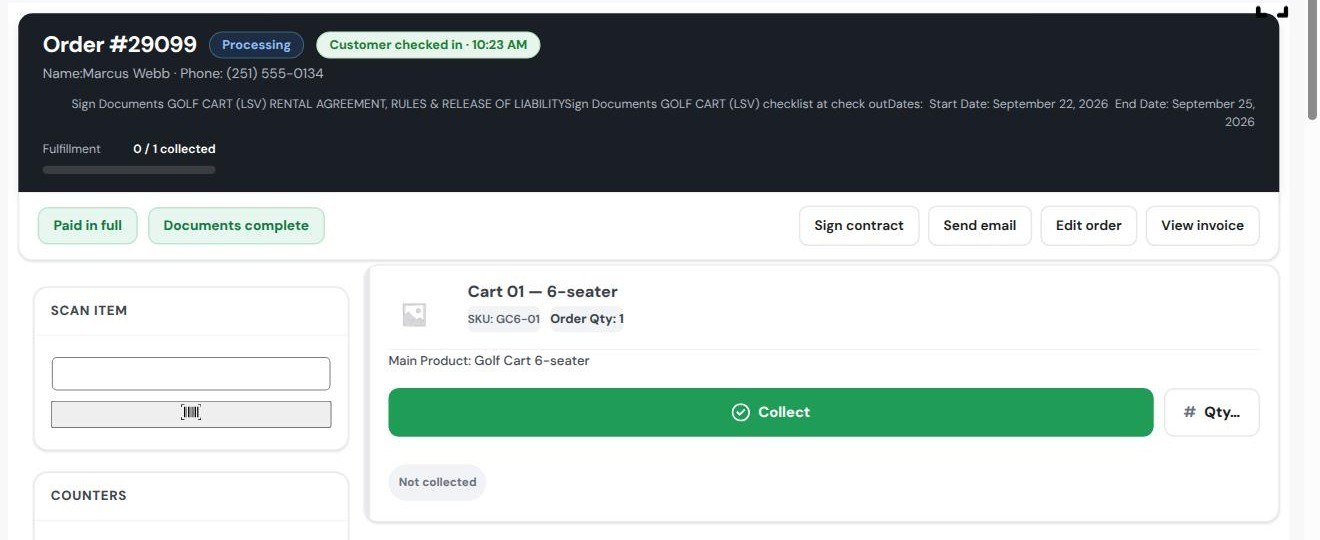
7.1 Both badges green

Prepare order header showing Paid in full and Documents complete badges both in green
Paid in full · Documents complete. The amber “1 document to sign” from part 05 has gone green without anybody editing a status by hand.

7.2 Collect the cart, then hand it over

Collecting is the physical act — this cart, off this rack, by this person, at this time. It is recorded separately from the status change so the shop can tell the difference between “fetched” and “gone”.
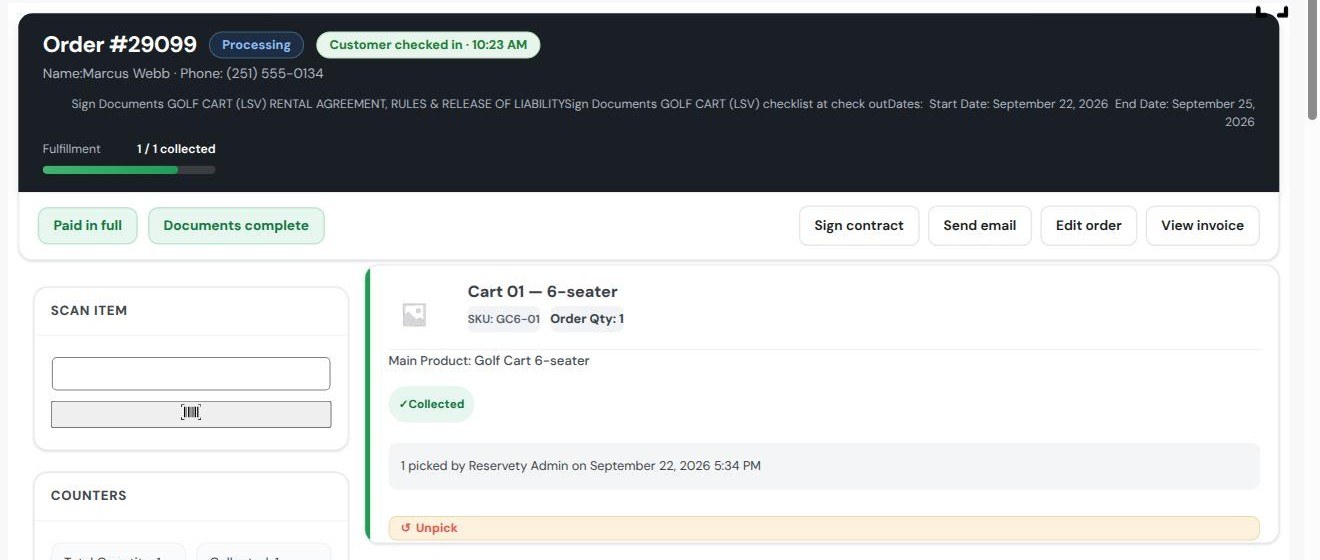
Prepare screen showing 1 of 1 collected with a note reading 1 picked by Reservety Admin on September 22 2026
1 / 1 collected. Picked by a named member of staff, with a timestamp.
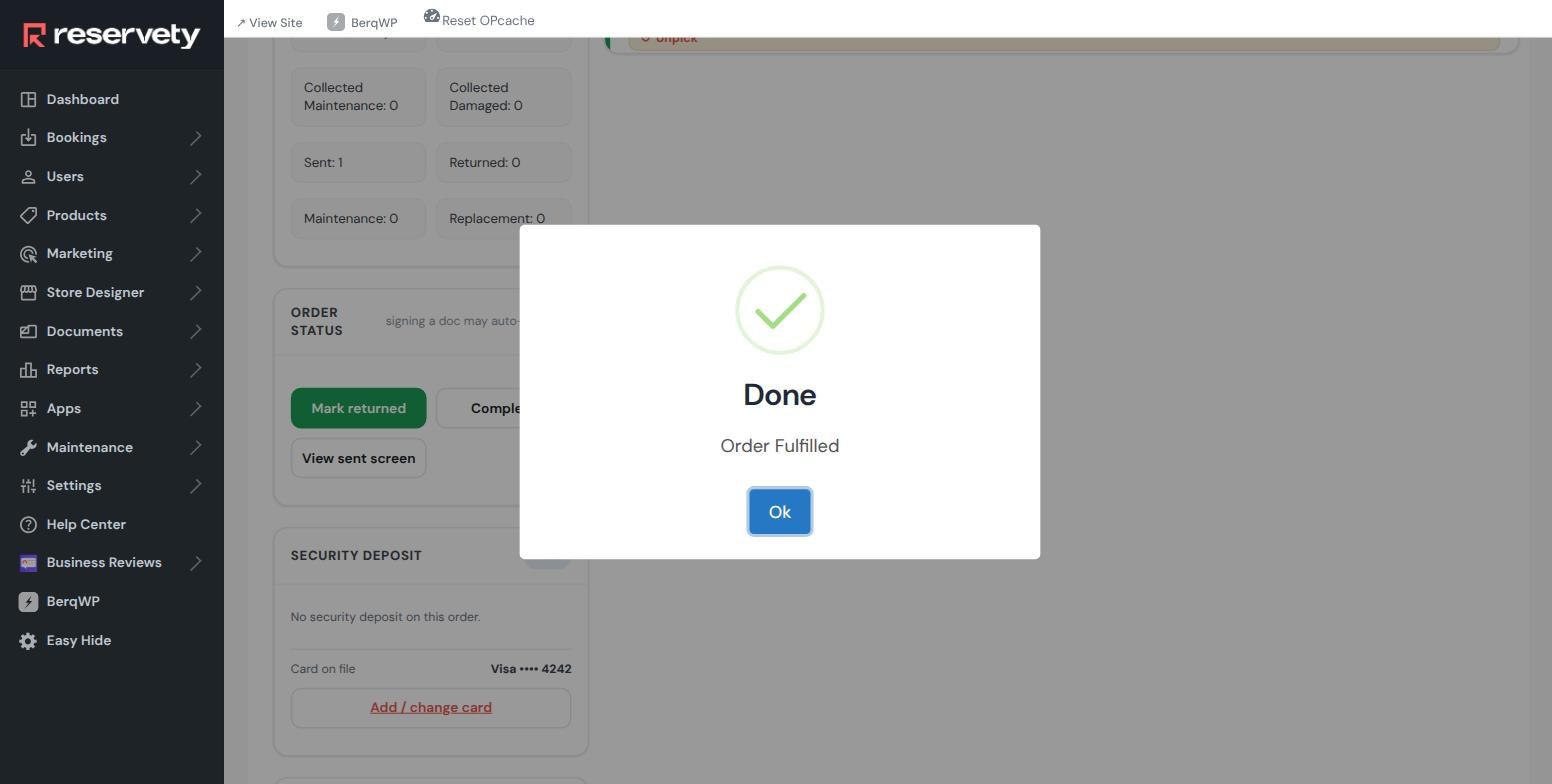
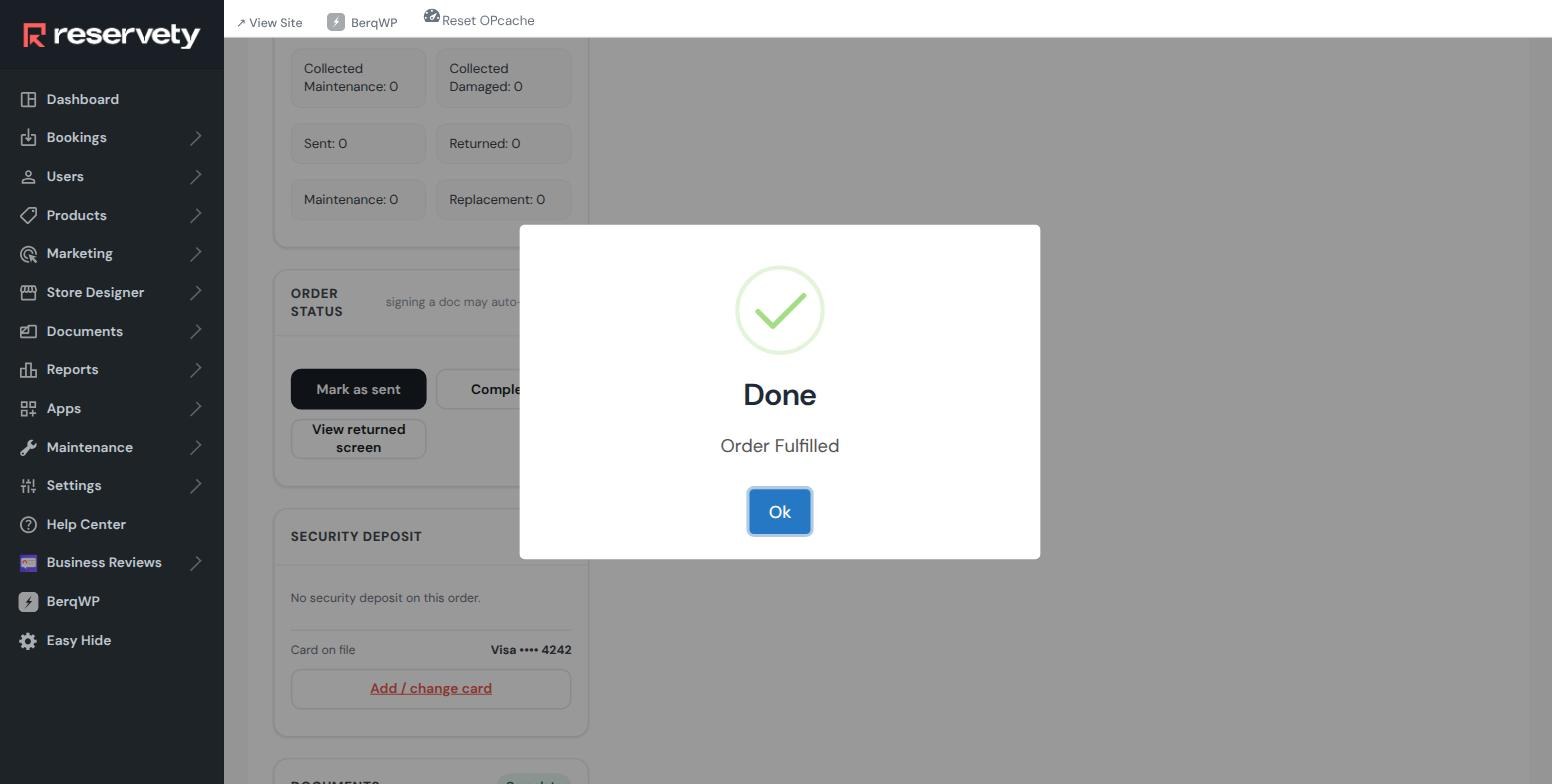
In-page confirmation dialog reading Done, Order Fulfilled, after Mark as sent
Marked sent. An in‑page dialog, not a browser alert — a native pop‑up would block the screen and can swallow an unsaved meter reading behind it.
PART 08

The cart comes back

Friday. The same mechanism runs in reverse, and it starts on its own.

8.1 The return sheet appears by itself

Nobody switched anything on. The return checklist is mapped to the Sent status, so the moment the cart went out it became the next thing waiting for the shop.
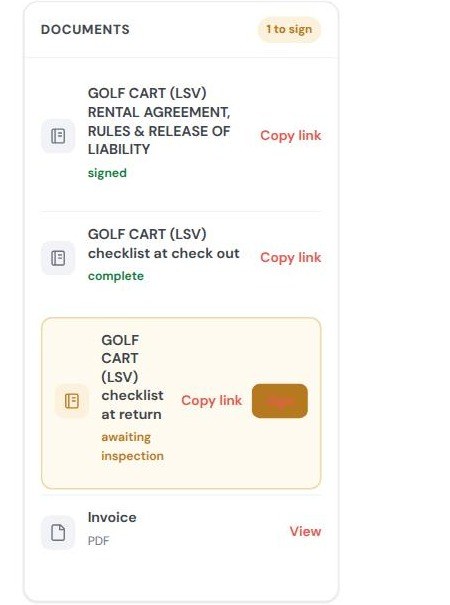
Documents card now listing the agreement as signed, the check-out checklist as complete, and a new return checklist marked awaiting inspection
Three documents, three states. signed, complete, and a fresh awaiting inspection for the return.

8.2 Staff inspect against the check‑out notes

The return inspection is the check‑out inspection’s twin, and the useful thing is that the earlier notes are on the same order, a click away. The question is never “is there a scratch” — it is “is this scratch new”.
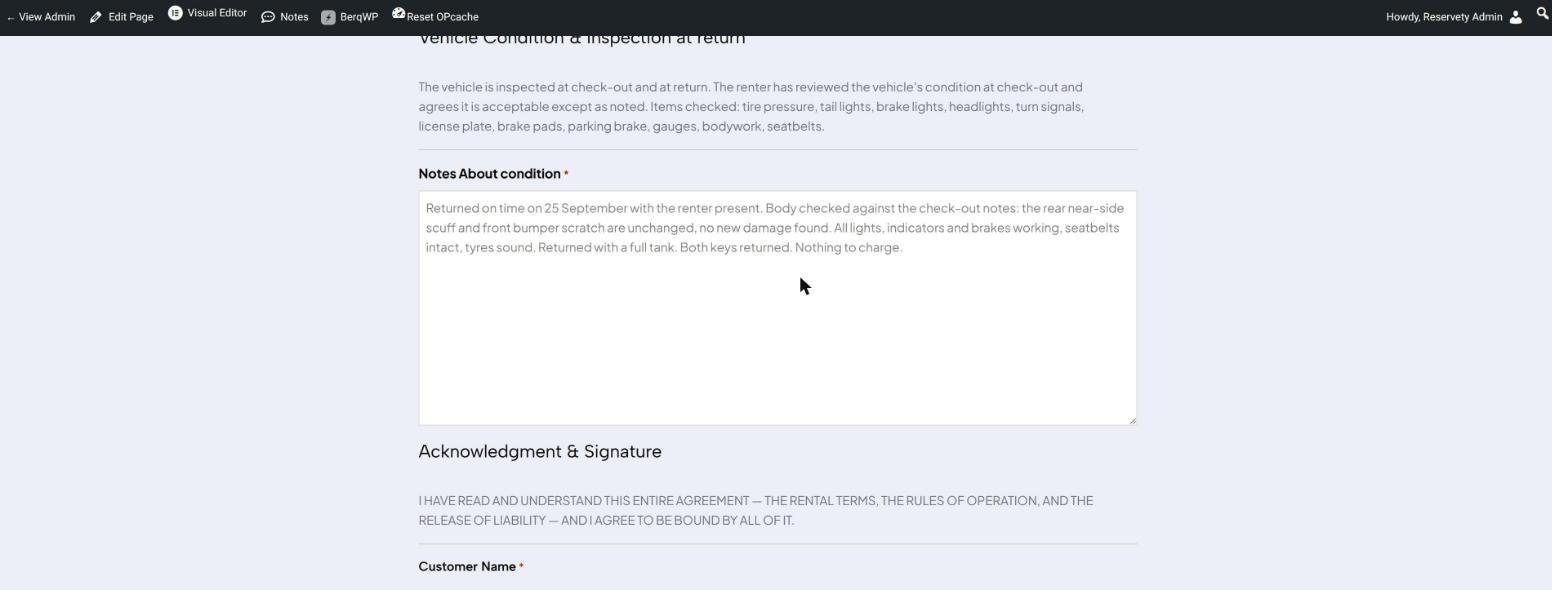
Return condition form with staff notes confirming the rear scuff and bumper scratch are unchanged, no new damage, full tank, both keys returned, nothing to charge
“Unchanged, no new damage found.” Full tank, both keys, nothing to charge — and if there had been, Report damage sits on the same screen and the card is still on file.

8.3 The renter signs the return too

Same flow as the hand‑over: the renter looks the booking up on the counter code, and the return sheet is waiting with the shop’s findings already written into it.
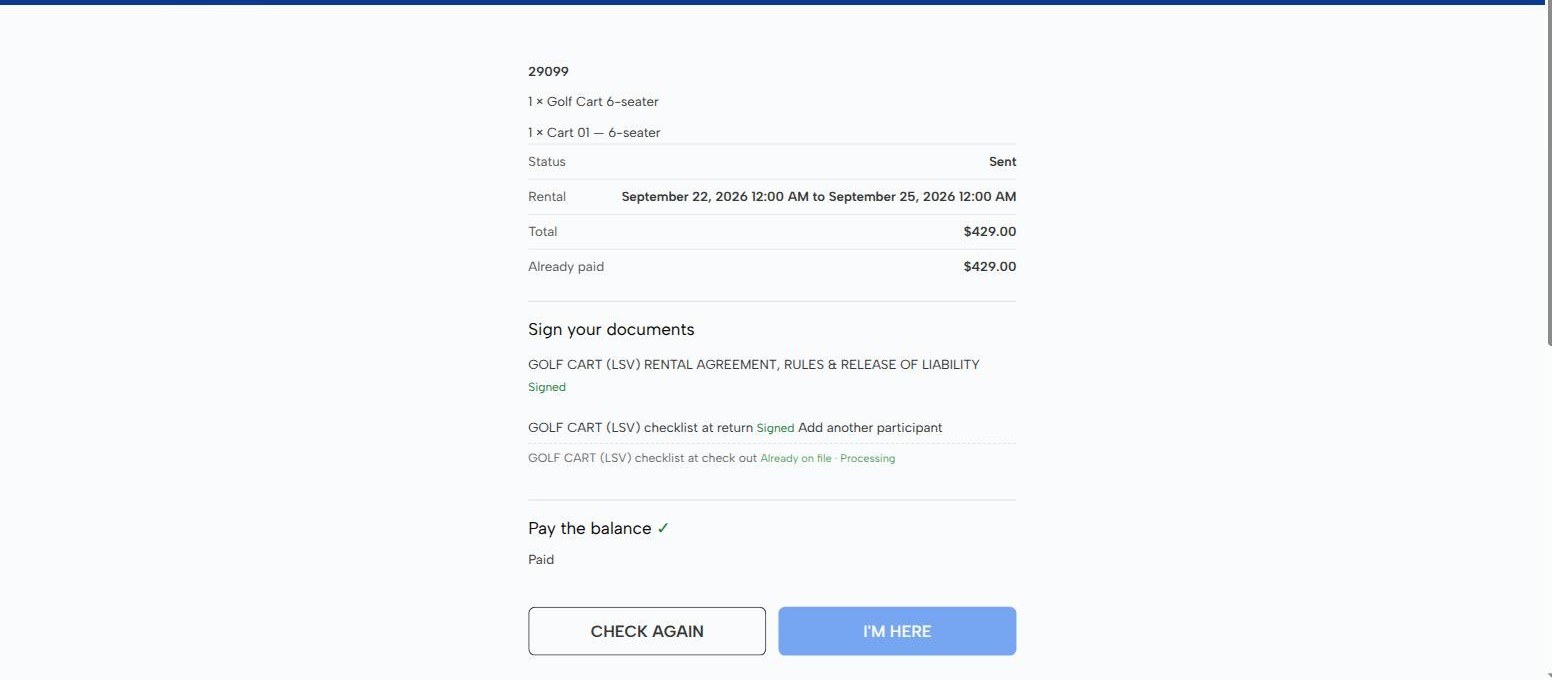
Check-in screen with status Sent, the return checklist listed for signature and the check-out checklist already on file
Status Sent, return sheet outstanding. The check‑in window stayed open for this: it does not close while a cart is still out or an inspection is still half signed, so an early return on day two and a return four days late both still work.
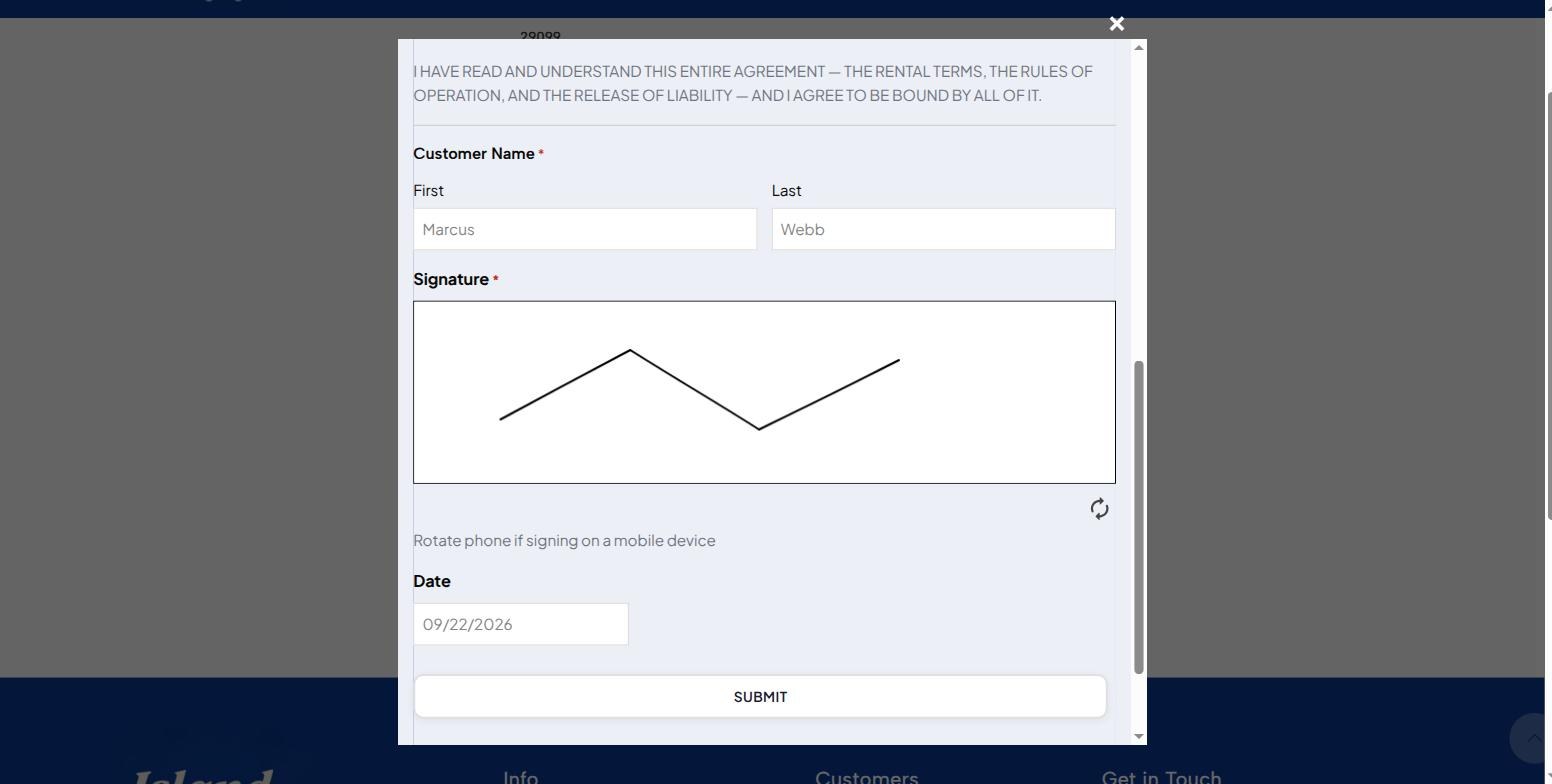
The renter signing the return condition form inside the check-in screen
Signed off on the way out. The renter leaves having agreed, in writing, that the cart came back undamaged.
Check-in screen showing both the check-out and return checklists as already on file with the statuses they were signed under
Both inspections on file. Each one labelled with the status it was signed under — Processing for the hand‑over, Sent for the return.
PART 09

Marked returned

The last action of the hire, and again it belongs to staff.
9.1 Booked back in

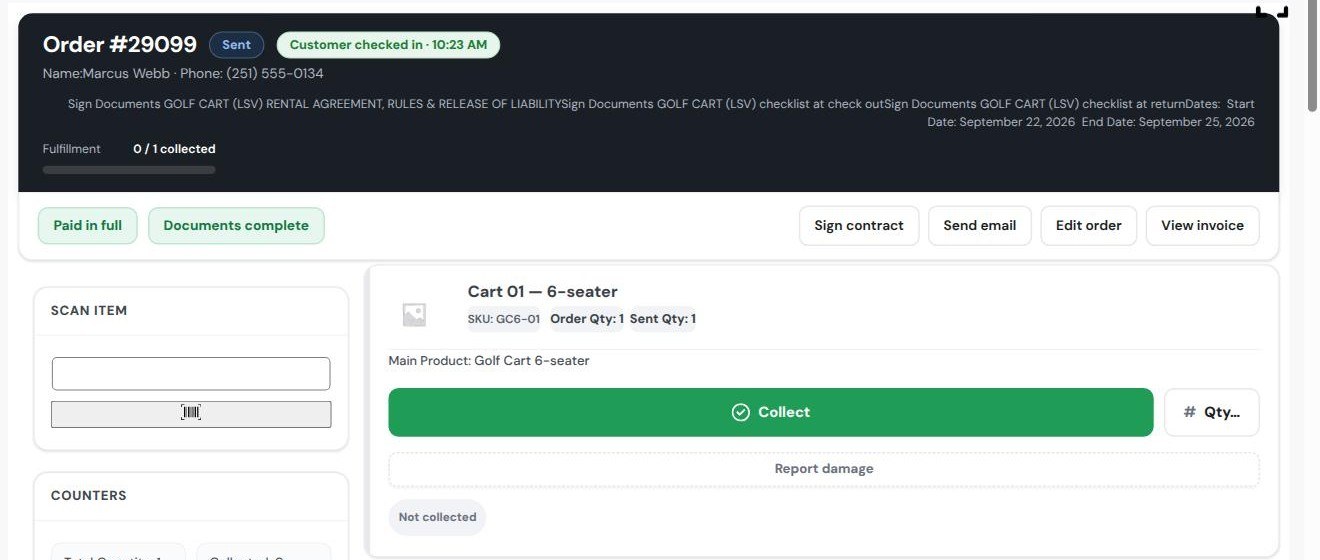
Prepare screen in Sent status showing Sent Qty 1, Collect and Report damage buttons, and Documents complete
The return desk. Same screen, different job: Sent Qty: 1, a Collect to book the cart back in, and Report damage if it is needed.
In-page confirmation dialog after Mark returned
Mark returned. The cart goes back into availability from this moment, which is what stops a returned unit sitting unsellable for the rest of the day.

9.2 The whole hire, in six lines

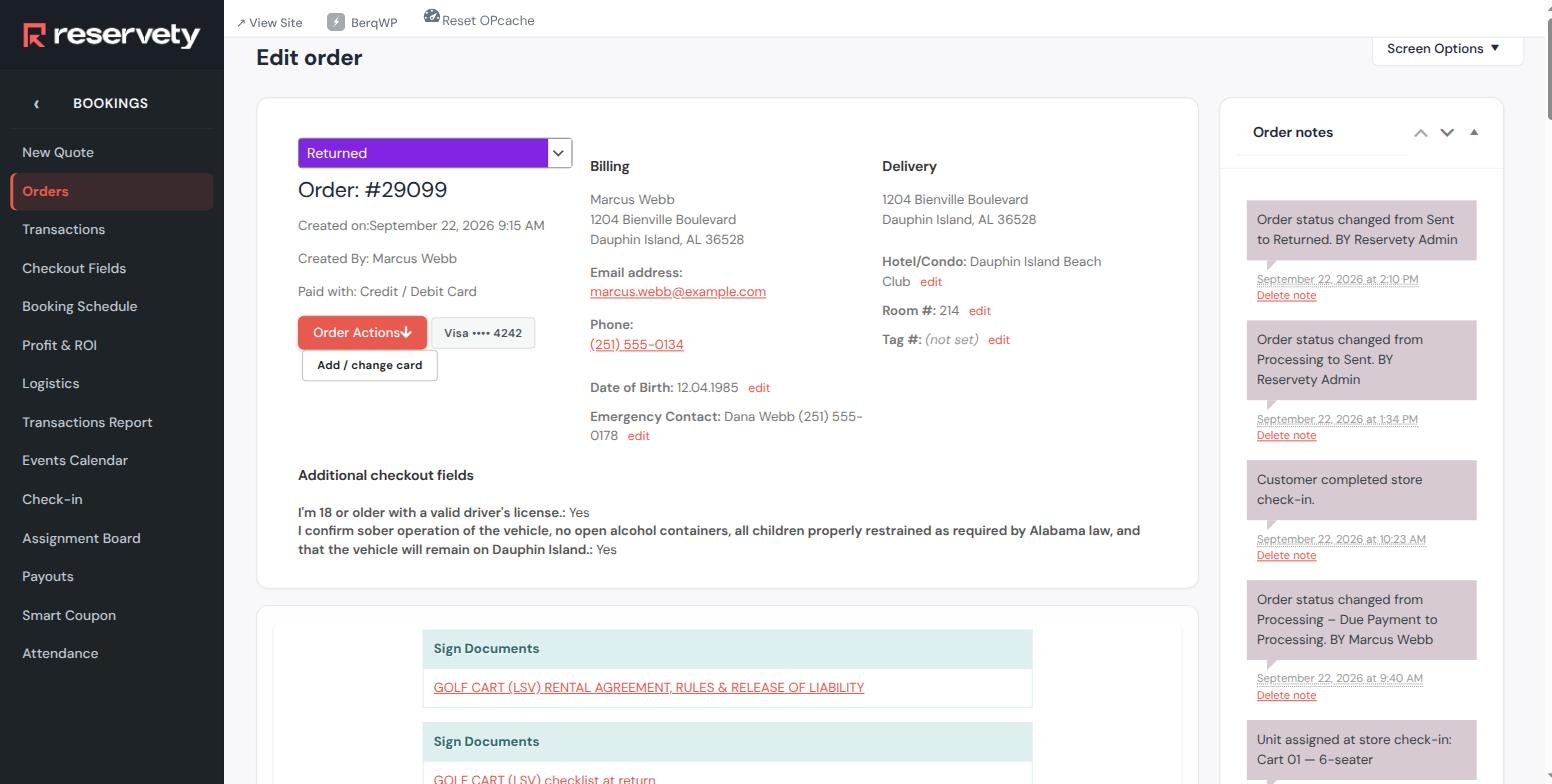
Order 29099 in Returned status with order notes listing every step from pending payment through unit assignment, payment, check-in, sent and returned
Order #29099 — Returned. Pending payment → Processing – Due Payment → unit assigned → balance paid → check‑in completed → Sent → Returned, each with a time and a name against it.
PART 10

What this proves

One hire, one afternoon, no special cases.

The ninety seconds at the counter

Built on the Island Fun Rentals demo. Order #29099 is a real order taken through the payment gateway in test mode; the renter, e-mail address and phone number are fictional. Every screenshot is the running system, unretouched.

Start Your Rental Business the Right Way

Reservety handles your website, bookings, inventory, and payments — so you can focus on growing your business.

Start Free Trial View Pricing
Free 14-day trial No credit card required Zero commission