
Last-minute cancellations are a real problem in a party rental business.
Last-minute cancellations are a real problem in a party rental business.
When the cancellation occurs, you lose that specific order and the opportunity to rent it to someone else.
Many party renters, especially beginners, ask for a solution to this problem.
We brought an example from the party rental group discussions to tackle this issue with real-world solutions.
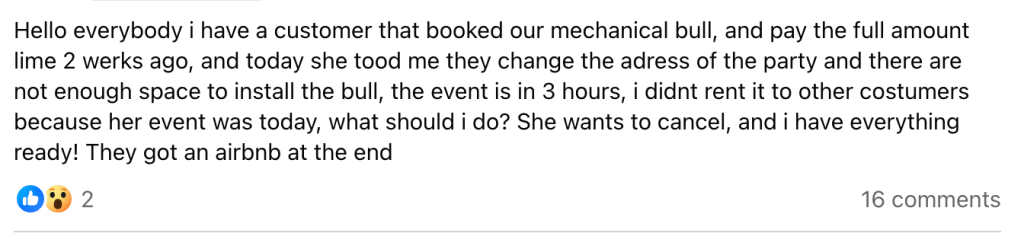
We provided suggestions from fellow party rental business owners and added our own, based on several years of experience.
Although this specific example talks about mechanical bull cancelation, it is also relatable to other party rental inventories.

1. Have a cancelation policy.
In general, you need a rental contract that mentions the terms and conditions of a business, including the cancellation policy.
Once you have that document, you must require the customers to sign it during the booking process.
Unfortunately, some businesses either forget to get the signatures or do not have such documents.
We recommend automating contract signatures.
I assume you are already using a rental software or rental website builder. If so, they should have this feature.
For example, when you use Reservety, it automatically prompts your rental contract during the online booking process to receive digital signatures from customers. Unless customers sign the document, they can’t finalize the booking.

2. Require Deposit.
Deposits are good to cover your expenses in the cases of:
Now, let's apply this to last-minute cancellations.
Let's assume your contract requires customers to cancel the booking 96 hours (4 days) before the event starts to avoid cancellation fees.
If a customer fails to do so, you can keep the deposit or deduct a portion of it to cover your losses.
The main obstacle to this model is that you must manually track the hours if you do not use the right software solution.
Reservety helps you to:
You must mention that in your contract.
For example, you can set up different refund brackets for each time frame.
That is just an example to show the different ways to structure refund policies.
You can create your policy based on the terms that suit you the best.

3. Give credit for the next bookings.
Some businesses care about their reputation and are willing to eat the losses to satisfy their customers.
It is a good strategy if you can afford it.
Unfortunately, small businesses with minimal budgets can’t take the losses.
But there is always a compromise.
The compromise is you can tell your client that you will credit a portion of their payment in the form of a credit for their next purchases.
Such a move gives some form of a break to the tense customer business relations fueled by cancellation disagreements.
Please note, that your credit refund policy should be mentioned in your rental contract.
If you take that approach, again, Reservety will be a perfect fit for your business. It allows your customers to create self-serve accounts and gives your business the flexibility to apply credits or discounts to individual accounts from the dashboard.

4. Allow reschedules.
Letting customers reschedule to the next available time can remove the need for cancellations.
For example, if Mr. Smith wants to postpone this weekend’s party to the next one, he can do so with a rescheduling feature.
That means he does not have to cancel his order.
Of course, reschedules should be done in certain time frames.

5. Refund for weather.
You must remember that it is not always customers' fault to cancel their orders at the last minute.
Weather can also affect parties.
People can cancel their orders if it unexpectedly rains or snows because they do not have control over it.
In those cases, you have to act on ethical grounds. You must side with customers and let them reschedule their orders for different days.

6. Track the cancellation rates.
It would help if you track the cancellation frequency of individual customers.
You can reinforce lower cancellation rates by offering perks or points to customers with low cancellation rates.
Such a move will help you better recognize your customers.
However, manual calculations will add extra work to the management unless you automatically track them with software like Reservety.

7. Send reminders a few days before the rental date.
It is always good to follow up with customers who made a booking to confirm that their plans go as scheduled.
You can do that by sending automated messages with Reservety and calling customers individually.
Either way is fine to prevent last-minute cancellations.

8. Create a waitlist.
Surely, a waitlist won’t prevent cancellations but help you retrieve some of your losses by renting items to someone else.
Some businesses offer generous discounts and points to encourage people to join the waitlist.
Whenever the cancellation occurs, you can inform the customers on the waitlist about the new availability.
We talked about how to minimize the impact of customers' last-minute cancellations.
But it can be the other way around.
Although such instances are rare, they can seriously harm businesses' reputations when they happen.
So, it should be your primary priority to avoid such negative circumstances.
We previously wrote an article about the qualities customers expect from rental businesses.
In the process, we analyzed hundreds of customer reviews and found that most customers expect businesses to deliver their items on time.
Late deliveries, and even worse, last-minute cancellations, can give you negative reviews which can decrease the number of bookings as people like to deal with social-proof businesses.
5 Tips to Avoid Last-Minute Cancellations from Your End
Reservety handles your website, bookings, inventory, and payments — so you can focus on growing your business.