
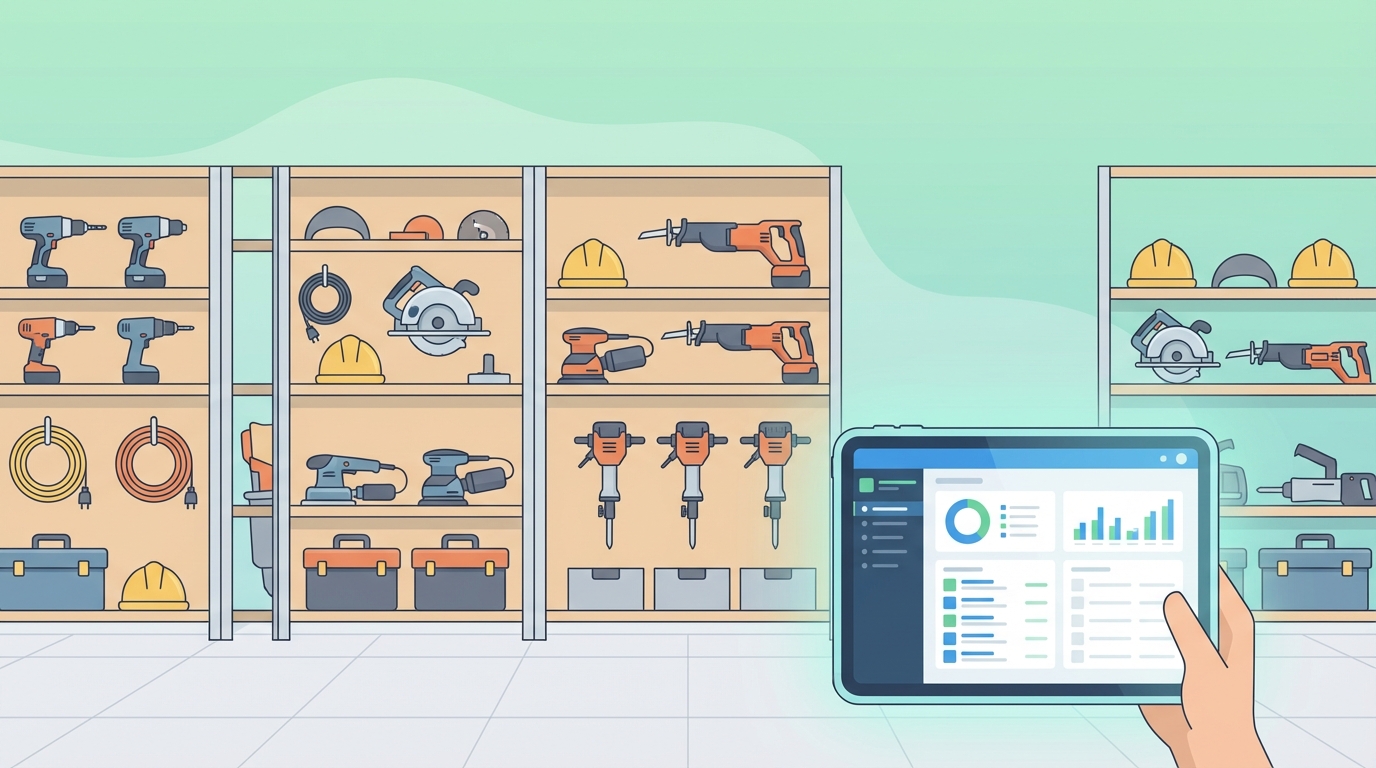
Tool rental software manages the booking, tracking, and billing of power tools, hand tools, and small equipment. Unlike heavy construction equipment platforms, tool rental software needs to handle high-volume, lower-value transactions - a single shop might process 50 rentals per day across concrete saws, generators, pressure washers, and nail guns.
Tool rental shops operate differently from other rental businesses. Customers often walk in without appointments, need the tool today, and return it tomorrow. The software must handle this fast-paced counter workflow while also supporting online reservations, late returns, and damage assessments on items that cost $200-$5,000 rather than $200,000.
We evaluated each platform from the perspective of an independent tool rental business running 100-500 individual tools across multiple categories.
Quick Comparison Table
| Software | Starting Price | Best For | Key Strength |
|---|---|---|---|
| Reservety | $59/mo | Tool shops going online | Concierge website build, zero commission |
| Point of Rental | Custom | Multi-location yards | 40+ years in rental, deep workflows |
| HireHop | Free tier | Small-mid shops | Cloud-based, free to start |
| EZRentOut | $89/mo | Asset-heavy operations | Barcode/QR scanning, lifecycle tracking |
| Booqable | $29/mo | General rental | Clean booking flow, easy setup |
| Quipli | Custom | US independents | Online ordering, modern UX |
| Rentman | $48/mo | AV + specialized tools | RFID/QR tracking, crew scheduling |
| RentPower | Custom | Busy tool shops | Counter workflow, reservations |
| Rentrax | $29/mo | Startups | Low entry price |
| Renterra | Custom | Growing companies | Modern interface, fast setup |
1. Reservety
Reservety works well for tool rental shops that want to accept online bookings without building a website from scratch. The concierge team builds your complete rental website during the 14-day free trial, including your tool catalog organized by category, availability calendars, payment processing, and rental agreements.
Flat pricing at $59 or $99 per month with zero commission keeps costs predictable. A busy tool shop processing 40 rentals per day pays the same monthly fee as a slow week. The platform handles daily, weekly, and monthly rental rates with automatic pricing calculations, security deposit holds, and late fee management.
For tool shops that currently rely on walk-ins and phone calls, Reservety adds an online booking channel that captures after-hours reservations and lets contractors reserve specific tools before driving to the shop.
2. Point of Rental
Point of Rental has been building rental management software for over 40 years and serves tool rental operations ranging from single-location shops to national chains. Their platform covers counter operations, inventory management, contract generation, and delivery scheduling in a comprehensive package.
The counter workflow is where Point of Rental excels for tool shops. Staff can process rentals quickly with barcode scanning, check tool availability in real time, generate contracts with pre-built templates, and collect deposits without leaving the main screen. Multi-location support lets operators transfer tools between yards and run consolidated reporting. The tradeoff is enterprise-level pricing and implementation timelines that reflect the depth of the system.
3. HireHop
HireHop offers a free tier for small operations and scales up as your business grows. The cloud-based platform handles quotes, contracts, invoicing, and inventory management with a browser-based interface that works on any device. For tool shops testing the waters with rental software for the first time, the zero-cost entry point removes financial risk.
The feature set is surprisingly capable for a free tool. HireHop includes job costing, sub-rentals, stock management, and integration with accounting platforms. The paid tiers add features like custom branding, API access, and priority support. Based in the UK, the platform has a strong following in Europe but works for US operations as well.
4. EZRentOut
EZRentOut starts at $89/month and focuses on asset lifecycle tracking with barcode and QR code scanning. Every tool in your inventory gets a detailed record covering purchase date, depreciation, service history, and current status. The scanning workflow is particularly useful for tool shops where hundreds of items move in and out daily.
Check-in and check-out become fast and accurate with barcode scanning rather than manual lookups. Each scan updates availability in real time and logs the condition at return. The platform integrates with QuickBooks and Xero for accounting, and the mobile app lets field staff check tool availability and process rentals on job sites.
Get your tool shop online in days
Reservety's concierge team builds your booking website during the free trial. Tool catalog, calendars, payments, and contracts included.
Start Free Trial5. Booqable
Booqable starts at $29/month and works as a general-purpose rental platform with a clean, modern booking interface. The setup process is quick: add your tools as products, set daily and weekly rates, and embed the booking widget on your existing website or use Booqable's hosted storefront.
For tool shops, Booqable handles the booking and payment side well but lacks tool-specific features like counter workflow optimization, barcode scanning for fast check-in/check-out, and maintenance tracking tied to usage. It is best suited for shops where online bookings are the primary channel and counter traffic is manageable without specialized POS features.
6. Quipli
Quipli is a US-based platform built for independent rental companies. The software handles online ordering, inventory management, payment processing, and maintenance tracking. Their modern interface reflects a focus on user experience that older platforms lack.
The online ordering flow lets customers browse available tools, check real-time availability, and complete bookings without calling the shop. QuickBooks integration keeps accounting in sync. For tool rental shops transitioning from manual processes, Quipli offers a modern platform without the implementation overhead of enterprise solutions. Pricing is custom per location.
7. Rentman
Rentman starts at $48/month and excels at equipment tracking with RFID and QR code scanning, crew scheduling, and flexible pricing. Originally built for AV and event equipment, the platform works for specialized tool rental operations that need detailed item-level tracking and project-based billing.
The quoting and invoicing workflow is strong. Rentman lets you build quotes with multiple line items, apply discounts, convert quotes to contracts, and track partial payments. For tool shops that serve commercial clients with purchase orders and net-30 terms, this workflow fits better than consumer-focused platforms. The 4.6/5.0 rating on review sites reflects solid execution on core rental workflows.
8. RentPower
RentPower by RentItBiz is designed specifically for busy tool rental shops. The platform handles reservations, delivery scheduling, custom rental agreements, and grace periods per item or category. This granularity matters for tool shops where a concrete saw might have a 4-hour minimum while a ladder rents by the day.
Grace period management is a standout feature. Different tools can have different late-return policies without manual overrides. The system also handles delivery and pickup logistics, which is relevant for larger tools like scaffolding, generators, and air compressors that customers cannot transport themselves. Pricing requires consultation.
9. Rentrax
Rentrax starts at $29/month and positions itself as affordable rental management software. The platform covers inventory management, booking, invoicing, and customer records. For small tool shops just moving away from paper-based tracking, the low entry price removes the financial barrier to going digital.
The feature set is basic compared to established platforms. Advanced features like barcode scanning, maintenance scheduling, and multi-location management are limited at this price point. But if your primary need is tracking what tools are out, who has them, and when they are due back, Rentrax handles those fundamentals reliably.
10. Renterra
Renterra is a newer entrant in the rental software market, positioning itself as a modern, AI-enabled alternative to legacy platforms. The interface is clean and mobile-ready, with features like live yard view that shows equipment status at a glance. Their dispatch module handles delivery coordination for larger tools.
As a newer platform, Renterra is still building out its feature depth and integration ecosystem. The modern design and fast setup appeal to operators who want to avoid the 3-6 month implementation timelines of enterprise vendors. Pricing requires a sales conversation, and the platform is best suited for growing companies that prioritize ease of use over legacy feature depth.
What to Look for in Tool Rental Software
Tool rental has specific operational patterns that differ from equipment or event rentals. Evaluate these features against your daily workflow:
- Fast counter checkout - Your busiest hours might see 20+ customers in a row. Barcode scanning, pre-built contract templates, and minimal-click workflows prevent counter bottlenecks during rush periods.
- Flexible rental periods - Tools rent by the hour, half-day, day, week, and month. The software should calculate pricing automatically when a customer extends a rental from one day to three days, including any rate tier changes.
- Damage and condition tracking - Photo-based condition reports at checkout and return prevent disputes. The system should flag tools returned in poor condition and route them to maintenance before they go back on the shelf.
- Late return management - Late returns are common in tool rental. The software should automatically calculate late fees based on per-item or per-category policies and notify customers when their rental is overdue.
- Inventory depth by category - You need to see not just "12 tools available" but "3 concrete saws, 4 generators, 2 pressure washers, 3 tile saws." Category-level visibility prevents the frustration of telling a customer you have tools available, only to discover the specific tool they need is rented out.
- Accounting integration - Tool shops process high volumes of small transactions. Manual entry into QuickBooks or Xero is unsustainable. Direct sync between rental software and accounting software is essential at scale.