
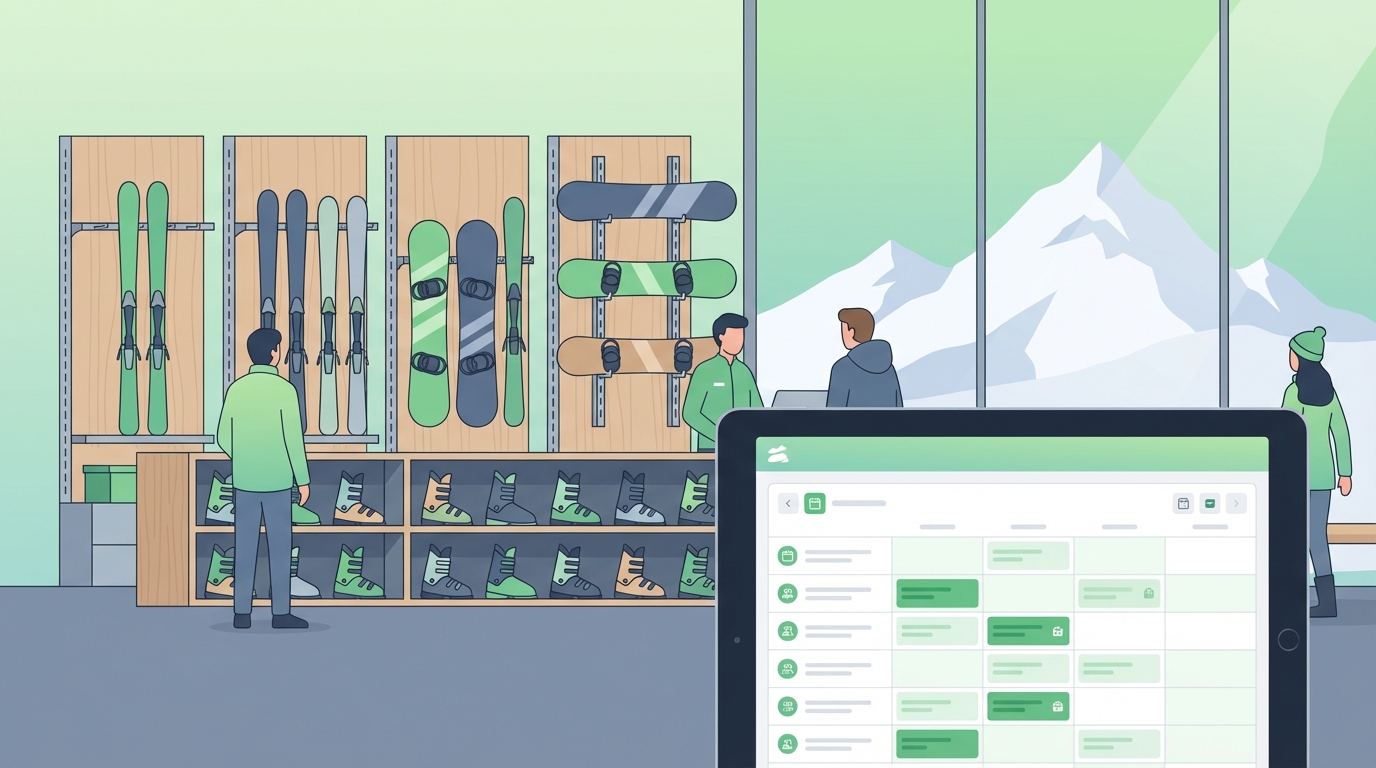
Ski rental software manages equipment reservations, sizing records, package bundling, seasonal pricing, and payment processing for ski shops, resort rental counters, and snowboard rental businesses. The best platforms handle walk-in queues during morning rush, track boot sizes and skill levels, and sync online pre-bookings with in-store inventory.
Ski rental operates under conditions that most general rental software was not built for. A resort shop processes 200 walk-ins before 10 AM on a powder day. Every customer needs boots fitted by size and ability, skis matched to height and weight, and poles cut to the right length. Packages need to be bundled, swapped mid-trip when conditions change, and tracked across multi-day holds. The software running this operation cannot afford a 30-second lag when the line stretches out the door.
We evaluated each platform from the perspective of a ski and snowboard rental shop managing 50-500 sets of equipment across skis, snowboards, boots, poles, and helmets. The comparison covers purpose-built ski rental tools and general rental platforms that handle seasonal gear well.
Quick Comparison Table
| Software | Starting Price | Best For | Key Strength |
|---|---|---|---|
| Reservety | $59/mo | Ski shops going online | Concierge website build, zero commission |
| Ski Rental Systems | Custom | Ski-specific operations | Purpose-built for ski rental reservations |
| Wintersteiger (EasyRent) | Custom (HW+SW) | High-volume resort shops | 3D foot scanning, automated workflow |
| TWICE Commerce | $29/mo (yearly) | General rental commerce | Rentals, leasing, subscriptions in one |
| Checkfront | ~$107/mo + 3% | Tours, activities, rentals | Online booking engine, waivers |
| EZRentOut (EZO) | $89/mo | General equipment rental | Mobile app, barcode scanning |
| Yo!Rent | $1,499 one-time | Lifetime license seekers | Source code included, no monthly fees |
| JupiterPeak | Custom | Ski and bike rental ops | Purpose-built for ski and snowboard |
| Rezo Systems | $500 setup + monthly | Ski-specific POS | Kiosk reservations, barcoded inventory |
| Booqable | $29/mo | General rental | Clean UI, quick setup |
1. Reservety
Reservety is built for ski rental shops that want a professional booking website without spending weeks building one. The concierge team builds your complete rental site during the 14-day free trial - your ski and snowboard catalog with photos, availability calendars, online payments, and digital waivers are all configured for you.
Flat pricing at $59 or $99 per month with zero commission keeps costs predictable. A busy Presidents' Day weekend with 300 ski package rentals costs you the same as a quiet Tuesday in April. Commission-based platforms would charge hundreds extra for that same peak weekend depending on their rate and your average rental price.
The platform handles hourly, daily, multi-day, and weekly pricing with automatic calculations. Ski package bundles group skis, boots, and poles into a single booking at a bundled rate. Snowboard packages work the same way. Seasonal pricing rules let you charge peak rates during holiday weeks and lower rates during shoulder season. Helmet add-ons, goggle upgrades, and lesson packages work as optional extras at checkout. Security deposit holds through Stripe protect against equipment damage without requiring cash at the counter.
2. Ski Rental Systems
Ski Rental Systems (skirentalsystems.com) is purpose-built for ski rental operations with online reservation capability from any device. Pricing is custom-quoted. The platform is designed specifically to convert web traffic into completed ski rental bookings, focusing on the unique workflow that ski shops and resort rental counters need.
The system handles the ski-specific booking flow where customers select equipment types, enter sizing information, and choose rental duration before arriving at the shop. Pre-booked customers skip the counter queue, which reduces morning rush bottlenecks. For shops that process heavy walk-in traffic alongside online reservations, the real-time inventory sync prevents double-booking the same pair of skis to both channels. The custom pricing model means contacting their team directly for a quote.
3. Wintersteiger (EasyRent)
Wintersteiger is the industry hardware leader that also makes ski tuning machines, boot dryers, and storage systems. Their EasyRent software integrates with proprietary 3D foot scanning technology that measures customers' feet and matches them to the right boot size and flex automatically. Pricing is custom and typically includes both hardware and software components.
The automated workflow covers the full rental cycle. 3D scanning collects customer data at check-in, the system assigns equipment based on measurements and skill level, and returns are processed with automated data collection. For high-volume resort operations processing 500+ rentals per day, the hardware-software integration eliminates manual data entry bottlenecks. Smaller independent shops may find the combined hardware and software investment difficult to justify, but for large operations the efficiency gains pay for themselves within a season or two.
4. TWICE Commerce
TWICE Commerce starts at $29/month on an annual plan and works as a general rental commerce platform supporting rentals, leasing, and subscriptions. The platform is not ski-specific but handles seasonal gear categories well, with flexible pricing rules that accommodate daily, multi-day, and weekly rental periods.
Add your ski packages, snowboards, and accessories as products with availability tracking. The online storefront handles reservations and payments. TWICE supports multiple locations from a single account, which works for shops operating both a base lodge counter and a village storefront. The trade-off is that you will not find ski-specific features like boot sizing records, skill-level matching, or 3D scanning integrations. For a ski shop that primarily needs online booking and payment processing without deep operational features, TWICE covers the basics at a low price point.
5. Checkfront
Checkfront starts at approximately $107/month (EUR 99) and adds a 3% booking fee on each transaction. The platform targets tours, activities, and rental businesses with a solid online booking engine, inventory management, and waiver collection. The booking widget embeds on your existing website or works as a standalone storefront.
For ski shops, Checkfront handles the reservation workflow competently. Customers browse available packages, select dates and duration, sign digital waivers, and pay online. The platform supports add-ons for helmets, goggles, and other accessories. The 3% booking fee stacks on top of the monthly subscription, which adds up during peak season. A shop processing $20,000 in bookings during a holiday week pays $600 in booking fees on top of the monthly cost. Flat-rate platforms eliminate that variable entirely.
Your ski rental website, built for you
Reservety's concierge team sets up your complete booking site during the free trial. Ski catalog, calendars, payments, and waivers included.
Start Free Trial6. EZRentOut (EZO)
EZRentOut, now part of the EZO platform, starts at $89/month and provides general equipment rental management with a sports and ski industry focus. The platform includes a mobile app for staff, a rental webstore for customers, and barcode scanning for equipment tracking. Asset lifecycle management covers maintenance schedules, depreciation, and retirement.
For ski shops, the barcode scanning feature speeds up check-in and return processing. Scan a ski's barcode, pull up its rental history, condition notes, and tuning schedule instantly. The rental webstore lets customers book online, but the interface feels more like enterprise asset management than a consumer booking experience. Shops that want a polished customer-facing website may need to build that separately and connect it via API. The $89/month starting price also does not include all features - advanced reporting, custom roles, and integrations cost extra.
7. Yo!Rent
Yo!Rent charges a one-time license fee of $1,499 with no monthly subscription. The package includes source code, which means full ownership and the ability to customize the platform without ongoing licensing costs. This model appeals to ski rental businesses that want to avoid recurring software expenses.
The platform functions as a rental marketplace where customers browse products, select rental periods, and complete bookings. It supports multiple vendor storefronts if you operate across several locations or want to run a marketplace connecting multiple ski shops. The one-time cost is attractive on paper, but factor in hosting, SSL certificates, security updates, and developer time for customizations. You are responsible for keeping the platform running, which shifts the maintenance burden from the software vendor to your team or a hired developer.
8. JupiterPeak
JupiterPeak is a newer entrant purpose-built for ski, snowboard, and bike rental operations. Based in Utah, the company focuses specifically on the rental workflow that seasonal outdoor gear shops need. Pricing is custom-quoted through their sales team.
The platform targets the operational pain points specific to ski rental - managing equipment packages, tracking sizes across a large inventory of boots and skis, processing high-volume morning rushes, and handling multi-day rentals with overnight equipment holds. The ski-and-bike focus means the feature set is designed for seasonal operations rather than adapted from a general-purpose tool. As a newer platform, the user base and track record are smaller than established players, which means fewer third-party reviews and integrations to evaluate before committing.
9. Rezo Systems
Rezo Systems charges a $500 setup fee plus a monthly subscription, though exact monthly pricing requires filling out a form on their website. The platform is built specifically for ski rental with a POS system, online booking, kiosk-based reservations, and barcoded inventory management. No per-transaction fees on any plan.
The kiosk reservation feature lets customers check in and select equipment from a self-service terminal at the shop, reducing counter staff requirements during morning rush. Barcoded inventory tracking means every pair of skis, every boot, and every helmet has a scannable tag for instant check-out and return processing. The ski-specific focus means features are tailored to the workflow rather than adapted from a generic tool. The form-gated pricing is the main friction point - you cannot evaluate cost without engaging their sales process first.
10. Booqable
Booqable starts at $29/month and works as a general-purpose rental platform with a clean, modern interface. Add your ski packages as products, set pricing rules for different durations, and embed the booking widget on your website or use Booqable's hosted storefront. Setup is straightforward and takes hours rather than weeks.
The platform handles bookings and payments well but lacks ski-specific features. There is no boot sizing workflow, no skill-level tracking, and no equipment-to-customer matching logic. Online bookings cost an additional $24/month as an add-on, bringing the effective starting price to $53/month for online reservation capability. For a small ski shop that manages fitting operations separately and primarily needs an online booking and payment tool, Booqable covers the reservation workflow at a reasonable price. Shops needing deeper operational features will find themselves working around the platform rather than with it.
What to Look for in Ski Rental Software
Ski rental has operational requirements that differ from general equipment rental. Evaluate these features based on how your shop actually operates day to day:
- Package bundling for skis, boots, and poles - Most ski customers rent a complete package rather than individual items. The software should group skis, boots, and poles into a single booking at a bundled rate, with the option to swap individual components without rebooking the entire package.
- Skill level and sizing records - Boot size, height, weight, and ability level determine which equipment a customer gets. The system should capture this information during online checkout so staff can pre-pull equipment before the customer arrives, cutting fitting time in half.
- Seasonal on/off pricing - Ski rental revenue concentrates into a 4-5 month window with dramatic peaks during holidays and powder days. The software needs date-based pricing tiers that automatically switch between peak, regular, and shoulder-season rates without manual adjustments.
- Walk-in queue management - A resort shop can see 200 customers before 10 AM. The system should handle rapid check-ins, support barcode or QR scanning for pre-booked guests, and let staff process walk-ins without the booking system becoming the bottleneck.
- Waiver collection - Liability waivers are standard in ski rental. Digital waivers collected during online checkout eliminate paper forms and counter wait times. The system should store signed waivers linked to each booking for easy retrieval.
- Multi-day rental pricing with overnight holds - Ski rentals commonly run 2-7 days. The software should calculate multi-day rates automatically, hold equipment as reserved overnight between rental days, and handle early returns with prorated adjustments or credits.